Muse Dream Recall Review: I Woke Up Inside My Dreams for 2 Weeks
This blog is based on a video from my YouTube channel. Prefer to watch? Click here.
James Cameron got the Terminator from a dream. He had a fever in a hotel room in Rome and dreamed of a chrome skeleton dragging itself out of a fire. Mary Shelley, half asleep in Geneva, saw the scene that became Frankenstein. Larry Page dreamed about downloading the entire internet — that one became Google.
None of those are stories about remembering a dream. They're stories about catching one. Being awake at the right second to grab it before it went.
You'll dream four to six times tonight. By breakfast, it'll be gone.
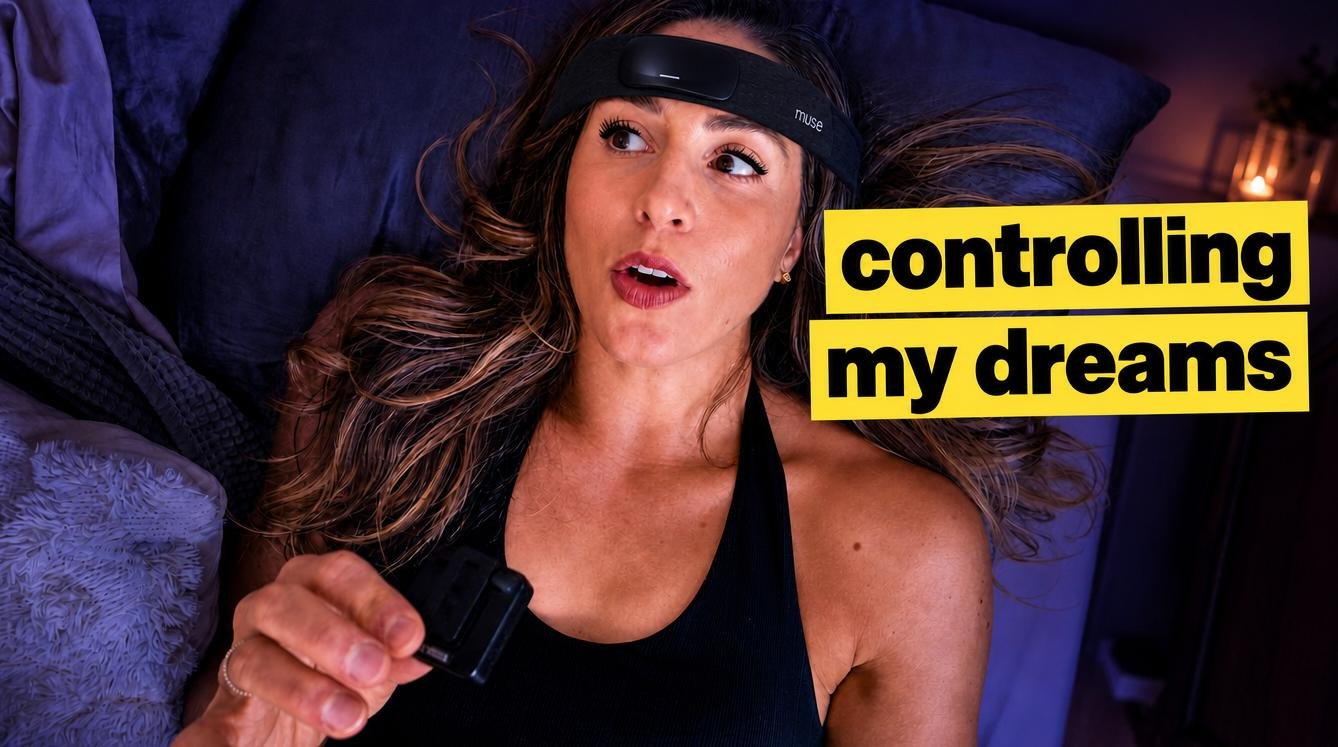
For the last two weeks I've been trying to catch mine, using a headband that reads my brainwaves and wakes me up mid-dream on purpose. It's called Dream Recall, it's new inside the Muse S Athena, and this is the honest breakdown of what happened — including the part where it genuinely surprised me, and the part where I'd tell you to skip it.
Why You'd Actually Want to Remember Your Dreams
Dreams aren't just noise your brain makes while the lights are off. That's the part I think most people have backwards.
While you're dreaming, your brain is doing about three jobs at once.
It's filing the day into long-term memory.
It's taking the emotional charge off things that happened to you — which is genuinely part of why a bad day feels smaller in the morning.
And it's shuffling ideas into combinations you'd never put together awake, because the part of you that says "that's stupid" is off duty (Lewis et al., 2018, Trends in Cognitive Sciences).
That last one is where it gets interesting.
There's a study I keep coming back to. Researchers gave people a set of math problems with a hidden shortcut buried in them, then let them doze off in a chair. Anyone who spent even fifteen seconds in that first drifting stage of sleep was three times more likely to spot the shortcut — 83% versus 30% for the people who stayed awake (Lacaux et al., 2021, Science Advances, N=103).
And the effect vanished if they fell all the way asleep. Too awake, nothing. Too far under, nothing. There's a window, and it's narrow.
A few years later another group did something I thought was genuinely wild. They played a chosen sound right as people were drifting off, to steer what they dreamed about. Those people came out performing better on creative tasks than people who'd just had the drifting stage on its own (Horowitz et al., 2023, Scientific Reports).
So you're not only along for the ride. You can aim it a little.
But here's the thing I had to get straight in my own head: all of that happens whether you remember any of it or not. Your brain files the day and takes the edge off it regardless.
So what does remembering actually get you? Two things.
The first is information. When researchers match people's dreams against logs of their actual days, the large majority trace back to something real that happened — 83% in one analysis. And it isn't the errands and the admin that get pulled in. It's whatever carried emotional weight (Vallat et al., 2017, PLOS ONE); Malinowski & Horton, 2014, Dreaming).
Translation: your dreams are basically a list your brain made of what's genuinely on your mind. Remembering them is how you get to read it.
The second is more practical. If you get bad dreams, the standard treatment is something called imagery rehearsal — you take the nightmare, rewrite the ending while you're awake, and rehearse the new version. It's first-line, and the evidence behind it is strong: a 2023 systematic review pulled 69 studies (Gill et al., 2023, BMC Psychiatry).
But it only works on a dream you can actually remember. You can't rewrite something you never caught.
And you spend about six years of your life doing this. Six years. It seems like a waste to have no access to any of it.
Why It All Vanishes by Breakfast
It's not that you're not a dreamer. Everybody dreams — four to six times a night, every single night. It's a timing problem.
Wake somebody up during REM and they'll remember a dream about 80% of the time. Wake them out of non-REM and it's closer to 43% (Carr et al., 2015, Consciousness and Cognition).
Here's why. During REM, the brain chemistry that files your experiences into long-term memory goes quiet. Your dreams never get written down the way your waking day does. What's left is a fragile trace, and almost anything wipes it — moving, light, the first thought you have in the morning.
So it comes down to a single question: were you awake, even for a second, while that trace was still there?
It's not talent. It's timing.
The Part You Can't Fix on Your Own
Timing is the one piece you have no control over.
You can set the intention before bed. You can lie still with your eyes shut and not reach for your phone. That helps a little. But you don't get a say in which stage of sleep you're in when your alarm goes off — and if you came up out of something other than REM, there's nothing there to write down.
To fix that, you'd have to know what your brain was doing at four in the morning. While it was doing it.
What Muse Dream Recall Actually Does
If you've been here a while, you know I've been testing the Muse S Athena — I've covered the deep sleep boost and the smart wake-up already.
Dream Recall is the new one. It's a mode inside smart wake-up.
Normally, smart wake-up looks for the lightest moment in your wake window and eases you out right there. Dream Recall just changes what it's looking for: instead of the lightest moment, it waits for REM. Which is the difference between roughly a 43% shot at keeping the dream and an 80% one.
Two practical things to know up front: it's in beta, and it requires Muse Premium on the Muse S or the Athena.
How to Set Up Muse Dream Recall: 5 Steps
Set your latest wake time. The absolute latest you're willing to be woken up.
Set your dream window, counting backwards from it. Muse suggests starting with an hour. That's the range where it's allowed to go hunting for REM.
Pick your cue. Continuous options (wind chimes, field crickets) are atmospheric — they blend into the scene. Intermittent ones (a bell, a ding) are nudges — distinct little moments of oh, I'm dreaming.
Rehearse the cue while you're awake, before bed. A few minutes of listening, breathing slow, pairing it with feeling calm. The cue isn't there to wake you up — the idea is that it travels with you into the dream and becomes a marker you recognize from inside it.
Decide on auto-snooze. As you start to surface, the sound backs off and holds you right at the edge of sleep instead of hauling you all the way out — so you can slip back into the dream. That edge is the fifteen-second sweet spot from the research above.
One more setup detail that matters: when the cue plays changes what you get. REM periods run thirty to sixty minutes and get longer toward morning. A cue earlier in a REM period gives you more runway; a cue later means the dream's had more time to build first. Muse recommends letting at least ten minutes of dreaming happen before the cue starts.
Does the Hardware Actually Hold Up?
REM is the hardest stage to detect from the outside. Your ring, your watch — they're reading movement and heart rate and inferring from that. Across several stages, your body looks pretty similar from the outside.
Muse reads EEG. Brain activity — the same signal a clinical sleep lab uses. And REM is the stage it reads most accurately. If your whole feature depends on knowing you're in REM while you're in it, you have to be reading the brain. That part is sound.
My Experience: What Actually Happened
I picked field crickets as my cue and stuck with just the one the whole time. I didn't want to be changing three variables at once.
And here's the part I genuinely did not expect.
The crickets showed up in the dream. Not as an alarm going off — as part of the setting. I'd be somewhere outdoors, a jungle, a field, and the crickets were just there. Part of the scene. I distinctly remember hearing them inside several of the dreams I woke up out of. And every single night I remembered a dream, it was something in nature.
Which is the dream incubation thing from that second study. A sound played during sleep, steering what you dream about. I did not expect to feel that happen to me.
I'll caveat it honestly: that's one person, two weeks, and I was rehearsing crickets every night before bed — so obviously crickets were on my mind. I can't establish causation from an n of me. But it was real enough that I noticed it immediately.
Two practical notes. I sleep in earplugs, so I had to turn the volume up to actually hear the cue. And I did the rehearsal Muse recommends, so that when the sound turned up eight hours later, my brain already knew it.
I expected to snap awake the second the crickets started. I didn't. It was gentle enough that I mostly just drifted with it — closer to a light lucid state than an alarm going off.
Did I get groggy? A little. Not terrible. But enough that I wouldn't want this every night.
Muse suggests a full week of nightly exploration to start. I didn't do that, and here's why: I don't love having an hour-wide window where I might get woken up. Sleep is the thing I protect most. So I landed on once or twice a week, with a normal wake-up the rest of the time. That's the version of this that actually fits my life.
And no — no huge revelations. Nothing I woke up and had to write down. It's been my brain working through ordinary stuff: relationships, things I'm feeling, recent events. I haven't managed to actually control anything inside a dream yet.
But I remembered them. Which two weeks ago, I wasn't doing at all. That's not nothing.
What It Costs You (The Honest Trade-Offs)
Waking up in REM isn't free.
Mild grogginess. Deep sleep is the worst stage to get pulled out of — that's the heavy, what-year-is-it feeling. Light sleep is the best. REM sits in between. In one lab study the fog cleared about thirty minutes after a REM wake-up versus twenty after a light one. So: ten minutes. Real, but small. And honestly, how long you slept matters far more than which stage you came out of.
So it's worth knowing which mode you have switched on. Regular smart wake-up is tuned for a clear morning; Dream Recall is tuned for the dream. Neither is wrong — it depends what you need out of that particular day.
You're clipping your longest REM period. REM stretches out as the night goes on, and the last one is the longest. Catching you inside it does, by design, cut it short. And that's the stage doing your emotional processing.
Dreams aren't always nice. This is the one I actually mean. If you get nightmares, or you're working through something heavy, or you're just in a rough patch right now — deliberately turning up the volume on your REM content is not a neutral thing to do. Be careful with this one.
And I want to be precise, because there is research where a sound cue during REM — delivered by a headband, actually — helped people with nightmare disorder (Schwartz et al., 2022, Current Biology). But that was a clinical protocol. Those people did the rescripting work first, with support, and the sound reinforced something they'd already built. That's a different thing from doing it on your own with a consumer device and hoping.
It's one more number to track. To their credit, Muse has published a genuinely good piece on orthosomnia — that's when tracking your sleep starts making your sleep worse. But know yourself. If you're already optimizing your health into feeling worse, this is not the feature that fixes it.
Who Muse Dream Recall Is For
Try it if: you've got a Muse S or an Athena with Premium, you're curious about your own dreams, and you can hold it loosely as an experiment. It's the most interesting thing they've shipped.
Skip it if:
You're not sleeping enough right now. Sleep more first. Duration and quality beat timing every single time, and it's not close.
You're in a nightmare-heavy or really stressful season. Come back later.
You're already tracking more numbers than you're acting on. You do not need another one.
If you do want to try it, you can use my Muse link here with code VICTORIADORSANO for a discount as part of my audience.
FAQ: Muse Dream Recall
What is Muse Dream Recall?
Dream Recall is a beta mode inside the Muse S Athena's smart wake-up. Instead of waking you at the lightest point in your wake window, it uses EEG to detect REM sleep and wakes you during it — the stage where you have roughly an 80% chance of remembering the dream.
Do I need Muse Premium for Dream Recall?
Yes. Dream Recall requires an active Muse Premium subscription and either the Muse S or the Muse S Athena headband. It's currently in beta.
Does waking up during REM make you groggy?
Mildly. REM sits between light sleep (easiest to wake from) and deep sleep (hardest). Lab data puts the difference at roughly ten extra minutes of grogginess versus a light-sleep wake-up. Total sleep duration affects how you feel far more than wake stage does.
Can Muse Dream Recall give you lucid dreams?
Not reliably, and Muse doesn't claim it will. The sound cue can become something you recognize from inside the dream, which is a step in that direction. In two weeks of testing I got vivid recall and a light, drifting awareness — but no actual control inside a dream.
Does the sound cue really change what you dream about?
There's real research behind the idea — targeted dream incubation at sleep onset has been shown to shift dream content and improve post-sleep creative performance. In my own testing, my cue (field crickets) showed up inside the dreams repeatedly, and every dream I recalled was set in nature. That's one person over two weeks, not proof.
Is Dream Recall safe if I get nightmares?
I'd skip it. Deliberately increasing access to your REM content during a nightmare-heavy or high-stress period isn't neutral. The clinical research that does use REM sound cues for nightmare disorder pairs it with supported imagery rehearsal therapy first — that's a different protocol than doing it solo with a consumer device.
How often should you use Dream Recall?
Muse suggests a week of nightly exploration to start. I landed on once or twice a week with a normal wake-up otherwise, because I'm not willing to give up an hour-wide wake window every night. Start where it doesn't cost you sleep.
When the Data Stops Being the Problem
A headband that reads your brainwaves, a ring, a couple of apps, a folder of biomarker results you haven't acted on. At some point the bottleneck stops being information and starts being what you do with it — and that's a much harder problem to solve alone.
That's exactly the problem my coaching practice exists to solve: turning the pile of data into a small number of things that actually change how you feel. If that sounds uncomfortably familiar, [book a free discovery call here](https://geni.us/bvc-book-a-call) and let's talk about it.
The Bottom Line
Dream recall isn't a talent — it's timing. You dream four to six times a night regardless; whether you keep any of it comes down to whether you happened to surface during REM. Muse Dream Recall is the first consumer tool I've used that actually solves the timing problem, because it reads EEG instead of guessing from your heart rate.
Two weeks in: I remembered dreams I otherwise wouldn't have, my sound cue showed up inside the dreams themselves, and the cost was about ten minutes of extra morning fog. No revelations. No lucid control. Just access to something I previously had none of.
The one action to take: if you own a Muse S or Athena with Premium, set a one-hour dream window, pick one cue, rehearse it before bed, and run it once or twice a week — not nightly. Protect the sleep first. The dreams are a bonus, not the point.
Related Articles
This article contains affiliate links. If you purchase through my links, I may earn a small commission at no extra cost to you. I only recommend products I actually use and that meet my evidence-based quality standards.
This article is for educational purposes and is not a substitute for professional medical advice. I am a health coach, not a physician. Consult your healthcare provider before making changes to your diet, exercise, sleep, or supplement routine — especially with existing conditions or medications.