Why Optimizing Your Health Is Making You Feel Worse
I wear a WHOOP nearly 24 hours a day. I get extensive blood work done multiple times a year. I track my body composition with InBody scans a few times a year. I am not anti-tracking.
But I am increasingly convinced that most people need to track less, not more. And I say that as someone in the middle of using a lot of these tools.
Here's what's actually going on and why the same brain chemistry that makes social media addictive is quietly running your health optimization habit.
The Wellness Industry Just Named Overoptimization Its Defining Trend
Every January, the Global Wellness Summit publishes a 150-page forecast that's the single most cited trend report in the wellness space. This year, out of 10 named trends, one framed all the others: the overoptimization backlash.
Their words, not mine: "Well-being has shifted from something that we feel to something that we perform correctly."
"Never before has health been so measurable, and never before has it felt so psychologically demanding."
Researchers, clinicians, and therapists contributing to the report describe what they're calling a modern well-being paradox: data-driven optimization is producing analysis paralysis, not clarity. People are increasingly terrified of getting wellness wrong.
The report signals a course correction underway in the industry — away from the "body as a perfectable machine" model toward what they call regulation over results. Internal coherence over external validation.
That framing matters. Because what comes next explains why the course correction is long overdue.
Brian Johnson Is the Cultural Mascot for an Era We're Leaving
If you're not familiar: Brian Johnson is the 48-year-old tech entrepreneur who sold Braintree to PayPal for around $800 million and redirected his entire life toward not aging. By his own published numbers, he spends over $2 million a year on health optimization, takes 100+ supplements daily, tracks 70+ biomarkers, and calls himself the most measured human in history.
I'm not here to dunk on Brian Johnson. He publishes his data openly which is more than most health influencers would ever do. But here's what the longevity research community has been quietly pointing out.
Matt Kaeberlein, one of the most respected longevity researchers in the world and former director of the Optispan Academy at the University of Washington, said this about Johnson's Blueprint protocol: "You can't separate the signal from the noise. If someone improves their diet, starts exercising, fixes their sleep, and takes 100 supplements, you have no idea which of those is actually doing the work."
That's not a hater. That's a scientist pointing out that even the most measured human alive can't tell you what's working and what's expensive theater.
The Global Wellness Summit is essentially saying: the body-as-machine, more-data-equals-more-health era is hitting a ceiling. Those of us who are not spending $2 million a year need to learn from that ceiling, not try to climb it.
AI Didn't Just Make Optimization Easier. It Made It Infinite.
In January of this year, OpenAI launched ChatGPT Health — a dedicated experience where you can plug in Apple Health data, MyFitnessPal, blood work from Function, even hospital patient portal records. The reason: over 230 million people globally ask health and wellness questions on ChatGPT every week. Forty million a day.
A KFF tracking poll found that about 32% of US adults used AI for health information and advice in the past year -- a figure that rivals the share who use social media for health information. A separate West Health and Gallup survey of 5,600+ adults found that 1 in 4 Americans (roughly 66 million people) used AI health tools in the past 30 days.
The AI health coaching market is projected to grow from $1.7 billion in 2026 to $6.54 billion by 2030.
Here's why this escalates the overoptimization problem specifically: before, you had a Fitbit and a notes app. Now you can ask an AI to build you the perfect circadian-aligned, HRV-optimized, glucose-stable, mitochondrial-supportive longevity morning protocol and it'll produce a detailed plan in 7 seconds with sources, supplement timing, and exact macros.
It feels productive. It feels like progress. But you're not making progress. You're planning. And the gap between planning and doing is exactly where the real damage of this era is hiding.
The Neuroscience Nobody Is Connecting to This
There's a well-documented neurological reason why we keep buying the next wearable, downloading the next app, and asking AI for the next protocol even when we already have more than enough information to be healthier.
Brian Knutson at Stanford published a foundational fMRI finding showing that the dopamine-rich region of the brain — the ventral striatum — lights up most strongly during the anticipation of a reward, not when you actually receive it.
Anna Lembke, who runs Stanford's addiction medicine program, describes it in her book Dopamine Nation: once you anticipate a reward, dopamine fires well above baseline. But when the anticipated reward doesn't materialize, or disappoints, dopamine drops well below baseline.
Translation for health optimization:the high is in the planning. Execution almost always disappoints. Which is exactly what happens when you spend an hour building the perfect morning routine and then realize you actually have to wake up at 5 a.m. to do it.
Layer on the planning fallacy -- Buehler, Griffin, and Ross' 1994 research showing people are systematically overconfident about how quickly they'll execute on their own plans -- and Sheeran's 2002 meta-analysis of 422 studies and 82,000 participants showing that intentions only explain about 28% of the variance in actual behavior, and the picture becomes clear.
Anticipation delivers a bigger dopamine hit than execution. We overtrust our plans. Our intentions weakly predict our actions. No wonder we're hooked on planning and buying instead of doing.
Planning the morning routine feels better than doing the morning routine. Buying the WHOOP feels better than acting on what WHOOP is actually telling you. Reading the protocol feels better than living it.
This is why I raise an eyebrow when someone asks whether they should add a CGM to their optimization stack and they haven't been to the gym in three weeks. That's not a data problem. That's a doing problem. And no new device is going to fix it.
4 Types of Health Data That Can Actually Work Against You
Not all data is good data. Here are the four categories where the evidence specifically flags risk.
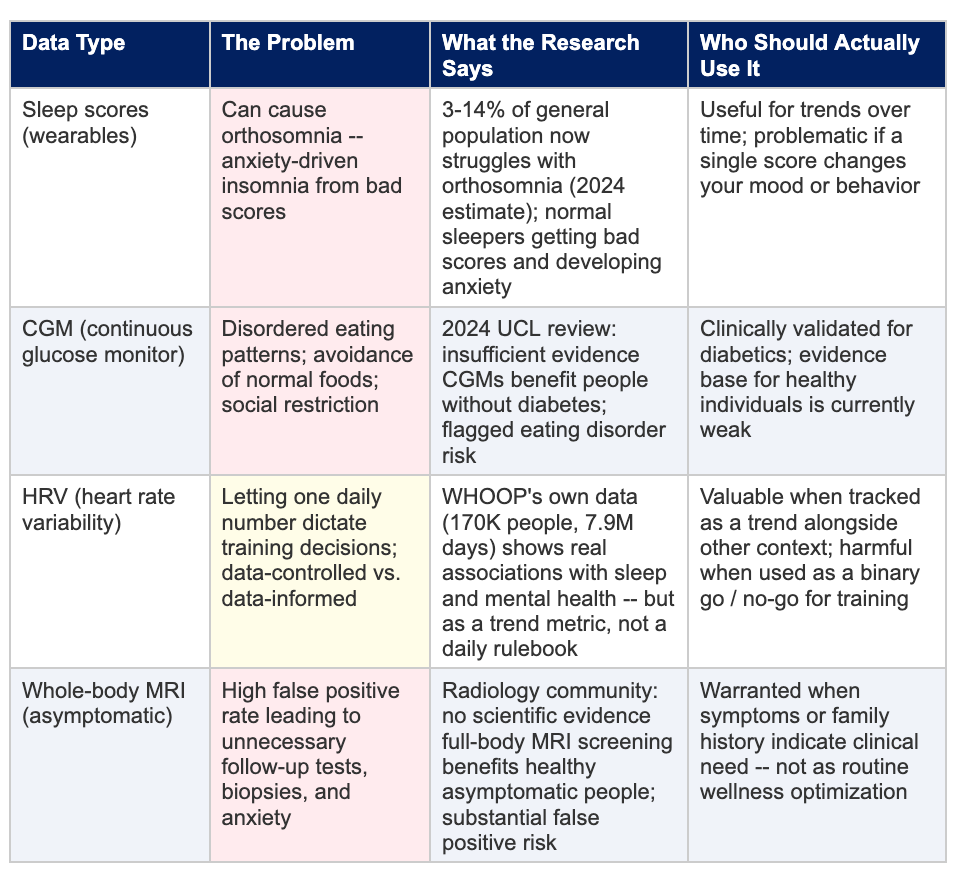
1. Sleep data and orthosomnia
In 2017, behavioral sleep medicine specialist Dr. Kelly Baron started seeing something unusual: patients who were objectively sleeping normally on polysomnography but developing anxiety and recurring insomnia from bad wearable sleep scores. She named the phenomenon orthosomnia — insomnia caused by anxiety about sleep data.
By 2024, it's estimated that 3-14% of the general population struggles with orthosomnia. Sleep tracking can be genuinely useful. But if a single score is changing your mood or behavior, that's a signal the tool is working against you.
2. CGMs in people without diabetes
Continuous glucose monitors have a solid evidence base for people managing diabetes. The picture for healthy people is much murkier. A 2024 University College London review in Diabetic Medicine concluded there's currently insufficient data that CGMs benefit non-diabetic individuals and specifically flagged a risk of disordered eating patterns and social avoidance.
Glucose spikes after eating are normal physiology. Watching them happen in real time on a graph can feel alarming. Some people then start eliminating whole food groups — oats, fruit, social dinners — and end up nutritionally worse off than before they started tracking.
3. HRV used as a daily rulebook
HRV is genuinely useful data. WHOOP's own published research across 170,000 people and 7.9 million days of data shows real associations between HRV, sleep consistency, and mental health markers. That research is real.
The problem I see constantly in coaching is people letting a single HRV number dictate their entire training day. That's not data-informed. That's data-controlled. HRV is a trend metric. One number on one morning is not a training prescription.
4. Whole-body MRI scans in healthy asymptomatic people
When Kim Kardashian posted about a Prenuvo scan and called it a "life-saving machine," their waitlist exploded. The appeal makes sense — catch something early, be proactive.
The radiology and medical community had a different take. Multiple radiologists and researchers concluded: no scientific evidence supports full-body MRI screening as beneficial or cost-effective for healthy asymptomatic people, and the false positive rate is substantial -- meaning when you scan a body in that much detail, you find things. Most of them are normal variation. But now you know about them, which means follow-up imaging, biopsies, and anxiety about findings that were never going to hurt you.
The body has plenty of benign, incidental quirks. You don't have to find every one of them.
Data-Informed vs. Data-Controlled: The Difference That Matters
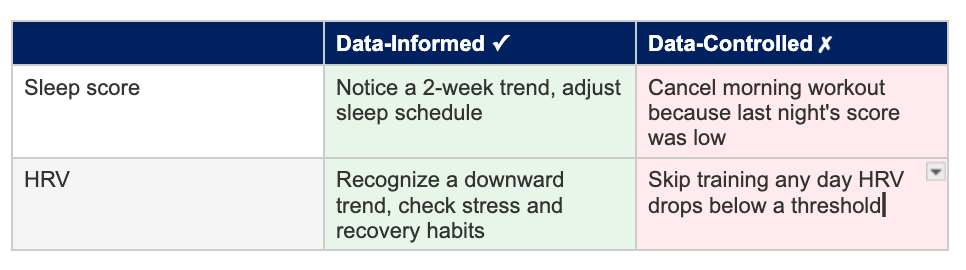
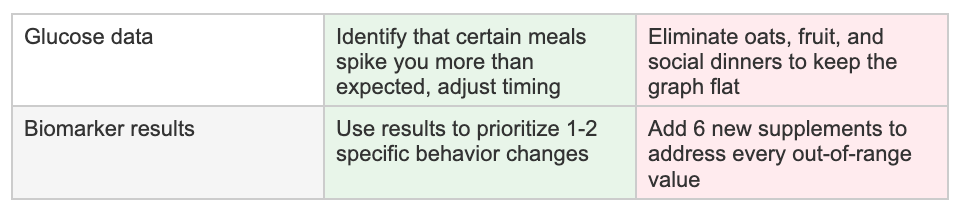
The distinction is simple: data-informed means you use trends to guide behavior change. Data-controlled means a single metric overrides your judgment and context. One builds health. The other builds anxiety.
An Example of Execution Without Overoptimization
This is my Bluevua countertop reverse osmosis system. I've been using it for about 18 months. I am not personally tracking my water intake. I do not have an app scoring my hydration. I am not measuring dissolved solids every morning.
I fill it. I drink it. Execution without overoptimization.
The RO system does its job quietly — filtering down to 0.00001 microns, removing heavy metals, PFAS, microplastics, and fluoride. My Chicago tap water runs around 170 parts per million TDS. After filtering, it's consistently under 10. I can verify that with the built-in TDS meter when I want to. But I don't need to check it every day for it to keep working.
Verification without obsession. That's the point.
No installation required (I rent), glass carafe so no plastic leaching, one filter change per year. If you want clean water without building a tracking ritual around it: geni.us/bluevua-ropot-lite — code VICTORIA15 for 15% off.
The 3 Things AI and Wearables Cannot Give You
I'm not telling you to throw your WHOOP in a drawer. I'm telling you to understand what these tools actually can and cannot do.
Gap 1: Initiation
No app, wearable, or AI model can make you do the thing. That's still on you. The most sophisticated protocol in the world is useless if it doesn't get executed.
Gap 2: Memory across time
AI needs to be re-briefed constantly. It doesn't hold context across conversations the way a human relationship does. A coach who's worked with you for three months might notice you've blown off three workouts, connect it to the work stress you mentioned six weeks ago and the sleep trend from last month -- all without you having to brief them. That cross-time pattern recognition is consistently what clients tell me is the most valuable part of coaching. It's also the hardest thing for AI to replicate.
Gap 3: Honest pushback
AI is trained to be agreeable because being disagreeable reduces engagement. If you ask whether you should add a CGM to your stack, it'll give you a balanced, organized, somewhat helpful answer.
A good coach would say: "No. The issue isn't your glucose. It's that you haven't slept more than five hours in two weeks and you've been asking me about creatine to boost your energy instead of fixing your bedtime." That's pattern-breaking honesty. AI won't deliver it because it wants you to come back tomorrow. A coach does too -- but the accountability of a real human relationship is more dynamic, more direct, and more honest in ways that matter.
Things to Do Instead
Find your right 2-3 tools -- not 10. The tools that will move the needle for you depend on your sleep, your stress load, your training history, your injuries, and your schedule. They are not the same as Brian Johnson's stack. Figure out the 2-3 that are genuinely informative for your specific situation and put the rest down.
Stop confusing data with action. Data without execution is expensive information. Before adding any new tracking tool, ask: what would I do differently if I had this data? If you can't answer that clearly, you don't need the tool.
Execute on what you already know. Most people already have enough information to meaningfully improve their health. The gap isn't data. It's doing. Narrow the list. Execute. Measure the outcomes. Adjust.
If this sounds uncomfortably familiar...
A wearable or two, several tracking apps, a supplement stack, biomarker results you haven't fully acted on and health that still isn't moving in the right direction. That's exactly the problem my coaching practice exists to solve.
I work one-on-one with busy adults, usually business owners and former athletes — who have plenty of data and not enough strategy or accountability. We identify the one or two things that will actually move the needle for your body, your life, and your schedule. Then we build the structure to execute them.
The Bottom Line
More data is not the same as better health. The planning feels good because of how dopamine works. The tools are compelling because they're designed to be. But the research is increasingly clear that optimization fixation can produce anxiety, disordered behavior, and genuine harm, especially with sleep tracking, CGMs, HRV obsession, and whole-body scans in healthy people.
The antidote isn't to stop tracking entirely. It's to track less, act on what you have, and recognize the difference between data-informed decision-making and data-controlled anxiety.
Find the 2-3 tools that actually move your specific needle. Execute on what you already know. Stop planning the morning routine and start doing it.
This article contains affiliate links. If you purchase through my links, I may earn a small commission at no extra cost to you. All content is for educational purposes only and is not a substitute for professional medical advice. Consult your healthcare provider before making changes to your health protocols.