How to Get Better Deep Sleep | Muse S Athena Deep Sleep Boost & Smart Wake-Up Review
Sleeping eight hours but still waking up wrecked? It's not how long you slept. It's what your brain was doing — and the exact moment your alarm yanked you out of it.
This blog is based on a video from my YouTube channel. If you prefer to watch that, click here.
Disclosure: This article is sponsored by Muse and contains affiliate links. If you use the code VICTORIADORSANO, you'll save 15% on the Muse S Athena and I earn a small commission at no extra cost to you. I only partner with brands whose products I've personally tested and would recommend regardless of the partnership. My honest take — including the limitations — is below. Educational content only. Not medical advice. If you're dealing with a sleep disorder, persistent insomnia, or symptoms of sleep apnea, please work with a qualified healthcare provider.
You slept eight hours.
So why do you feel like you got hit by a truck?
Here's something I hear from clients constantly: "I woke up in the middle of the night, fell back asleep, and when my alarm went off I felt completely wrecked. It threw off my entire day."
Sound familiar?
Most people assume that's just bad luck (or a sign they need more sleep). But the problem usually isn't how long you slept. It's what's happening inside your brain while you sleep — and the exact moment your alarm yanks you out of it.
I've spent the last few weeks testing two new features on the Muse S Athena that are designed to address both of those things. As a health coach who looks at client sleep data every week, I have some thoughts. Some of them are pretty enthusiastic. Some are honest "here's the friction you should know about before you buy" thoughts.
Let's get into it.
Quick context: I had reservations about this device for sleep
If you saw my last Muse video, you know I had concerns about wearing the headband for sleep. Comfort. Hair. Real things. I said what I said and I stand by it.
But Muse just dropped two features that are specifically about sleep — and they're different enough that I wanted to actually test them and report back. So here we are.
Before we get to the features, I need to give you context that makes everything else make a lot more sense.
Your wearable isn't actually measuring your sleep stages
You've probably heard of WHOOP. I use WHOOP with clients. I love it for HRV, recovery, and readiness data. It does that really well.
But here's something most people don't realize: WHOOP, Apple Watch, Oura, Garmin — every wrist-based or finger-based wearable — they don't actually measure your sleep stages. They infer them.
From what?
Heart rate
Heart rate variability
Movement (or lack of it)
Skin temperature
Those are reasonable physiological proxies. But they're still proxies. The device is making an educated guess about what your brain is doing based on what your wrist is doing. And that distinction matters at two specific moments: during deep sleep, and the exact moment you wake up.
EEG is different. EEG actually reads your brain's electrical activity. It's the same technology used in clinical sleep studies (called polysomnography, or PSG — the gold standard for sleep staging).
I wore both WHOOP and Muse on the same nights. The data tells an interesting story.
Why deep sleep is the metric that actually matters
Most people have a pretty incomplete picture of what's happening when they sleep. So a quick primer — because this is the entire reason these new Muse features exist.
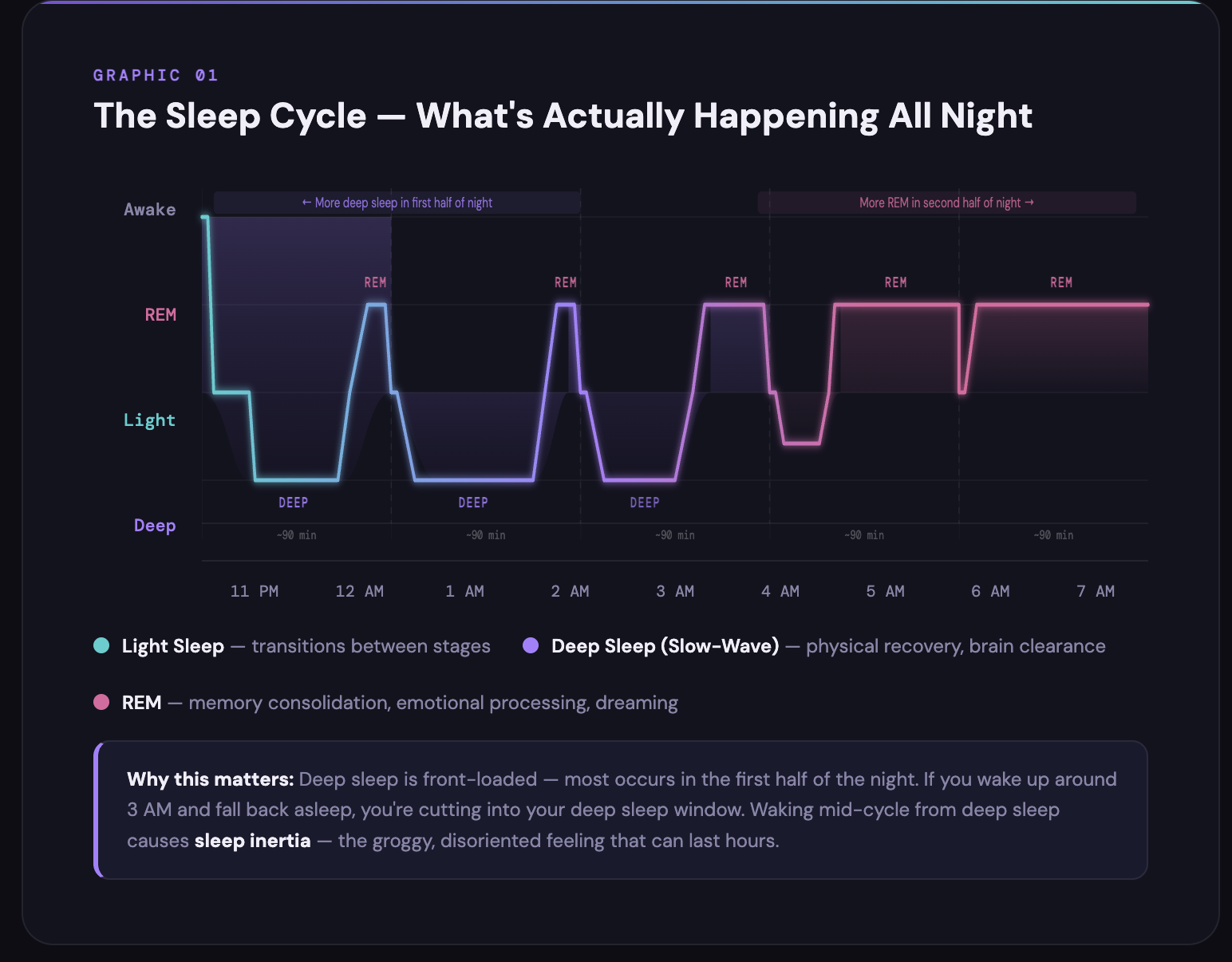
Your body cycles through sleep stages roughly every 90 minutes throughout the night:
Light sleep (NREM stages 1 and 2)
Deep sleep (NREM stage 3, also called slow-wave sleep)
REM sleep (where most dreaming happens)
You go through this cycle four to six times a night. Deep sleep dominates the first half of the night. REM dominates the second half. Both matter. They have different jobs.
What deep sleep is actually doing for you
This is where the real restoration happens. Specifically:
Growth hormone is primarily secreted during deep sleep. If you're training, recovering from workouts, or trying to maintain muscle (especially over 40), this is a huge deal.
Your brain's waste removal system — the glymphatic system — is most active during deep sleep. It's literally flushing metabolic byproducts out of your brain while you sleep.
Memory consolidation for facts and events happens during deep sleep.
Immune function peaks during deep sleep.
And here's the part I bring up with clients constantly: deep sleep naturally declines with age. Significantly.
That's why I keep hearing some version of "I used to recover so fast" from people in their forties and fifties. It's often not about total hours. It's about deep sleep quality. The culprits are usually evening habits — screens, late workouts, alcohol, news scrolling before bed. I see this pattern in client wearable data over and over.
So the problem usually isn't falling asleep. It's getting deep enough, and staying there long enough.
That's exactly what one of the two new Muse features is built to address.
The two new Muse S Athena features (in plain English)
Feature 1: Deep Sleep Boost (DSS)
Launched February 2026.
What it does: while you're sleeping, the Muse S Athena reads your EEG in real time. When it detects you've entered slow-wave sleep, it delivers precisely timed pink noise cues through headphones. Those cues are designed to help you sustain longer, more stable deep sleep.
The underlying science here — it's called closed-loop acoustic stimulation (CLAS) — has real peer-reviewed research behind it. Multiple studies have shown that timed acoustic cues during slow-wave sleep can enhance the depth and duration of that stage.
What we don't have yet is independent validation of Muse's specific implementation. Their internal beta data shows around 24% longer slow-wave trains and more organized deep sleep activity. That's promising. I want to be transparent that those are their internal numbers, not independent peer-reviewed studies of this exact device.
I respect that they published the numbers. I just keep my expectations calibrated until independent labs replicate them.
Feature 2: Smart Wake-Up
Launched April 2026.
This is the feature that directly addresses that "hit by a truck" feeling we opened with.
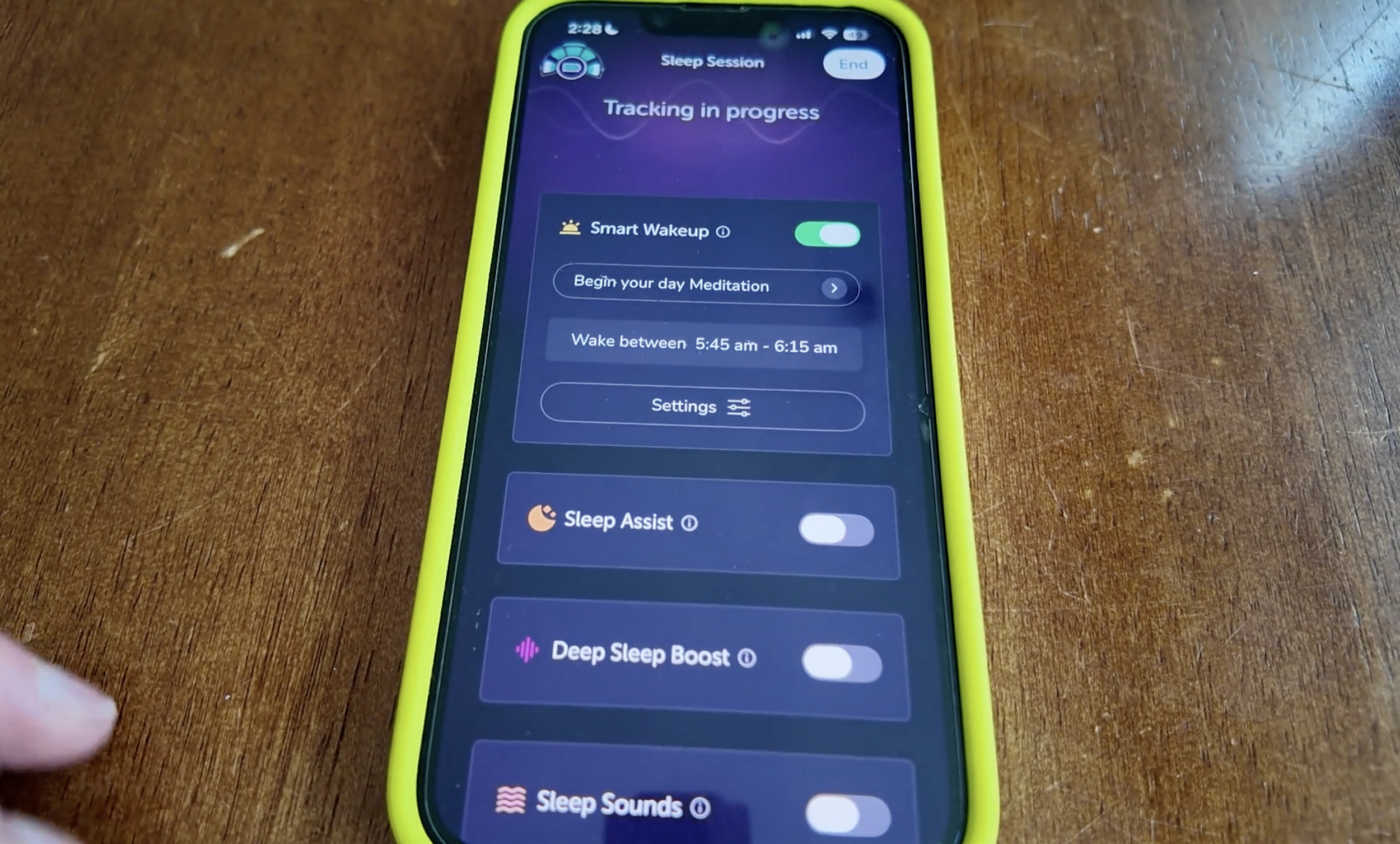
Here's how it works:
You set a wake window — anywhere from 5 to 60 minutes before your alarm.
During that window, Muse monitors your EEG in real time.
When it detects a lighter sleep stage (a more "wakeable" moment), it starts the alarm. Gradually. Not jarring.
If you never hit a lighter stage during that window, it wakes you at your set time anyway. So you're not going to oversleep your meeting.
The key thing — and this is what makes it different from other "smart" alarms on the market — is that it's EEG-based. Not heart rate. Not movement. Direct brain measurement, validated against polysomnography.
You also get to choose your wake-up audio: traditional alarm sounds, music, or one of five morning meditations. There's also a "Dreaming" category — gentle sound cues to support dream recall as you transition out of sleep.
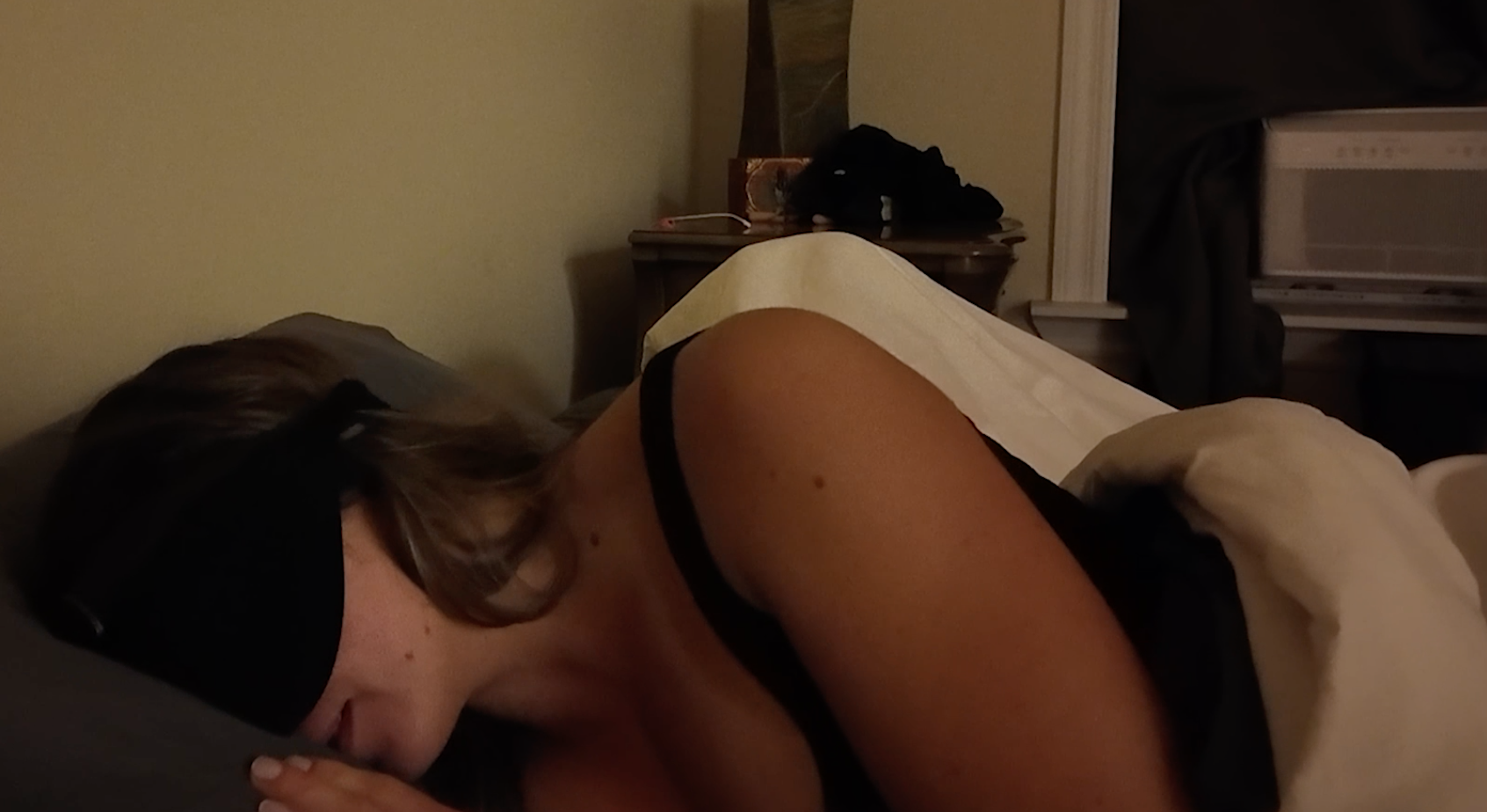
(Quick PSA: preview your audio selection before your first night. Especially if you share a bedroom. I picked a meditation. The man's voice coming on in the dark at six AM scared my husband half to death. Learn from me.)
“Want to try the Muse S Athena yourself?
Use code VICTORIADORSANO for 15% off, plus a 30-day return window so you can actually test it.”
What sleep inertia actually is — and why this matters
The technical name for that "hit by a truck" feeling is sleep inertia. It's the period of impaired alertness, slower cognitive performance, and grogginess you experience after waking. It's worst when you're pulled out of deep sleep, and it can last anywhere from a few minutes to over an hour.
This is why the moment you wake up matters as much as the duration of your sleep. Eight hours waking out of deep sleep can feel worse than seven hours waking out of light sleep.
It's also why setting your alarm for "the absolute latest possible moment" can backfire — you don't get to choose what stage you're in when it goes off. A 30-minute wake window does the choosing for you.
My testing experience: Smart Wake-Up
I'll start with Smart Wake-Up because this is the one I've used more consistently.
I set my wake window to 30 minutes. I'll be honest — I was skeptical I'd notice a difference. I'm someone who generally wakes up at the same time every day and feels relatively okay. But there are definitely those nights where you wake mid-cycle, fall back asleep, and then your alarm hits and you feel completely off. That specific experience is what I was watching for.
What I noticed (and I want to be careful here because this is subjective): on the mornings Smart Wake-Up triggered before my set alarm time, the grogginess felt less heavy. Less of that disoriented "where am I" feeling. More of a gradual rise.
After the meditation alarm incident, I switched to a gentler tone option. Going much better since.
WHOOP vs. Muse: the data side-by-side
This is the part I was genuinely curious about. I wore both devices on the same nights and compared what each one reported.
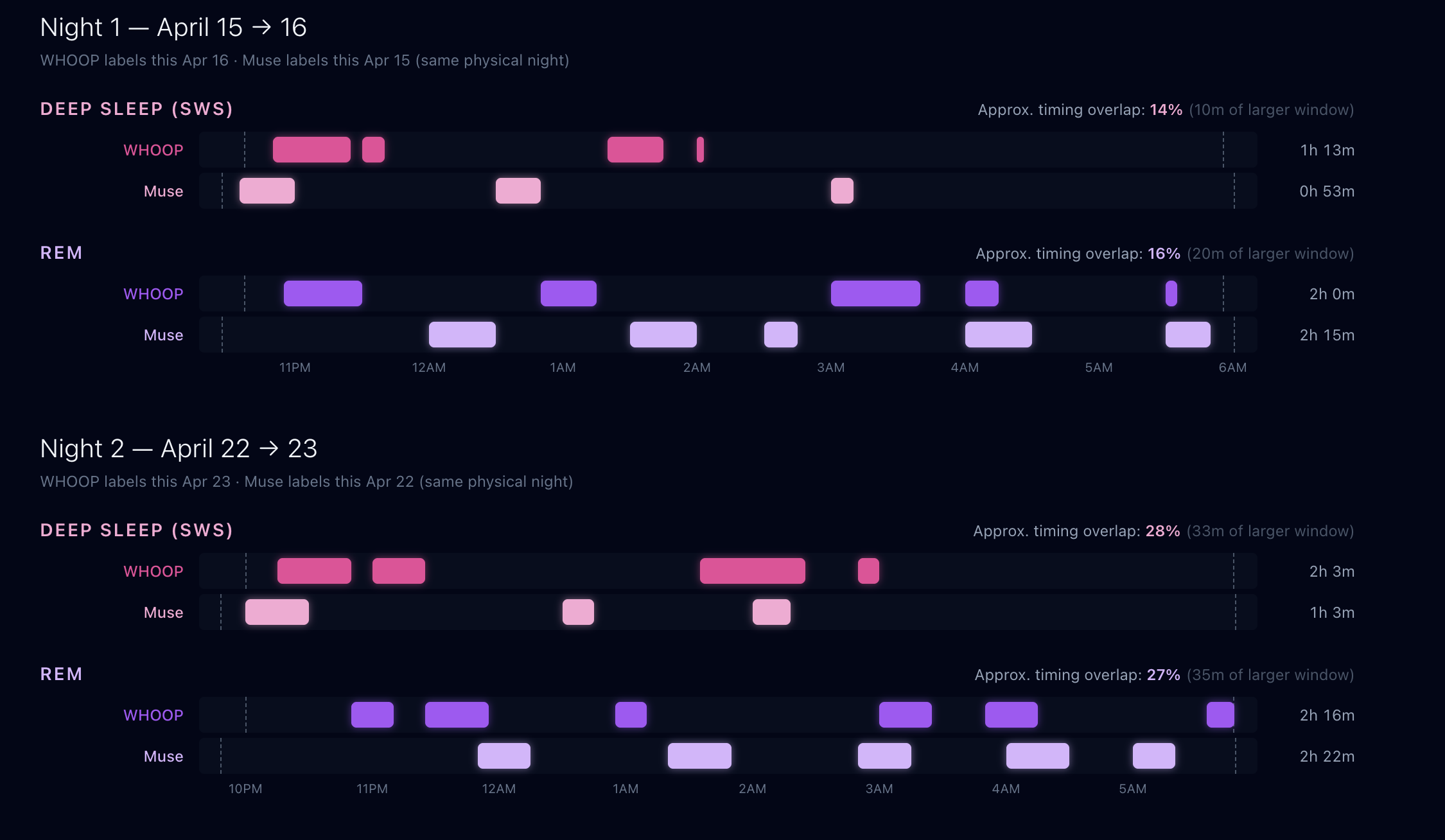
Here's what I found:
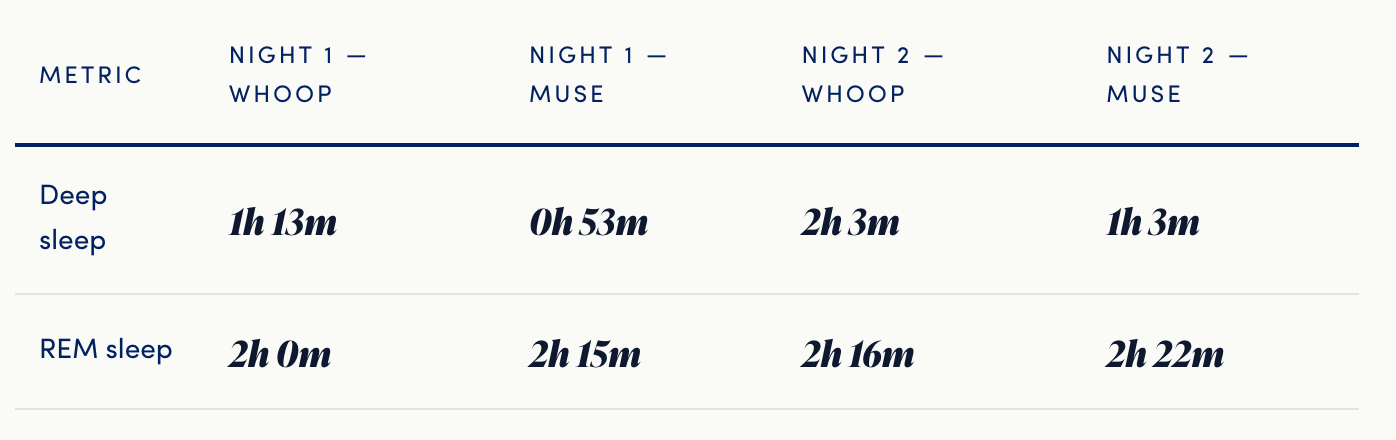
On REM sleep, both devices were close. Within 15 to 22 minutes across both nights. They largely agreed.
On deep sleep, they diverged. Significantly. On Night 2, WHOOP reported nearly double the deep sleep that Muse did.
I looked into why, and this is actually well-documented in the research. Wrist-based devices have the hardest time specifically with slow-wave sleep. They tend to overestimate it because they're inferring from physiological signals (heart rate, HRV, movement) that don't cleanly distinguish deep sleep from lighter NREM stages. EEG reads brain state directly, and validates against PSG with much higher agreement.
I'm not saying WHOOP is wrong. WHOOP is doing exactly what it's designed to do, and for HRV, recovery, and strain data I still rely on it completely. But for deep sleep staging specifically, the technology is fundamentally different. The data showed it.
If you've been tracking your "deep sleep" on a wrist or ring device and feeling pretty good about your numbers — those numbers are likely inflated.
My testing experience: Deep Sleep Stimulation
This is probably NOT for you if:
You genuinely can't sleep with anything on your head. That's a real barrier and I'm not going to pretend it isn't.
You haven't yet addressed the basics: consistent sleep schedule, alcohol, late screens, late caffeine, room temperature, evening stress. Optimizing the brain-level stuff before you've handled the foundations is like buying a Ferrari before you've learned to drive.
For DSS specifically — if the headphone setup sounds like a dealbreaker, it might be. Be honest with yourself about that before you buy.
Sleep inertia and grogginess: FAQ
Why do I feel groggy even after 8 hours of sleep?
The most common culprit is sleep inertia — the impaired alertness that hits when your alarm pulls you out of deep sleep instead of light sleep. Total hours matter, but the stage you're in when you wake up has a huge effect on how you feel for the next 30 to 60 minutes. Deep sleep quality also declines with age, so eight hours of poor-quality sleep can leave you feeling worse than seven hours of high-quality sleep.
Is deep sleep more important than REM?
Both matter — they have different jobs. Deep sleep handles physical restoration: growth hormone release, glymphatic waste clearance, immune function, and memory consolidation for facts. REM handles emotional processing, creative problem-solving, and motor learning. You need both. But for "I feel wrecked in the morning" specifically, deep sleep quality and timing of wake-up are the bigger levers.
Can my Apple Watch or WHOOP measure my deep sleep accurately?
Wrist-based wearables infer sleep stages from heart rate, HRV, and movement. They're reasonably good at total sleep time and REM, but they tend to overestimate deep sleep because the physiological signals they're reading don't cleanly separate deep sleep from lighter NREM. EEG measures brain activity directly and is validated against polysomnography (the clinical gold standard). They're different technologies doing different jobs.
Does the Muse S Athena replace my WHOOP or Oura?
No — and you probably don't want it to. WHOOP and Oura do HRV, strain, recovery, and 24/7 metrics that Muse isn't built for. Muse is a sleep-specific layer on top of those tools. If you're choosing between them for daytime data, stick with your wrist or ring. If you're adding a brain-level layer to your sleep optimization, Muse is the one with EEG.
What is closed-loop acoustic stimulation?
Closed-loop acoustic stimulation (CLAS) is the science behind Deep Sleep Boost. The device monitors your brainwaves in real time, detects when you've entered slow-wave (deep) sleep, and delivers precisely timed acoustic cues to enhance the depth and duration of that stage. Multiple peer-reviewed studies have shown the underlying mechanism works. Independent validation of Muse's specific implementation is still pending.
So — back to where we started
You slept eight hours. Why do you feel like you got hit by a truck?
It's almost never the eight hours. It's usually:
The stage you were in when your alarm went off (sleep inertia).
How much actual deep sleep you got (which your wrist wearable is probably overestimating).
The quality of that deep sleep — which declines with age and gets compromised by evening habits most people aren't auditing.
Smart Wake-Up addresses problem #1. DSS is built for problems #2 and #3.
If you're already tracking your sleep and actually doing something with the data, the Muse S Athena adds a layer your WHOOP or Apple Watch literally cannot. Not because those devices are wrong. Because they're reading your wrist. This reads your brain. Those aren't the same thing.
Ready to test it for yourself?
Grab the Muse S Athena and use code VICTORIADORSANO for 15% off. There's a 30-day return window — actually test it and decide.
When tracking isn't the bottleneck coaching is.
A lot of people land on a post like this because they've already bought the wearable, already read the books, already know what they "should" be doing. The data isn't the problem. The execution is. If that's where you are, that's the work I do with my 1:1 coaching clients.
Either way: stop accepting "I'm just tired" as the answer. There's almost always a reason. And it's almost always fixable.
Talk soon,