Red Light Therapy Panel Review: I Tested the BestQool Pro100 for 30 Days
This blog is based on a video from my YouTube channel. Prefer to watch? Click here.
I've been putting red light on my body for months now. A targeted laser clamped onto my knee. A wrap around my joints. And for the last 30 days, this: a full red light therapy panel.
Here's the thing nobody tells you — they are not the same tool, and most people buy the wrong one for what they're actually trying to do.
So I ran this panel for a full month, and I'm answering the three honest questions that actually matter. What does a panel do that the other two can't? Is a roughly three-hundred-dollar one worth it? And — the part that genuinely surprised me — does the company tell the truth about its numbers?
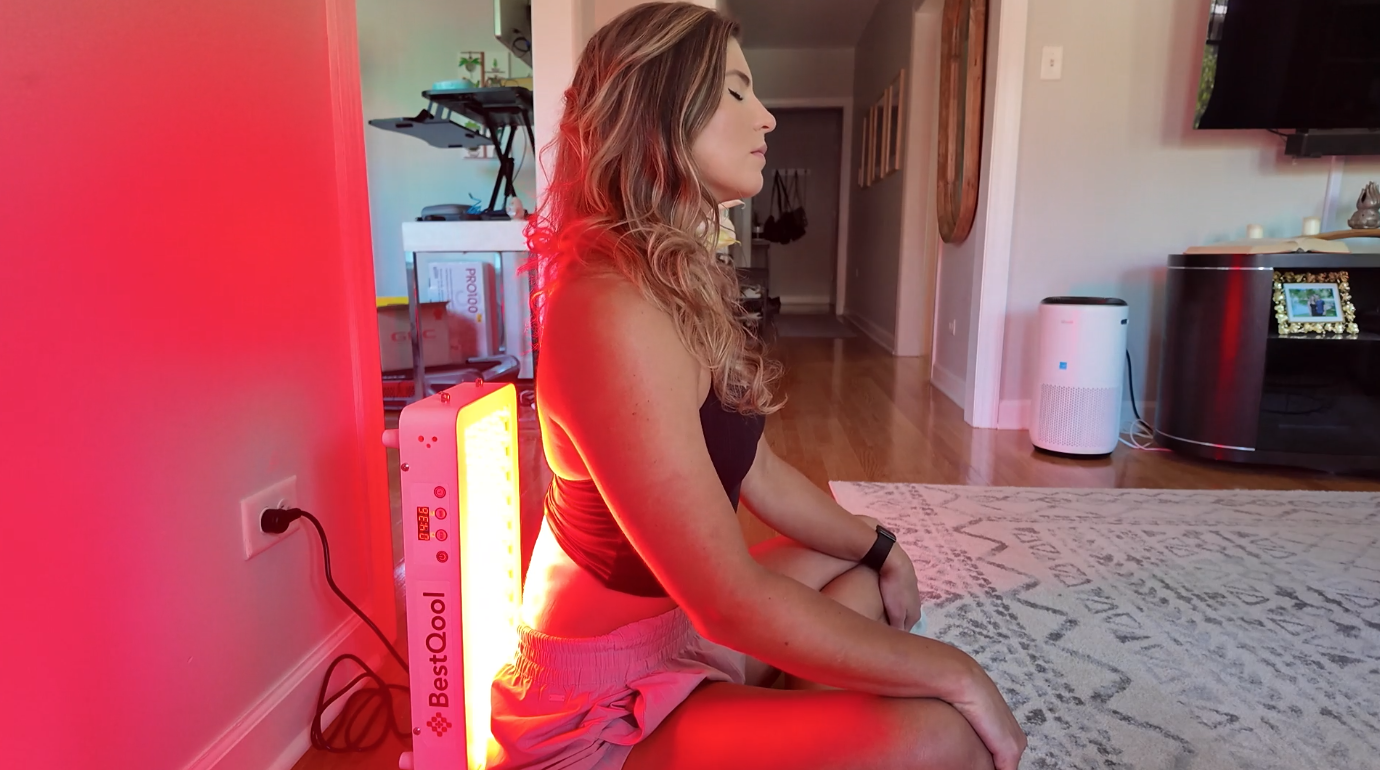
Who a Red Light Panel Is Actually For
A panel is the right category if you want broad, hands-free coverage — your skin, or a whole region of your body — instead of treating one small spot at a time.
You just stand in front of it, which makes it easy to actually stay consistent with. So this is for people who want the skin-and-surface side plus an easy daily habit. It is not for someone hunting down one deep, angry joint.
I'll come back to that distinction, because it's the thing people get wrong most often.
How Red Light Therapy Works (The Short Version)
Quick version of the science, in case this is your first red light video. If you want the full tissue-by-tissue deep dive, I did that in my Kineon MOVE+ review.
Certain wavelengths of red and near-infrared light get absorbed by your cells — mainly by the mitochondria, the part that makes energy. That can nudge up cellular energy, support local circulation, and help calm the body's inflammatory response (Hamblin, 2017, AIMS Biophysics — mechanisms of photobiomodulation).
The reason a panel runs four wavelengths comes down to depth.
Wavelength | Type | Where it mostly works
630 nm | Red (visible) | Surface — skin
| 660 nm | Red (visible) | Surface — skin
| 850 nm | Near-infrared (invisible) | Deeper — muscle, tissue around a joint
| 940 nm | Near-infrared (invisible) | Deeper — muscle, tissue around a joint
The two red wavelengths mostly work near the surface — your skin. And that's the part a panel is genuinely well-suited for, because it's covering a big area of skin at once. The two near-infrared ones are invisible and reach deeper, toward muscle and the tissue around a joint — the soreness-and-recovery side.
One thing I didn't expect to like: the warmth. A panel like this gives off a gentle, pleasant heat. If you run cold, or you live somewhere with real winters, standing in front of one is genuinely cozy.
Accuracy note so I don't oversell it: the benefit isn't coming from the heat. The warmth is a nice side effect — the actual work is the light being absorbed by your cells, not your skin getting warm. But as a reason to actually stand there and stay consistent in January? I'll take it.
Honest science in one breath: the evidence is strongest for skin — dermatologic photobiomodulation has reasonable support for collagen and photoaging — and for calming inflammation the light can actually reach. For muscle soreness specifically, it's genuinely mixed: some studies show a benefit, others show nothing versus placebo. It's a supportive tool, not a magic switch, and consistency is where the payoff lives.
Panel vs. Targeted Device vs. Wrap: Where Each One Fits
Think coverage versus precision.
Tool | What it does | Best for
Targeted device (e.g. the MOVE+ I reviewed) | Press it onto one specific joint to drive light in deep | One angry joint
Wrap | Conforms around a limb | A limb, contact coverage
Panel (like this one) | Broad, hands-free, non-contact coverage of a whole region | Skin, broad soreness, an easy standing routine
The trade-off with a panel is that it's non-contact — the further back you stand, the less light you're actually getting.
The rule I keep coming back to: match the tool to the target. One angry joint, reach for the targeted device. A whole region, your skin, or an easy standing routine, a panel makes more sense.
One honest thing about this specific panel: BestQool calls the Pro100 a "targeted" panel, and that's fair. It covers an upper-body-sized region at a time, not head-to-toe in one shot. It's modular — you can splice more together for full-body coverage — but by itself, one panel treats one region. I'd rather you know that than expect a full wall of light.
The Part That Surprised Me: What "Irradiance" Actually Means
Here's what changed my opinion of this brand.
Panels get sold on one number: irradiance. That's how much light actually lands on you, measured in milliwatts per square centimeter. Bigger number, better panel. That's the pitch.
Here's the problem. There are two ways to measure it. Most companies use a solar power meter — a cheap device built for measuring sunlight, not LEDs. And it reads red and near-infrared high. How high? BestQool says it in their own manual: about sixty percent high. So a panel genuinely putting out fifty can get advertised at eighty, and nobody's technically lying. They just used the flattering ruler.
BestQool went the other direction. They sent this panel to a third-party lab — LightLab International — and they publish those numbers instead.
109 mW/cm² at 3 inches. 56 mW/cm² at 6 inches.
Sit with that for a second. Inflate fifty-six by sixty percent and you could put ninety on the box. They published fifty-six.
Two takeaways.
One: a company choosing the smaller number is a company I trust more, not less. I spend most of my time on this channel calling out inflated health claims, so I did not expect a red light company to police its own marketing. I'll take a small honest number over a big fake one every time.
Two — and this one's for you regardless of what you buy: irradiance means nothing without a distance attached to it. If a panel advertises a number and doesn't tell you how far away they measured it, that's marketing, not a spec.
How I Actually Used It for 30 Days
Here's the real routine.
Distance: about 6 to 9 inches from the area.
Modes: both red and near-infrared running together.
Time: 15–20 minutes for surface stuff like skin. Longer — 25–30 minutes — when I was going after deeper soreness.
Frequency: daily to about four times a week.
Eyes: goggles on.
The controls are just buttons on the panel — power, red, near-infrared, a timer. No app, nothing to fuss with.
One honest tip that tripped me up: the near-infrared is invisible, so it can look like nothing's on. Point a phone camera at it and you'll see it glowing. That's how you confirm it's working.
The checkpoints, because results take time
Week 1: nothing dramatic. That's normal.
Week 2: what I noticed most was on the skin and surface side — and honestly, that it was easy to keep up, because I could do it while I got ready.
Day 30: a genuinely nice supportive piece of my routine for skin and broad soreness. Not a miracle. Consistency did more than any single session.
Honest Pros and Cons
Pros
The honesty on the numbers. That's a real one for me.
Modular — splice panels together, daisy-chain them, use it on a stand, a table, or hung on a door.
Low EMF — rated 0 EMF at 6 inches.
Runs cool enough for low-heat contact use.
Dead simple. Real buttons and a timer.
Cons
It's a region-at-a-time panel, so true full-body means buying more than one.
No app or smart control. Fine by me, but worth knowing.
The near-infrared being invisible means you'll want that phone-camera check to trust it.
Your 6-inch number isn't your 12-inch number. Stand back and you're getting less. Distance matters.
The Verdict: Is the BestQool Pro100 Worth It?
Get it if you want broad, hands-free coverage for skin and surface-level recovery, you'll actually use it consistently, and — for me — you value a brand that publishes honest, tested numbers.
Skip it if you expected one panel to cover your whole body, or if you're hoping it fixes structural damage. No light device does that.
Where it lands for me: after testing a targeted device, a wrap, and now this panel — the panel is the one I reach for on skin and broad soreness, and I still grab the targeted device for one specific joint. Match the tool to the target.
If you want to try the Pro100, here's my link and code VICTORIA10 gets you 10% off. I earn a small commission if you use it, so thank you if you do.
One ask before you buy: give it a few weeks of consistency before you judge it. That's where the benefit shows up.
FAQ: Red Light Therapy Panels
What does a red light therapy panel do that a targeted device can't?
A panel gives you broad, hands-free coverage of a whole region — best for skin and for building a consistent daily habit. A targeted device presses onto one specific joint to drive light in deep. Different jobs. Match the tool to the target.
Does red light therapy actually work?
The mechanism is real: red and near-infrared light are absorbed by mitochondria, which can support cellular energy, circulation, and inflammation regulation. The evidence is strongest for skin and for superficial inflammation. For muscle soreness specifically, the research is genuinely mixed. Treat it as supportive, not a replacement for training and sleep.
How far should you stand from a red light therapy panel?
I used 6 to 9 inches. Irradiance drops off fast with distance, so the number a company advertises only means something when it's paired with a distance. Your 6-inch dose is not your 12-inch dose.
How long should a red light therapy session be?
I ran 15–20 minutes for surface and skin work, and 25–30 minutes when I was targeting deeper soreness, roughly four times a week to daily. Start shorter and build. Consistency over months matters far more than any single long session.
What is a good irradiance for a red light panel?
There's no single magic number — and more importantly, an irradiance figure is meaningless without a stated distance and a stated measuring method. Solar power meters read red and near-infrared roughly 60% high. Look for third-party lab numbers with the distance attached.
How do I know the near-infrared is working if I can't see it?
Point a phone camera at the panel. Phone sensors pick up near-infrared, so you'll see the invisible LEDs glowing on screen. It's the easiest way to confirm the mode is actually on.
Can red light therapy heal an injury?
No. It won't repair structural damage like a full tear. It's an adjunct that may support the tissue-level environment around recovery. Anything promising more than that is overselling it — talk to your provider about structural issues.
When You're Recovering and Still Trying to Train
A drawer of recovery tools, a training plan you keep modifying, and a nagging sense that you're guessing. That's a genuinely hard spot — and the device is almost never the thing that fixes it.
Figuring out recovery while staying active is what I coach people through. If that's your whole life right now, book a free discovery call here and let's talk it through.
The Bottom Line
A red light therapy panel is a coverage tool, not a precision tool. It's the right buy if you want your skin and a broad region covered hands-free, and if standing in front of something for 15 minutes is a habit you'll actually keep. It's the wrong buy if you want one deep joint handled or a full-body wall of light from a single unit.
The BestQool Pro100 earned my trust in an unusual way: by publishing a smaller number than it could have. 56 mW/cm² at 6 inches, third-party lab tested, when the industry-standard flattering measurement would have let them say ninety.
The one action to take: whatever panel you're looking at, find the irradiance number and the distance it was measured at. If the distance isn't published, that's not a spec — that's marketing. Everything else follows from getting that one habit right.
Related Articles
Red Light Therapy for Joint Pain: My Honest Kineon MOVE+ Review
Does Red Light Therapy Really Work? My Honest Review of the Fringe Red Light Therapy Wrap
Why Optimizing Your Health Is Making You Feel Worse
This post is sponsored by BestQool, who provided the Pro100 panel for testing. It also contains affiliate links — if you purchase through my link, I may earn a small commission at no extra cost to you. Sponsorship does not change my assessment; I only work with products I actually use and that meet my evidence-based quality standards, and the cons stay in.
This article is for educational purposes and is not a substitute for professional medical advice. I am a health coach, not a physician. Results vary. Consult your healthcare provider before starting a new therapy — especially for structural injuries, existing conditions, or if you're taking photosensitizing medications.