This blog is based on a video from my YouTube channel. Prefer to watch? Click here.
The short answer: the Black Friday health tech worth buying this year is the stuff that helps strength, metabolic health, recovery, or resilience and mobility, and that you'll actually use most weeks. My 8 picks are three SKG recovery devices (G7 Pro Fold Ti neck massager, W9 Ultra back massager, DS300 massage gun), Rouge and Fringe for red light, the Kineon MOVE+ for one joint, the XPOLAR X2 for hot/cold therapy, and the Muse S Athena headband for your brain. Skip magnetic and copper bracelets, ionic foot detox baths, at-home fat-freezing gadgets, and hydrogen or alkaline water machines.
Every November my inbox fills up with Black Friday codes, and most of it is stuff I'd never tell a coaching client to buy. You're busy. You don't have time for 50 open tabs. So I cut it down to the 8 I'd actually buy, plus what I'd skip.
Whether you're shopping for yourself or looking for the best gift for Black Friday for someone on your list, I'll tell you exactly who each one is for. (The skip list is at the end, and it's just as useful.)
How did I choose these Black Friday health tech picks?
Three questions decided what made the list:
Do I actually use it? Not "I tried it once for a video." It's in my routine.
Is the deal real? A lot of Black Friday prices are just the normal price with a line through a higher number nobody ever paid.
Does it help one of the four pillars? In the Longevity Blueprint, our coaching framework, those are strength, metabolic health, recovery, and resilience & mobility. If a device doesn't help one of those, it doesn't make the list. (For the bigger picture on training for the long haul, see how to build a body that lasts.)
The 8 picks at a glance
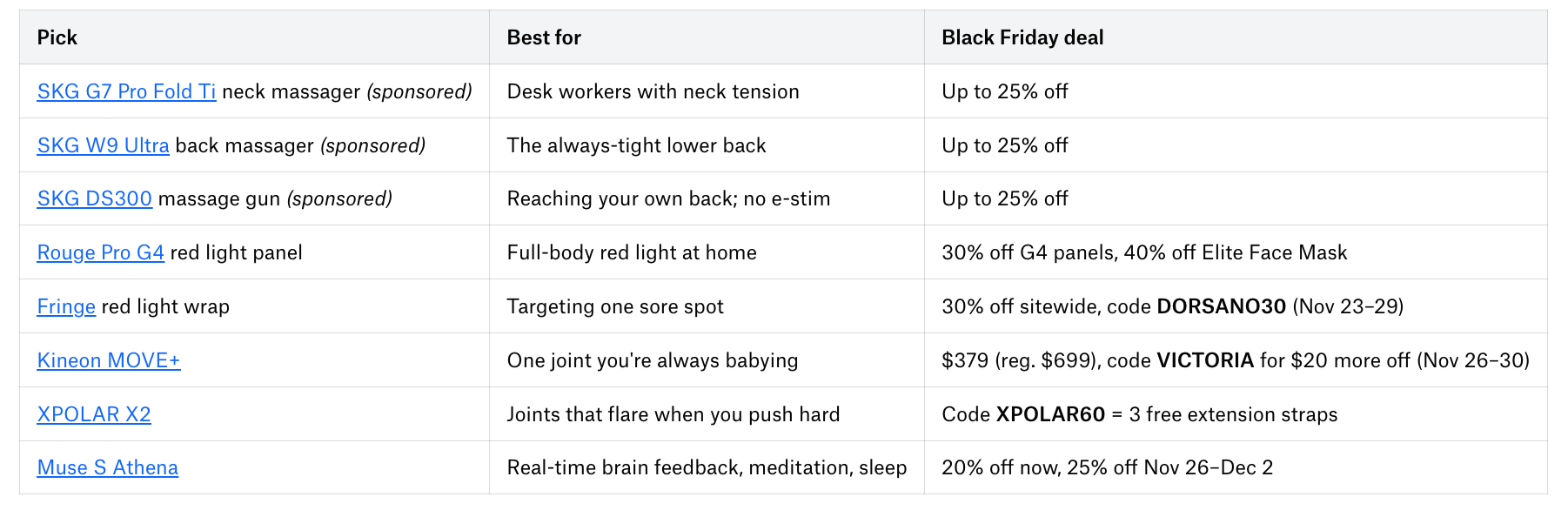
Which SKG recovery devices are worth it? (Sponsored)
SKG sponsored this section. The place most of my money goes is recovery, because between volleyball and a desk job, something always hurts. These are three SKG devices I've been using.
SKG G7 Pro Fold Ti neck massager
I've been in PT for neck pain this year, and this is the one I grab on flare days. It uses TENS and EMS, the same kinds of e-stim you'd find at a PT clinic, plus heat with red and near-infrared light. The heads warm up in about five seconds, and it folds small enough to go in my bag when I travel. I didn't expect much from it. It's turned into the first thing I reach for on a bad neck day.
The honest part on the research: electrical stimulation for neck pain looks best as short-term relief alongside other treatment, like PT. On its own, the evidence is pretty weak. Which is exactly how I use it: symptom relief and recovery support, not a fix. (My full SKG G7 review is here.)
SKG W9 Ultra lower back massager
Volleyball leaves the left side of my lower back tight pretty much all the time. This belt has eight titanium kneading nodes, pulse stimulation, and heat with near-infrared light, and it's slim enough to wear under a shirt. I put it on and read on the couch in the evening, and the heat on that spot feels really good.
SKG DS300 massage gun
The new one. What I like is that it comes apart. With the long handle you can reach your own back and shoulders without needing someone to help; with the short handle you get more control on your legs and arms. It has a heated metal head that warms up in about ten seconds, four attachments, and a slider that turns the speed up smoothly. That slider is my favorite part. Honestly, I haven't found a real downside yet.
SKG safety notes
Start low. The G7 and W9 are strong. I max out at level 3 of 9 on the neck and level 2 on the belt.
Pacemaker or metal implant? Skip the G7 and the W9, since they use electrical stimulation. The DS300 doesn't, so that's the one to look at.
With any massage gun, stay off the front and sides of your neck.
The deal: for Black Friday, SKG is running up to 25% off on the G7 Pro Fold Ti, the W9 Ultra and the DS300.
Red light therapy: should you buy a panel or a wrap?
Red light is everywhere this time of year: panels, masks, wraps, belts. Panel versus wrap isn't really a quality question. It's how much of your body you want to cover, and what you'll actually use most weeks.
Rouge: my full-body pick
I use the Rouge Pro G4 at home. It has presets built in, so you're not guessing how long to stand there. Their Black November sale has the G4 panels at 30% off, plus free shipping and a 60-day trial. They also make the Elite Face Mask, which is 40% off. I haven't tried the mask myself, but Rouge is a reputable company, which is why it's the one I'd look at. They haven't posted an end date for the sale, so that 60-day trial is your safety net.
Fringe: my targeted pick
I use my Fringe wrap on my lower back, calves and quads. Everything on their site is 30% off with my code DORSANO30 from November 23 through the 29th. They also just launched the Light Therapy Liner. It's brand new and I haven't tried it, so all I'll say is that it's in the sale.
Quick decision tree: want whole body? Rouge. Want a spot you can wear around? Fringe. Want just one joint, like a knee? Keep reading.
And if you're not sure you'll use it most weeks, hold off and read how to use red light therapy (dose, distance and timing) first. Most people who say red light "didn't work" were using it wrong.
Is the Kineon MOVE+ worth it for knee pain?
My single-joint pick for resilience and mobility is the Kineon MOVE+. It's a wearable that puts red and near-infrared light right on a joint, and for me it's been the go-to for keeping my knee pain-free and recovering after hard volleyball days.
This is one of the few places in red light with decent research. A 2019 meta-analysis of 22 placebo-controlled trials in BMJ Open found low-level laser therapy reduced knee osteoarthritis pain, mostly at guideline-recommended doses.
Translation: the approach has real support, but that doesn't prove any one wearable hits that dose. So I use it alongside strength work and rehab, not instead of it. (My full Kineon MOVE+ review has the details.)
If pain is new or sharp, get it looked at first. This is for a joint you already know you're rehabbing.
The deal: from November 26–30, the MOVE+ is $379 (regularly $699), and my code VICTORIA takes another $20 off, for $359 with free shipping. Outside the sale, VICTORIA is 10% off any time.
Does contrast therapy work? My XPOLAR X2 pick
If you'd rather go hot and cold on that joint, my contrast pick is the XPOLAR X2. It's a wrap that does cold, heat, or switches between the two, with pulsing compression on top, and the compression is what surprised me most. I tested it for three weeks on my right knee (the one with the ACL surgery and the broken kneecap), and I've strapped it on sore hamstrings too.
The honest part: you can hear the fans, and on cold mode the battery runs out after about three sessions.
Buy it if you're coming back from a knee injury (with your PT's okay), or a joint flares up when you push hard.
Skip it if a fifteen-dollar gel pack already does the job.
The deal: use code XPOLAR60 on their site and you get three extra extension straps, a $60 value, free. XPOLAR lists the X2 as FSA/HSA eligible. My full XPOLAR X2 review has the long version.
Is the Muse S Athena worth it?
Everything so far was muscles and joints. This one's for your brain. The Muse S Athena is a headband that reads your brain activity in real time. I use it for meditation and guided wind-downs, it tracks my sleep, and I've used it to test my brain age and even to remember my dreams.
Deal timing matters here. Right now it's 20% off. From November 26 through December 2 it goes to 25% off. So if you can wait a couple of days, wait.
Who it's not for: if you know a headband is going to annoy you, skip it. If you just want to fall asleep faster, the no-gadget version is free: here's how I went from 60 minutes to 10.
What health gadgets should you skip this Black Friday?
No brands here, just device types. These are the ones you'll see in your ads all week, and when you look at the research, they don't hold up.
1. Magnetic and copper bracelets for pain
A systematic review in CMAJ pooled nine placebo-controlled trials and found static magnets did no better than a fake magnet for pain. And when people with rheumatoid arthritis wore a copper bracelet and magnetic wrist straps for five weeks each, neither did better than the placebo strap. If your joints hurt, put that money toward something that's been tested.
2. Ionic foot detox baths (and detox foot pads)
The water turns brown, and I get it, it looks really convincing. But when researchers measured what was in the footbath water and in people's urine and hair, the footbath wasn't pulling anything toxic out through their feet. It was a small study, but it's the best test we have, and nobody has tested the pads that carefully. Your liver and kidneys are already doing the real detox work.
3. At-home fat-freezing gadgets
The FDA says the safety and effectiveness of at-home fat freezing hasn't been established, and that only FDA-authorized devices should be used for it. A belt from an Instagram ad isn't that, and cold injuries to the skin can happen. If fat loss is the goal, that comes from food, training and sleep, which is what we actually coach.
4. Hydrogen and alkaline water machines
Some of these cost a lot. The hydrogen water studies are small and early: maybe promising, not proven. For the big alkaline claims, like preventing cancer, a systematic review in BMJ Open found almost no research either way and concluded that promoting alkaline water for cancer isn't justified. Filtered water you'll actually drink does the job.
One shopping rule for everything (mine included)
If the "original" price is a number it never sold at, the deal isn't real. Check the price history before you buy, wherever you're shopping.
Which health tech makes the best Black Friday gift?
Screenshot this one:
SKG G7 Pro Fold Ti: the desk worker who carries tension in their neck, if they can handle e-stim.
SKG W9 Ultra: the person whose lower back is always the problem, and who'd rather wear it while doing something else.
SKG DS300: the person who wants a massage gun they can use on their own back, or who can't use e-stim.
Rouge: the person who wants full-body red light at home.
Fringe: the person who'd rather target one sore spot.
Kineon MOVE+: the person with one joint, like a knee, they're always babying.
XPOLAR X2: the athlete whose joint flares up when they push hard.
Muse S Athena: the data-lover who wants real-time feedback on their brain, from meditation to sleep, and doesn't mind a headband.
FAQ
Are Black Friday health tech deals actually real?
Some are, many aren't. A common trick is showing the normal price next to a crossed-out "original" price the product never sold at. Check the price history before you buy, and favor brands with a long trial or return window.
Is red light therapy worth buying?
Red light is worth it if you'll use it consistently at an effective dose, and it has its best evidence for joint pain like knee osteoarthritis. Choose a panel for full-body use, a wrap for one area, or a joint wearable like the Kineon MOVE+ for a single knee.
Are neck massagers with TENS and EMS safe?
For most healthy adults, yes, if you start at a low level. Skip e-stim devices like the SKG G7 Pro Fold Ti and W9 Ultra if you have a pacemaker or a metal implant, and treat them as short-term symptom relief alongside PT, not a fix.
Do copper or magnetic bracelets help joint pain?
No. Placebo-controlled trials, including a five-week study of copper bracelets and magnetic wrist straps in rheumatoid arthritis, found they did no better than placebo for pain.
Do ionic foot detox baths remove toxins?
No. When researchers measured the footbath water, urine and hair, the footbath didn't remove toxic elements through the feet. The brown color comes from the water, salt and metal electrodes, not from your body.
What's the best health tech gift for someone who sits at a desk all day?
For neck tension, the SKG G7 Pro Fold Ti neck massager is my pick, as long as they can use e-stim. If they can't, the SKG DS300 massage gun is a good alternative, but keep it off the front and sides of the neck.
If this sounds uncomfortably familiar
If you already own a drawer full of gadgets, a wearable or two, and a red light you used for three weeks, the problem was never the device. It's that nobody helped you build the plan the tools are supposed to support. That's exactly what my coaching practice exists to solve: a training, recovery and nutrition plan that fits your real week, with the tech in a supporting role. If you want help building yours, book a free discovery call here.
Want structure starting in January? Registration for Reignite opens on Black Friday. And if you'd rather start with the free stuff, join the newsletter.
The Bottom Line
The best Black Friday health tech is the device you'll actually use most weeks for a real goal: strength, metabolic health, recovery, or resilience and mobility. My 8 picks are the ones in my routine, with honest notes on who should skip them. The 4 gadget types on my skip list don't hold up in the research. The one action: before you check out, ask "will I use this most weeks?" and check the price history. If either answer is no, keep your money.
Related Articles
Sponsorship and affiliate disclosure: SKG sponsored the SKG section of this post. This article also contains affiliate links. If you purchase through my links, I may earn a small commission at no extra cost to you. I only recommend products I actually use and that meet my evidence-based quality standards. Deals and prices are as published by each brand at the time of writing and can change.
This article is for educational purposes and is not a substitute for professional medical advice. I am a health coach, not a physician. Consult your healthcare provider before using electrical stimulation, red light, or hot/cold therapy devices, especially if you have a pacemaker, metal implant, existing condition, or a new or sharp pain.