How to Build a Body That Lasts: Training for Longevity in Your 50s and 60s
This blog is based on a video from my YouTube channel. If you prefer to watch that, click here.
If you're in your 40s, 50s, or 60s and wondering how much longer your body will let you do the things you love — hiking, skiing, pickleball, golf — here's the honest answer: it depends almost entirely on how you're training right now.
I see the same pattern over and over with clients who come to me feeling exhausted, injured, and less capable every year despite staying "active." They're doing the right things, sort of. But they're making three key mistakes that are quietly guaranteeing their body won't hold up later. And the frustrating part is that none of it has to happen.
I'm Victoria, a certified health coach who specializes in training for longevity. Here's what actually builds a body that lasts.
The 3 Mistakes That Are Quietly Aging You Faster
Mistake #1: Confusing Being Active with Building Strength
They are not the same thing.
Walking is movement. Hiking is movement. Yoga is movement. Pickleball is movement. All good things. But none of them are systematically building the strength you're going to need to stay capable as you age.
Here's a quick gut check. Can you:
Get up from the floor without using your hands?
Carry two heavy bags of groceries up a few flights of stairs without struggling?
Catch yourself from a nasty trip without getting injured?
Lift a suitcase into an overhead bin without straining?
Those are strength demands. And if they require significant effort right now, pay attention — because in 10 years, without actively building strength, these things won't just be hard. They'll feel impossible.
Being active maintains your cardiovascular system and some agility. But strength requires progressive resistance training. It requires challenging your muscles beyond their current capability and demanding that your body get stronger over time — not just moving more.
Mistake #2: Random Acts of Fitness
You're doing stuff. But there's no plan, no progression, no strategy.
Monday: you feel good, so you do a hard hike. Tuesday: a friend invites you to yoga, so you go. Wednesday: you're tired, so you skip. Thursday: guilt kicks in, so you hammer an intense HIIT class. Friday: your back hurts from the HIIT class, so you rest.
Sound familiar?
Something is always better than nothing — I want to be clear about that. But when everything is reactive and based on how you feel that day, you're not actually building anything. At best, randomness maintains. At worst, it creates overuse in some areas and neglect in others with zero progress toward strength.
Building a body that lasts requires:
Progressive strength training — week over week, getting objectively stronger
Intentional mobility and stability work — keeping you injury-free
Planned recovery — not just rest when you're forced to
95-99% of people cannot random-act-of-fitness their way to being strong and capable in their 80s. You need a plan.
Mistake #3: Ignoring the Small Stuff Until It Becomes Big Stuff
Your knee feels a little weird after long hikes. Eh, I'll stretch more.
Your shoulder gets tight and pinchy reaching overhead. I'm just getting older.
You're brutally sore for 3 days after a workout. Must have been a good one.
These are signals. And as you age, ignoring them has compounding consequences.
Most active adults don't address things proactively. They wait until the knee pain stops them from hiking entirely, until the shoulder becomes a tear, until the recovery issue turns into chronic fatigue. Then they come to me saying "I just want to get back to where I was 6 months ago" — and I have to tell them it's going to take longer to fix than it would have taken to prevent.
The strongest, most capable 70, 80, and 90-year-olds I know take the small stuff seriously. They don't push through everything. They train smart, recover intentionally, and address small issues before they become big ones.
The 5-Component Longevity Framework
This is the framework I use with clients who want to stay genuinely active into their 80s and 90s — not just surviving, but doing the things they love.
Component 1: Foundational Strength
Non-negotiable. You need to systematically build strength in the movement patterns that matter for real life:
Hip hinge patterns: deadlifts, Romanian deadlifts, kettlebell swings
Squat patterns: goblet squats, split squats, step-ups
Push patterns: chest press, overhead press
Pull patterns: rows, pull-downs
Loaded carries: farmer's carries, suitcase carries (underrated for balance and real-world strength)
These aren't random exercises. These are fundamental human movement patterns. And the question isn't just "did I do some squats this week?" — it's "am I actually lifting more than I was a few months ago? Am I getting objectively stronger?"
For most people, this means 2-3 dedicated strength sessions per week with a clear progression plan.
Component 2: Movement Quality
You can be strong and still move terribly. And if you move terribly, injury is usually just a matter of time.
Movement quality means:
Hip mobility — so you can squat and hinge without compensating
Shoulder mobility — so you can reach overhead without pain
Ankle mobility — so your knees aren't absorbing stress they shouldn't be
Thoracic spine mobility — so you're not hunched over and off-balance
Core stability — so your spine is protected under load
This doesn't mean an hour of yoga every day. It means 10-15 minutes of targeted mobility work, 2-3 times per week, and making sure your strength training uses full range of motion.
Quick rule: if you can't get into a position properly without weight, you have no business loading that position heavily.
Component 3: Activity-Specific Preparation
This is where the hiking, skiing, golf, and pickleball fit in. But here's the reframe: your activity is not your training. Your training prepares you for your activity.
If you want to ski all day without your legs giving out (and without blowing your ACL), you need to progressively build the leg strength that can handle that demand. If you want to hike 12 miles without your knees complaining the next week, your training needs to support that.
The fun stuff is the reward. The training is what makes it sustainable long-term.
Component 4: Recovery Protocols
This is where a lot of active adults completely drop the ball. Recovery isn't just "rest when you're sore." It's a deliberate part of your training.
Recovery fundamentals:
Sleep — this is where your body actually repairs and builds tissue
Strategic rest days — not just collapse days, but planned recovery
Active recovery — easy movement that promotes blood flow without adding stress
Nutrition — enough protein, enough calories, enough carbs to actually support recovery
Hydration — and this one matters more than most people realize
On hydration: I used to think all filtered water was basically the same. Drink enough of it and you're fine. But when you're training hard and asking your body to repair tissue, flush metabolic waste, and regulate inflammation, water quality actually matters.
That's why I switched to a reverse osmosis filter — specifically, the Bluevua countertop RO system. It's the only type of filter that removes contaminants down to 0.001 microns, including fluoride, heavy metals, microplastics, and pharmaceuticals that basic pitcher filters don't catch. I've been using it for over a year and a half. Chicago tap water runs around 170 parts per million of total dissolved solids — after running it through this filter, it drops to 1.
Is clean water going to revolutionize your training on its own? No. But when you're stacking all the recovery pieces together, every input matters.
Use code VICTORIA15 for 15% off at checkout → Bluevua countertop RO filter
Component 5: Progressive Adaptation
Here's the tension most people over 50 don't know how to navigate: you can't train like you're 25, but you also can't just coast.
Maintenance equals slow decline. You need to keep getting stronger and more capable over time — just at a pace your body can actually handle. That means more preparation before activity, more recovery time built in, and more gradual progression. But still progression.
This is exactly the approach we take at Be Victorious Coaching — wrapping strength, mobility, nutrition, and lifestyle together into a plan that builds for decades, not just a month ahead. Train smart, progress consistently, listen to what your body is telling you.
What This Looks Like in a Real Week
Putting all five components together in practice:
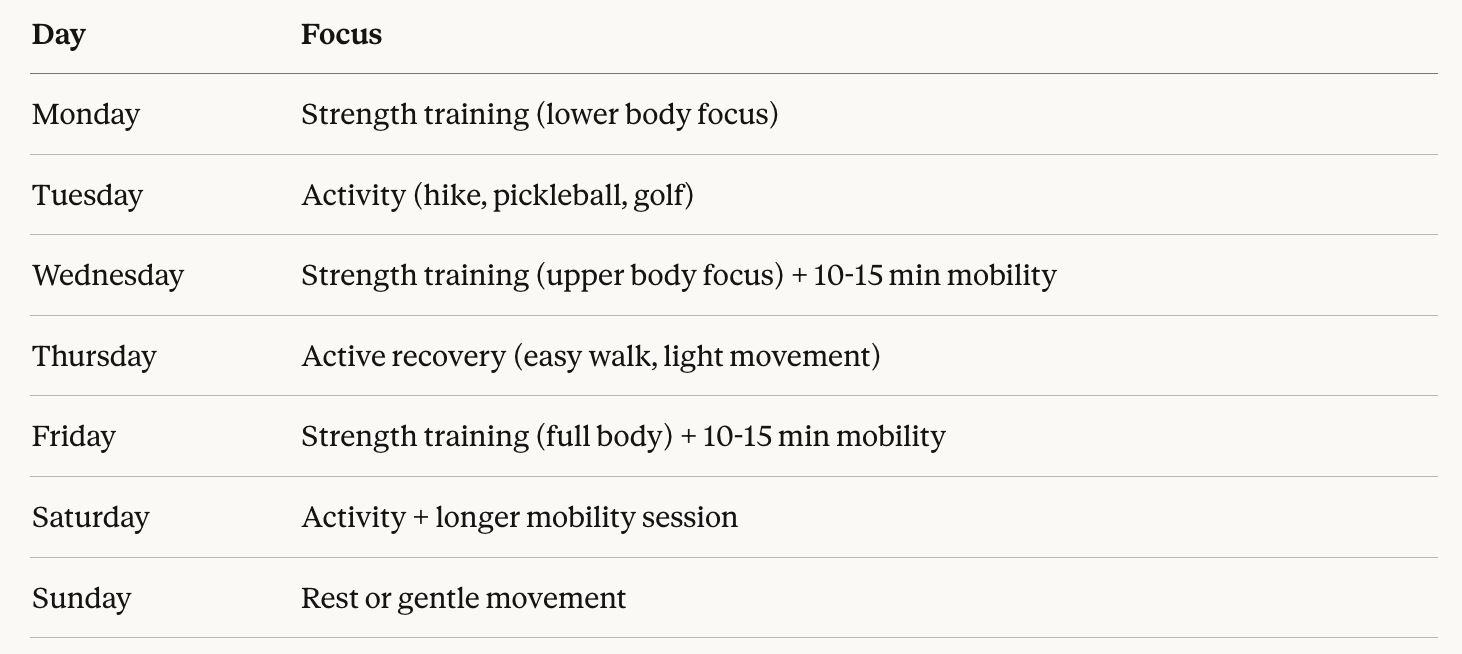
This isn't a rigid prescription — it's a framework. The specifics will vary based on your activity of choice, your current fitness level, and what your body is telling you.
The Bottom Line
If you want to be genuinely active in your 70s, 80s, and beyond, here's the summary:
Build foundational strength — progressive, deliberate, getting objectively stronger over time
Prioritize movement quality — strong and controlled, not just strong
Train for your activities — let your training prepare you for the fun stuff
Recover intentionally — sleep, nutrition, hydration, rest (not as an afterthought)
Progress sustainably — build for decades, not months
The goal isn't to feel like you're 25. The goal is to feel capable, resilient, and strong for the next 30+ years. That's absolutely possible. But it requires a plan.
Ready to stop guessing and start building? Grab our free Longevity Blueprint — a practical roadmap of how to integrate these five components with sample workouts you can start using right away.
Or if you're ready to skip straight to a personalized plan, book a free discovery call and let's build yours.
Disclaimer: This article provides general information and is not intended as medical advice. Always consult with a qualified healthcare provider before making changes to your exercise regimen, especially if you have existing health conditions or injuries.