The short answer: a good hotel room workout is five bodyweight moves (squats, push-ups, reverse lunges, glute bridges and a plank or dead bug) done for 40 seconds on and 20 seconds off, for 4 rounds. That's 20 minutes and a few feet of floor. Research suggests one or two hard sessions a week like this can maintain your strength while you travel, as long as the last reps of each set feel genuinely hard.
I'm Victoria Dorsano, founder of Be Victorious Coaching. Our team works with busy professionals and former athletes whose routines run beautifully at home and fall apart the minute they pack a suitcase. Then getting back on track somehow takes longer than the trip did.
The fix isn't a better hotel gym. (Hotel gyms with one wobbly dumbbell rack, you can relax.) It's a plan that fits in the room, plus an honest look at how little training it takes to hold onto the strength you've built. In the Longevity Blueprint, our four-pillar framework of strength, metabolic health, recovery, and resilience & mobility, this one lives squarely under strength. (For the bigger picture on training for the long haul, see how to build a body that lasts.)
What is the best 20-minute hotel room workout?
The best 20-minute hotel room workout uses five bodyweight exercises that cover your legs, push muscles, hips and core, done as a circuit: 40 seconds of work, 20 seconds of rest, 4 rounds.
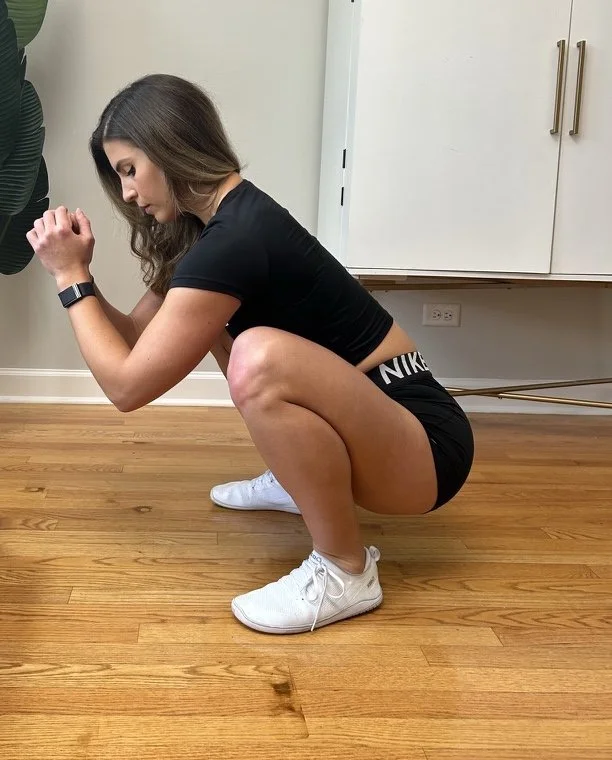
Squats. Feet about shoulder-width, sit back and down, stand tall. Harder: take 3 seconds on the way down each rep.
Push-ups. Hands under shoulders, body in one line. Easier: hands on the bed or desk.
Reverse lunges. Step back, lower the back knee toward the floor, drive through the front foot. Alternate legs.
Glute bridges. On your back, knees bent, drive your hips up and squeeze. Harder: one leg at a time.
Plank or dead bug. Slow and controlled. Quality beats duration here.
Short on time? Do two rounds. Ten minutes absolutely counts, even if your fitness tracker isn't impressed.
Can a bodyweight workout build or keep strength?
A bodyweight workout can build and keep strength if it's hard enough, which is the part most travel workouts skip.
Push-ups can match a light bench press. In a small 8-week trial, young men doing push-ups matched to the load of a light bench press (about 40% of their max) gained similar strength and chest and triceps muscle as the bench-press group (Kikuchi & Nakazato, 2017). A separate 4-week study found progressive push-up training increased bench-press strength too (Kotarsky et al., 2018).
Light loads work when you push close to fatigue. A 2017 meta-analysis found light-load and heavy-load training built similar amounts of muscle, while heavy loads still won for maximal strength (Schoenfeld et al., 2017).
What that means for you: bodyweight work counts, but only if the last few reps of each 40-second set are genuinely hard. If you finish a round and could chat comfortably, slow the reps down or move to the harder version.
The honest limits: these studies were small, short and mostly in young men. They show bodyweight training can work. They don't prove it matches a full gym program for everyone.
How much exercise do you need to maintain strength while traveling?
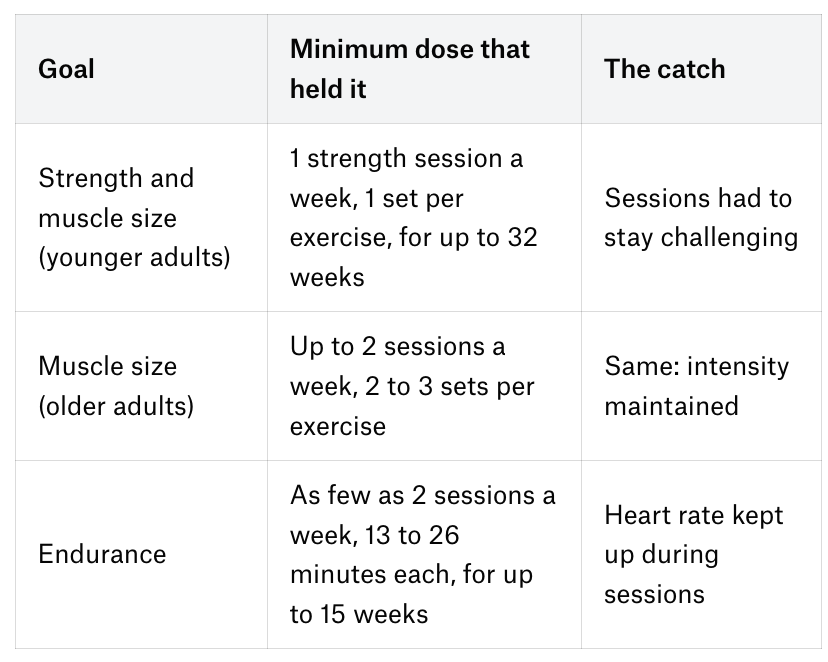
Most people can maintain strength while traveling with one or two short, hard strength sessions a week, because intensity matters more than how often or how long you train.
A 2021 review from researchers at the U.S. Army Research Institute of Environmental Medicine looked at the minimal dose of exercise needed to maintain fitness when time is short:
So for most busy adults, and especially as we get older, two short, hard sessions a week is a smart target on the road. That's the "movement minimum" in what we call the Minimum Effective Week: two short strength sessions plus a daily walk.
How do you make a hotel room workout harder without equipment?
You make a no-equipment workout harder by changing one thing at a time: slow the lowering, go single-leg, add pauses, use the furniture, or load up your bag.
Slow the lowering. Three seconds down on squats and push-ups.
Go single-leg. Single-leg glute bridges, split squats with the back foot on the bed.
Add a pause. Two seconds at the bottom of each squat and lunge.
Use the furniture. Feet on the bed for decline push-ups. A sturdy chair for step-ups.
Use your bag. A packed backpack held at your chest turns squats and lunges into loaded work.
Who is a hotel room workout not a good fit for?
A hotel room workout isn't the right tool if you're training for a specific strength goal over months, rehabbing an injury, or newly cleared after surgery.
If you're chasing a new max: heavier loads still win for maximal strength, so treat the hotel version as maintenance and pick your program back up at home.
If you're in rehab: follow your physical therapist's plan on the road instead. Lunges and decline push-ups aren't automatically safe for a healing knee or shoulder.
If anything causes sharp pain: stop that exercise and swap it for one that doesn't.
What should you pack to work out while traveling?
You don't need any gear for this workout, but two small things make travel weeks easier:
A light, flat shoe. The Xero Shoes Prio packs almost flat and doubles as your walking shoe for the trip.
Protein you can carry. Airports and road trips are where the protein-forward first meal falls apart. Jacked Granny bars (code VICTORIOUS for 10% off) are our team's go-to for the car, the airport and the carpool line.
Want the whole travel plan on one page?
This workout is page 6 of our free Holiday Health Playbook, next to the Minimum Effective Week, a sleep plan for the season and a two-minute Sunday check-in. Print it, screenshot it, or keep it in your bag.
FAQ
Can you build muscle with a hotel room workout?
You can build some muscle with a hotel room workout, especially if you're newer to training, and you can maintain what you have. The key is effort: sets need to end close to fatigue.
What if my hotel room is tiny?
Every move in this workout fits in the space of a yoga mat. Do reverse lunges in place, and use the bed or desk for incline push-ups if the floor is tight.
Is a bodyweight workout as good as the gym?
For maintaining strength over a trip, a bodyweight workout can come close if you push the effort. For building maximal strength over months, heavier loads still win.
Should I do the workout in the morning or at night while traveling?
Do it whenever it's most likely to happen. On travel days that's usually first thing, before meetings and dinners fill the calendar.
Does walking around a new city count as exercise?
Walking counts toward your daily movement, and it's part of the Minimum Effective Week. It doesn't replace the strength work, so aim for both.
If this sounds uncomfortably familiar
If every trip turns into a two-week restart, the workout isn't the problem. It's that your routine only has one version: the one that works when life is calm. That's what we build with our 1:1 coaching clients: a home version, a travel version and a busy-week version, so the plan bends instead of breaking. You can read what real 1:1 health coaching for busy professionals looks like, or if you want help building yours, book a free call here.
The Bottom Line
You don't need a hotel gym to keep your strength on the road. Five bodyweight moves, 40 seconds on and 20 off, for 4 rounds, is a real workout if you make the last reps hard. Research suggests one or two challenging sessions a week can maintain strength, with older adults needing closer to two. The one action: before your next trip, put two 20-minute sessions on your calendar like any other meeting.
Related Articles
This article contains affiliate links. If you purchase through my links, I may earn a small commission at no extra cost to you. I only recommend products I actually use and that meet my evidence-based quality standards.
This article is for educational purposes and is not a substitute for professional medical advice. I am a health coach, not a physician. Consult your healthcare provider before starting a new exercise routine, especially with existing conditions, joint pain, or injuries. Stop any exercise that causes sharp pain.