Fuel Meals vs. Factor vs. CookUnity: I Tested 10-12 Meals from Each. Here's the Honest Breakdown.
The prepared meal delivery industry is a $9 billion category in the US. There are dozens of services competing for your subscription, and the marketing across all of them sounds basically identical: fresh, healthy, convenient, delivered to your door.
I work with a lot of busy professionals as coaching clients. Many of them don't have time for Sunday meal prep but also can't keep ordering takeout and expect to make progress on their fitness goals. They need a reliable source of food with solid macros, at a reasonable price, that doesn't add another layer of complexity to their week.
So I get asked the same question constantly: which meal prep delivery service should I actually use?
I tested 10-12 meals from each of the three biggest names — Fuel Meals, Factor, and CookUnity — and compared them across nine categories that actually matter for using prepared meals to support health and fitness goals. Not just taste. Macros, storage flexibility, subscription management, cost structure, and more.
Full transparency upfront: I have an affiliate partnership with Fuel Meals because they've been a strong resource for my clients. I wanted to make sure that partnership was actually warranted, which is why I did this comparison in the first place. Factor and CookUnity links are informational only — no commission either way.
Who You're Actually Buying From
Understanding the company behind the product matters, particularly when you're trusting them with a recurring subscription and your food supply.
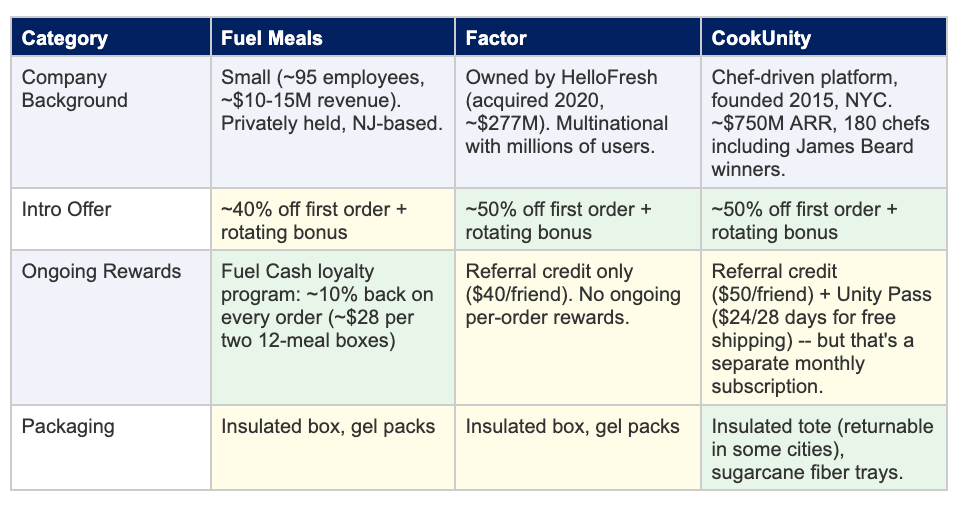
Factor is owned by HelloFello HelloFresh, the publicly traded German meal kit company. They acquired Factor in 2020 for approximately $277 million. When you order from Factor, you're ordering from a multinational corporation with millions of active users worldwide. Operational at scale, but decisions are made within a large corporate structure.
CookUnityis a chef-driven platform founded in 2015 and headquartered in New York. They closed 2025 at approximately $750 million in annual recurring revenue and raised $250 million in funding from General Catalyst in late 2024. They host around 180 chefs, including James Beard Award winners like Marcus Samuelsson. Serious culinary credibility.
Fuel Mealsis the small one in this comparison — roughly 95 employees, an estimated $10-15 million in annual revenue, privately held, and based in New Jersey. Smaller doesn't mean worse, but it's a meaningfully different operation than the other two.
None of this automatically makes one better than another. But it's relevant context for understanding how each company makes decisions and who they're optimizing for.
The Full 9-Category Comparison
The Categories That Separate Them
Freezability: The Biggest Practical Differentiator
This is the one that moves the needle most for my clients and for me personally.
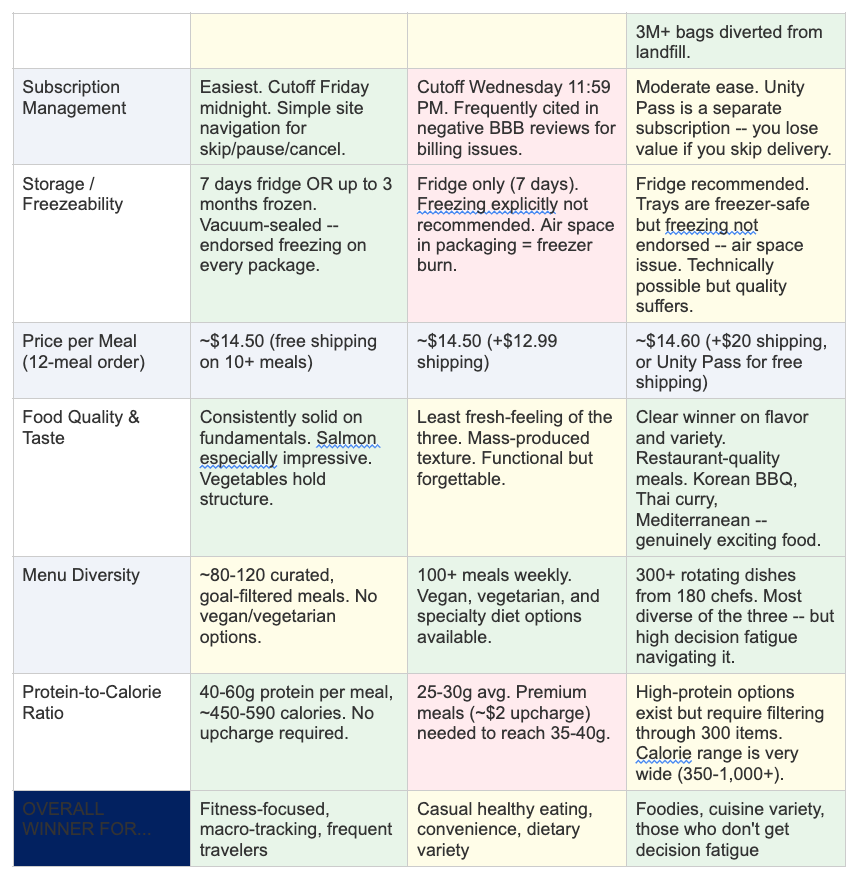
Fuel Meals vacuum-seals every meal and explicitly endorses freezing on the packaging. They stay fresh in the fridge for 7 days or in the freezer for up to 3 months. If you have a travel week, a schedule change, or just over-ordered, you're not throwing food away. You freeze it and pull it when you need it.
Factor explicitly advises against freezing. There's air space in the packaging, which means freezer burn is a real outcome if you try it anyway. A busy week where you miss a few meals means food in the trash.
CookUnity lands in the middle — their trays are technically freezer-safe, but they also don't endorse it for the same reason. Air space, freezer burn, degraded texture. Possible, but not ideal.
Bottom line: if your schedule is unpredictable, you travel, or you want the flexibility of a backup food source rather than a weekly obligation, Fuel Meals is the only one of the three that's built for that.
Protein-to-Calorie Ratio: Not All Meal Delivery Is Built the Same
For clients focused on body composition, muscle building, or fat loss, this is the metric that makes or breaks whether prepared meals are actually useful as a nutrition tool.
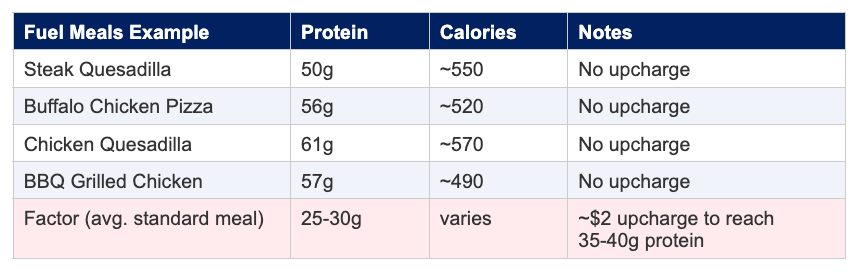
Factor's average standard meal delivers 25-30g of protein. To get near 35-40g, you're paying a ~$2 upcharge for a premium meal. CookUnity has high-protein options, but you have to hunt for them in a 300-item menu and the calorie range is extremely wide — meals run from 350 to over 1,000 calories, which makes macro management much harder.
Fuel Meals is simply built differently from a nutrition standpoint. Every standard meal delivers 40-60g of protein within a 450-590 calorie range, with no upcharge required. For someone actively tracking macros or trying to hit protein targets on a busy week, that's a meaningful structural advantage.
Subscription Management: The Friction That Kills Subscriptions
A Wednesday 11:59 PM cutoff is not a user-friendly subscription model for busy professionals. That's Factor's current cutoff -- in the middle of the workweek, easy to miss, and a common source of frustration. It's the most frequently cited complaint in their BBB reviews.
CookUnity is easier to navigate than Factor for skipping or pausing, but the Unity Pass adds a layer of complexity: you're paying a separate $24/month for free shipping, and skipping a delivery doesn't pause that charge. You lose value you've already paid for.
Fuel Meals' cutoff is Friday at midnight. End of week. Easy to integrate with weekly planning. The site is straightforward to navigate for skip, pause, delay, or cancel. No hidden subscription layers.
Food Quality and Taste: The Honest Assessment
CookUnity is the clear winner on flavor and culinary diversity, and it's not particularly close. Korean barbecue, Thai curry, fresh salad options, Pacific fish, Mediterranean dishes — some of the meals were genuinely restaurant-quality. If you want exciting, diverse food, CookUnity delivers.
Factor tasted the least fresh of the three. The texture leaned soft and sometimes slightly liquid, with a mass-produced feel. The meals were fine, but not memorable. For a company backed by HelloFresh's scale, you feel that scale in the food.
Fuel Meals is consistent rather than exciting. They nail the fundamentals — the salmon was particularly impressive for a prepared meal service, the lean proteins weren't dry, and the vegetables held their structure instead of going to mush. If you're eating these meals as a nutrition tool rather than a culinary experience, that consistency matters more than cuisine variety.
Decision Fatigue Is Real
Three hundred dishes from 180 chefs sounds like a feature. In practice, it means every order requires navigating an overwhelming menu. There's well-established research on decision fatigue — the more options you have, the more cognitive energy it costs to choose, and the worse your decisions tend to be at the end of the process.
Fuel Meals' curated, goal-filtered menu is a smaller selection, but the navigation is dramatically simpler. You pick your goal (muscle, weight loss, performance), the list narrows, you pick your meals. For people who already have too much to manage, that simplicity has genuine value.
The trade-off: Fuel Meals has no vegan or vegetarian options. If that's a requirement, Fuel Meals is out.
If you’re looking for more vegan/vegetarian options that are freezer-friendly, you may want to try Hungryroot. Hungryroot starts with a short quiz on taste, dietary pattern, and who's eating, then builds a weekly SmartCart from more than 50,000 chef-crafted recipes and 1,000-plus grocery items. Ratings tune future weeks, and shoppers can swap items, resize a delivery, or set a budget the service holds to.
That structure covers the corners prepared-tray menus tend to miss. High Protein, Gut-Friendly, Gluten-Free, Dairy-Free, and Vegetarian sit alongside each other as normal starting points, not filters to hunt through. Skipping a week, pausing, or canceling is one click, so a travel stretch or a slow week doesn't turn into wasted food. For readers who like the idea of outsourcing decisions but still want to cook, it's a middle path between a rigid weekly menu and starting from scratch at the grocery store.
Who Should Order What
Choose Fuel Meals if:
You're actively tracking macros or focused on body composition
You travel or have an unpredictable schedule and need freezer flexibility
You want high protein without having to pay upcharges or search for it
You prefer a simple, curated menu over 300 options
You eat meat/fish and don't need vegetarian or vegan options
Choose CookUnity if:
Food quality and cuisine variety are your primary criteria
You want chef-driven, restaurant-quality meals
You don't get decision fatigue from large menus
Sustainability and packaging quality matter to you
You're okay navigating a large menu to find what works nutritionally
Choose Factor if:
You want a simple introduction to healthy prepared meals
You need vegan, vegetarian, or specialty diet options
You're not primarily focused on protein targets or macro tracking
You want access to a free dietitian call to get started
You can reliably manage a Wednesday cutoff
Prepared meals as a tool, not a crutch
Meal delivery can be a genuinely useful part of a nutrition strategy but the service doesn't replace understanding how to fuel your body for your specific goals. If you want help building the actual nutrition framework (not just outsourcing meals), that's the work I do with coaching clients. We figure out what your body actually needs to support your training, body composition goals, and schedule and then build a structure around executing it.
Frequently Asked Questions
Which meal delivery service has the most protein per meal?
Fuel Meals delivers the highest protein per meal of the three services tested, consistently providing 40-60g of protein per meal within a 450-590 calorie range at no upcharge. Factor averages 25-30g for standard meals and requires a ~$2 upcharge for premium high-protein options. CookUnity has high-protein options but requires filtering through 300+ items to find them.
Can you freeze Factor meals?
Factor explicitly advises against freezing their meals. The packaging contains air space, which leads to freezer burn if you attempt it. Factor meals are designed to be consumed fresh within a few days of delivery.
Can you freeze Fuel Meals?
Yes -- and Fuel Meals is the only one of the three services that actively endorses freezing. Their meals are vacuum-sealed, which prevents freezer burn. They can be stored in the fridge for up to 7 days or frozen for up to 3 months, making them a much more flexible option for busy schedules and frequent travelers.
Is Factor owned by HelloFresh?
Yes. HelloFresh acquired Factor in 2020 for approximately $277 million. When you subscribe to Factor, you're purchasing from HelloFresh's corporate family.
What is CookUnity's Unity Pass?
The Unity Pass is a $24/28-day subscription add-on that provides free shipping on CookUnity orders. Think of it as an Amazon Prime model for meal delivery. The important caveat: if you skip or pause your meal delivery, you continue paying for the Unity Pass, meaning you lose value you've already paid for during that period.
Which meal prep service is best for weight loss?
For active fitness goals including weight loss and body recomposition, Fuel Meals' combination of high protein (40-60g per meal), controlled calorie range (450-590 per meal), and no upcharge for protein-forward meals makes it the most practical tool for macro tracking. Factor and CookUnity both require more navigation and upcharges to achieve similar protein targets.
How does CookUnity compare to Factor on food quality?
CookUnity is clearly superior on taste and culinary diversity. Their chef-driven model with 180 chefs produces restaurant-quality meals across a wide range of cuisines. Factor, operating at multinational scale, delivers more of a mass-produced texture and taste — functional but not memorable.
The Bottom Line
At roughly $14.50 per meal, all three services land at essentially the same price point. The difference is entirely what you're getting for that money.
CookUnity wins for food you actually look forward to eating. Factor wins for low-friction entry into healthy eating with dietary variety. Fuel Meals wins when your goals are fitness-forward and your schedule doesn't cooperate with a rigid weekly consumption window.
Those two things — the protein density and the freezer flexibility — are why Fuel Meals has been my personal go-to and what I recommend to most of my clients. But if those aren't your priorities, the other two are legitimate options.
Try Fuel Meals here | Factor: factor75.com | CookUnity: cookunity.com
Disclosure: I have an affiliate partnership with Fuel Meals and may earn a commission from purchases made through my Fuel Meals link at no extra cost to you. I do not have an affiliate relationship with Factor or CookUnity. All reviews are based on personal testing of 10-12 meals per service. This content is for informational purposes and is not a substitute for personalized nutrition guidance.