I Drank Mushroom Coffee Every Day for 30 Days. Here's What the Science Actually Says.
This blog is based on a video from my YouTube channel. If you prefer to watch that, click here.
Mushroom coffee is everywhere right now. Whole Foods. Amazon. Every wellness creator's morning routine. And the claims are... aggressive. Better focus. More energy. Less stress. Basically regular coffee, but smarter.
So I bought Ryze — one of the most popular brands blowing up across social media lately — and drank it every single day for 30 days. I took notes. I read the research. And what I found was more nuanced than either the believers or the haters are telling you.
Spoiler: mushroom coffee is not a scam. But it's also not the superfood revolution the marketing wants you to believe. Let's dig in.
What Is Mushroom Coffee, Exactly?
Mushroom coffee is normal coffee (usually instant) mixed with powdered extracts from functional mushrooms. Not the kind you throw on pizza -- we're talking about medicinal species like lion's mane, reishi, and cordyceps that have been used in traditional medicine for centuries and are now being studied in research labs.
The pitch is simple: you get the caffeine-based energy from the coffee, plus the functional benefits from the mushrooms. Blended together in something that's convenient, lower in caffeine than a standard cup, and theoretically doing more for your brain and body.
On paper, that sounds reasonable. In practice, it gets more complicated.
The $3 Billion Problem: What the Marketing Doesn't Tell You
Mushroom coffee is a nearly $3 billion industry as of 2025. That's a lot of money riding on claims that the research doesn't fully support yet.
Here's the core issue: most mushroom coffee products use what I'd call "dose theater." They'll advertise a big-sounding number -- 2,000 mg, 5,000 mg -- but that number represents a proprietary blend of multiple mushrooms. You have no idea how much of any individual mushroom you're actually getting.
Ryze, for example, contains six mushrooms: cordyceps, reishi, lion's mane, shiitake, turkey tail, and king trumpet. Total blend: 2,000 mg. But 2,000 mg spread across six species with no disclosure of individual amounts? That could be 99% king trumpet with a dusting of everything else. We simply don't know.
That's not a minor detail. It matters a lot once you look at what the research actually requires.
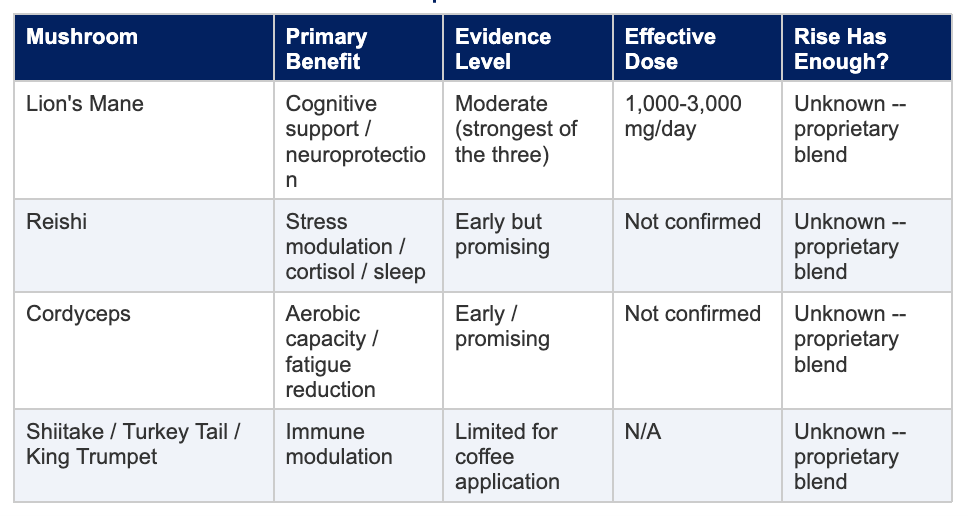
Important caveat: those trials used 1,000-3,000 mg of standardized lion's mane extract, taken consistently over months. And the benefits were most pronounced in older adults with mild cognitive impairment. A 2024 review in Neuroscience & Biobehavioral Reviews found that the signal in younger, healthy adults is much weaker.
Does lion's mane do something real? Yes -- especially with age or specific cognitive concerns. Does a single cup of mushroom coffee deliver enough to matter? Almost certainly not.
Reishi
Reishi actually has some of the most relevant evidence for being in a morning beverage, though probably not for the reason it's being marketed. It's a well-documented adaptogen with real mechanistic and early clinical evidence for stress response and cortisol modulation. There's also some data on sleep quality improvement.
Notably, this lines up with my personal experience during the 30 days. What I felt most consistently wasn't sharper focus or more energy -- it was a notable calm. More mellow than my baseline. Some mornings, honestly too mellow for volleyball. Whether that was the reishi or just the lower caffeine dose is hard to say with certainty. But the reishi hypothesis is at least plausible.
Cordyceps
Cordyceps is marketed as the performance mushroom, linked to improved ATP production and reduced exercise-related fatigue. Athletes in particular fall for this one (understandably). A 2021 review in Frontiers in Pharmacology found positive signals for fatigue reduction -- but explicitly noted that the active components aren't fully characterized and the effective dose isn't confirmed. Promising direction, incomplete science.
Bottom line on all three: the research is real. It's promising. But the phrase that came up constantly across studies was "gram-level dosing of a single standardized extract." That's what the trials used -- not a multi-species proprietary blend in one cup of instant coffee.
Mushroom Benefits at a Glance
The Label Problem Is Bigger Than You Think
Here's something that should give you pause: a 2023 paper in Nutrients analyzed commercial mushroom supplements and found widespread mislabeling -- species mismatches, variable beta-glucan content, and contaminants. A separate analysis found that 74% of products claiming to contain reishi had no reishi at all.
This isn't industry gossip. This is peer-reviewed documentation of a serious quality control problem.
Which is why, when I evaluate any mushroom coffee, I look for three minimum criteria:
Fruiting body extracts -- not just mycelium. The fruiting body (cap and stem) is the highest-bioactive part of the mushroom. Mycelium is the root system, often grown on grain substrate in lab settings -- meaning you could be getting filler grain mixed in. Some mycelium research exists, but it has a very different bioactive profile than what's been studied.
Individual milligram doses per mushroom -- not just a total blend weight. You need to know if lion's mane is dosed near 1,000 mg, not just that "the blend" contains 2,000 mg.
Third-party testing certification -- either on the package or verifiable on their website. NSF, Informed Sport, or USP are the gold standard.
If you can't answer yes to at least two of those three, you're mostly paying for marketing.
How Ryze Stacks Up Against Those Criteria
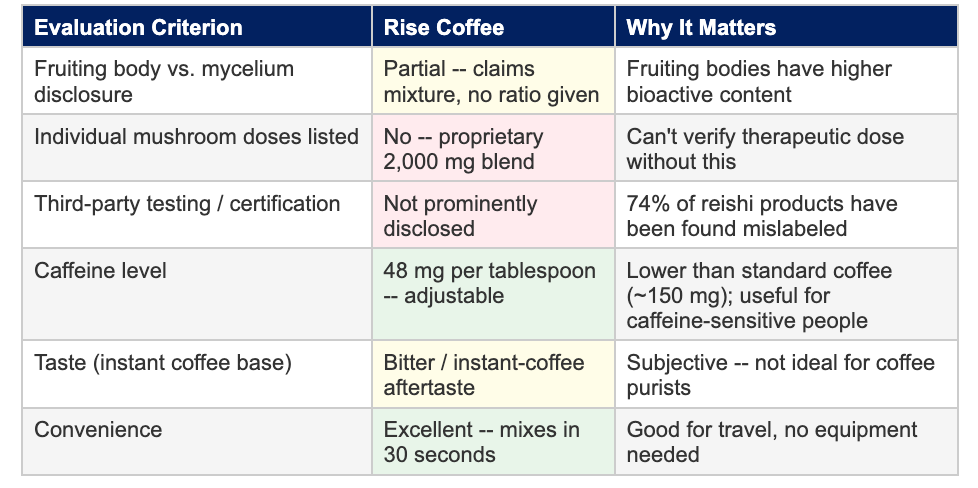
Ryze does some things well -- the convenience is genuinely excellent, the adjustable dosing is a smart feature, and the lower caffeine is appropriate for its target audience. But on the transparency criteria that actually matter for efficacy? It falls short of what I'd want to see.
A Note on Water Quality (Sponsored by Bluevua)
One thing I realized during this 30-day test: if you're going to invest in a quality functional beverage, the water you make it with actually matters.
Water quality affects both taste and how well the beneficial compounds extract. I've been using a Bluevua countertop reverse osmosis system for over a year and a half now, and it's been the best water filter I've had. Reverse osmosis filters down to 0.00001 microns -- removing heavy metals, PFAS, microplastics, and other disinfection byproducts that a standard pitcher filter simply doesn't touch.
It's a practical fit for me specifically because I rent an apartment and couldn't install an under-sink system. Plug and play, glass carafe (no plastic leaching), filter replaced once a year.
Is clean water going to transform your health overnight? No. But if you're already being deliberate about what you consume, water is a logical piece of that. You can check out the Bluevua system here — use code VICTORIA15 for 15% off.
Who Mushroom Coffee Is (and Isn't) For
It makes sense for:
Caffeine-sensitive individuals who still want a coffee experience. At 48 mg per tablespoon, Ryze is significantly lower than standard coffee (~150 mg). If regular coffee gives you jitters, anxiety, or blood pressure concerns, a lower-caffeine option with some adaptogenic support is a reasonable trade.
Adults 50+ specifically interested in lion's mane. The cognitive research is most relevant for older populations with mild cognitive concerns. That said, if this is your primary goal, I'd point you toward a dedicated lion's mane supplement at a proper therapeutic dose rather than relying on an undisclosed amount in a blend.
People who need maximum convenience. Thirty seconds in hot water, no equipment, adjustable dosing. If you travel frequently or just need the absolute minimum friction in your morning routine, the format has real merit.
It probably doesn't make sense for:
Healthy adults under 40 without caffeine sensitivity. The peer-reviewed literature doesn't support a clear benefit for this group from mushroom coffee specifically. You'd get more cognitive return from improving your sleep by 5% than from any mushroom coffee on the market right now.
Coffee lovers who care about taste. It's instant coffee. If that bothers you, it will bother you here.
Anyone expecting measurable performance gains. The cordyceps research is early and the dose is unknown. Don't make training decisions based on this.
What to Consider Instead
If the goal is lower caffeine plus a calm, focused energy, high-quality green tea is the most evidence-backed alternative. You get well-documented EGCG antioxidant properties, naturally occurring L-theanine (which genuinely does produce a calm focus when paired with caffeine), lower caffeine, and something that actually tastes like what it is.
If you specifically want lion's mane benefits, look for a standalone supplement that lists fruiting body content, individual milligram dosing near 1,000 mg, and third-party testing. That's where the evidence lives -- not in a blend where lion's mane might represent 200 mg of a 2,000 mg total.
Tired of trying to evaluate every wellness product that crosses your feed?
This is exactly what I help clients cut through. We figure out what actually moves the needle for your body, your schedule, and your goals -- and stop spending money on things that sound great but don't deliver. Book a free discovery call to see if we're a fit.
Disclosure: This post contains a paid sponsorship from Bluevua and affiliate links. Sponsorships and affiliate relationships do not influence my editorial positions. Rise mushroom coffee was purchased independently. Health information provided is for educational purposes only and is not a substitute for professional medical advice.