The Honest Case FOR Gray-Market Peptides (From a Skeptic)
This blog is based on a video from my YouTube channel. Prefer to watch? Click here.
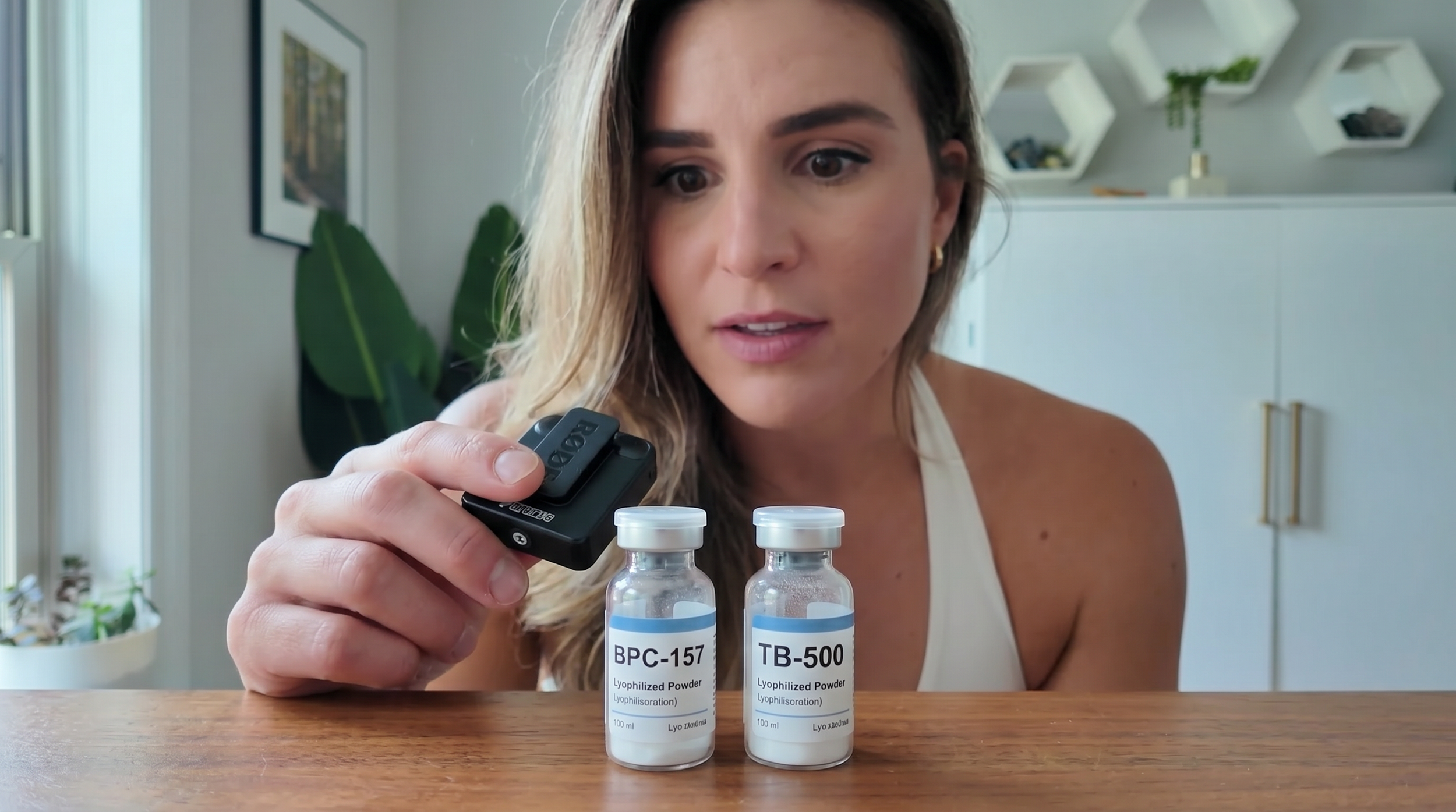
A hundred years ago, one of the most important peptides ever discovered started keeping people alive. Today, a completely different group of peptides is being sold out of unmarked vials on the internet — and people swear they're life-changing.
In the first episode of this series, I told you my gut says no on gray-market peptides. So in this one, I'm going to do the single hardest thing you can ask a skeptic to do: argue the other side, as honestly and convincingly as I possibly can.
This is the case for peptides. And I'm not going to half-do it. Because if I can't build the strongest version of an argument, I have no business rejecting it.
One rule first, and I mean it: do not make a decision off this post alone. This is one half of a pair. The next episode is the case against, where I take everything you're about to read and try to tear it apart. Any argument sounds convincing when you only hear one side. So read both.
And to be clear, same as the whole series: this is a personal exploration for educational purposes only. I'm a health coach, not your doctor. No dosing, no brands, no how-to anywhere. Just the argument.
Start from solid ground: peptides are not woo
Here's where the strongest case actually starts — and it's a better starting point than I wanted to admit.
Peptides are not fringe internet science. Your body runs on them. A peptide is just a short chain of amino acids, and some of the most important medicines of the last century are peptides. Insulin is a peptide — it's kept people with diabetes alive for a hundred years. The GLP-1 drugs everyone's talking about, Ozempic and Wegovy, are peptides, and they're rewriting how we treat obesity and diabetes. Tesamorelin, prescribed for certain kinds of fat loss, is also a peptide, also FDA-approved.
So the proponents' opening move is genuinely reasonable: we already know peptides can be powerful, targeted, life-changing medicine. If semaglutide can do what it does, is it really crazy to think some other peptides have real value we just haven't formalized yet?
That's a fair question. And it's the foundation everything else gets built on.
Where gray-market peptides actually came from
But "peptides" is doing a lot of work in that sentence. The ones I just listed are FDA-approved. The ones this series is about are a different list entirely — and you should know what's on it and why it's sold the way it is.
The gray-market peptides people chase fall into a few buckets:
Healing and recovery — BPC-157 and TB-500, nicknamed the "Wolverine stack" after the comic-book guy who heals from anything.
Growth hormone — CJC-1295, ipamorelin, sermorelin — the pitch being "nudge your own growth hormone instead of injecting synthetic HGH."
Longevity and cellular energy — NAD+, epitalon, MOTS-c — marketed for aging and mitochondria.
Metabolic — newer compounds like retatrutide chasing the GLP-1 weight-loss results.
Different goals, different mechanisms, one thing in common: none are FDA-approved, and most have very little human data.
So why are these floating around the internet in "research only" vials instead of behind a pharmacy counter? Here's the part most people don't know. Back in 2023, the FDA put about nineteen of these peptides on a restricted list that effectively stopped licensed compounding pharmacies from making them. And here's the irony proponents love: that didn't kill demand — it pushed it out of the regulated system and into the unregulated one. The gray market we're talking about was, arguably, created by regulation. Sit with that, because it comes back later.
The strongest individual cases
Let's give the best peptides their best shot.
Start with the flagship, BPC-157. It's derived from a protective compound in the gut, and in study after study it shows striking effects on tendon, ligament, and muscle healing. There's even a sliver of human data: one small retrospective study of knee patients found fourteen of sixteen — about 87% — reported meaningful pain relief after BPC-157 injections.
Honest tag, and I'm saying it once so it covers everything below: the overwhelming majority of this evidence is animal studies, and that human study was tiny, uncontrolled, and had no placebo. The next episode sits on that hard. But for a steelman, it's a real signal.
The rest of the lineup targets exactly the person reading this:
The "Wolverine stack" (BPC-157 + TB-500) is the athlete-recovery version — local healing and systemic repair at once.
The growth-hormone secretagogues target anyone who's noticed recovery slowing in their 30s or 40s — better sleep, better body composition, faster bounce-back.
Retatrutide, the metabolic one, is genuinely wild: it's in real trials with a major drug company, early results look strong, and people want it so badly they're buying it gray-market before it's even approved.
The longevity lane (NAD+, epitalon, MOTS-c) is the most aspirational pitch of all — not fixing an injury, but slowing aging itself.
The three arguments that are actually hard to dismiss
Honestly, the individual peptides aren't the strongest part of this case. The strongest part is bigger than any single compound. It's three arguments — and the first is the one I find hardest to wave away.
1. The system pushed people here
Think about what it actually takes to deal with a stubborn health problem through the front door. You see your primary care doctor, who refers you to a specialist, who orders labs your insurance may or may not cover. You wait weeks. You pay a lot. And a huge number of people, after all of it, walk out feeling dismissed — told it's normal, told to lose weight, told nothing's wrong when they know something is off.
A sports-medicine doctor at the University of Utah put it plainly: people turn to peptides because they feel their doctors aren't helping them, and because conventional treatment for things like slow-healing tendons is expensive and sometimes just doesn't work.
So when someone can order a vial online for a fraction of the cost and take their health into their own hands, for a lot of people that doesn't feel reckless. It feels like the rational response to a system that's been failing them. And honestly? That one lands for me.
2. "Under-studied" is not the same as "doesn't work"
This is the argument proponents lean on hardest, and the uncomfortable part is that it's not crazy. Most of these peptides can't be patented. And if a drug company can't own something exclusively, it will never spend a billion dollars running the trials to prove it works. So the absence of big human studies, they argue, isn't evidence the peptides fail — it's evidence nobody had a financial reason to test them.
This is where it stops being a gym-bro thing. Andrew Huberman, a neuroscientist and professor at Stanford, devoted an entire episode to peptides, walked through the mechanisms, and was open that he'd personally experimented with one. The underlying repair research on BPC-157 is published in real peer-reviewed journals. Physicians run supervised peptide protocols in actual clinics.
When a Stanford scientist and practicing doctors take the mechanisms seriously, "there's nothing here" gets a lot harder to say with a straight face.
Honest tag — and this one matters: that same Stanford scientist is explicit that the human data is basically nonexistent, that it's almost all animal studies, and that there are real risks. Taking something seriously is not the same as saying it works.
3. The responsible version actually exists
When most people picture this, they picture a guy injecting a mystery vial off Instagram. But there's a far more responsible version, and it's a spectrum.
At the top end: real physician oversight. Bryan Johnson — the guy spending millions trying to reverse his own aging — is the poster child. Nothing goes in without bloodwork and data. That runs through a compounding pharmacy: a licensed pharmacy making a custom preparation for one patient with a prescription. But be precise, because this is where people get fooled — compounded is not the same as FDA-approved. It's a legal pathway, not proof the thing works.
And here's what surprised me. Some of these peptides were never banned and are quietly, legally available through a doctor right now — sermorelin, tesamorelin, the growth-hormone-side compounds. But the flagship, BPC-157, had that legal door slammed shut in 2023. In 2026 it's slowly reversing, with an advisory committee vote on the first batch, including BPC-157, set for this July. Honest tags: that's a procedural step, not the finish line, it's not FDA approval, and it could take a while to actually land.
Why this is genuinely tempting for me
I'll be honest about why this isn't abstract. I'm an athlete. My recovery is slower than it used to be. My neck has been a problem. My body composition shifts in ways it didn't ten years ago. And aging kind of sucks. So when someone offers me a shortcut back to the body that bounced back overnight, that is genuinely tempting.
Steelmanning this made it harder to dismiss than I expected, and I'm not going to pretend otherwise.
That's the strongest version of the case. Not "this peptide definitely works." It's: real mechanisms, real-enough early signals, serious people taking it seriously, a legitimate physician route reopening, and a healthcare system frustrating enough that taking matters into your own hands feels rational.
Frequently asked questions
What are gray-market peptides?
Gray-market peptides are compounds like BPC-157, TB-500, and the growth-hormone secretagogues sold online — usually labeled "for research purposes only" — that are not FDA-approved for human use. They're distinct from approved peptide medications like insulin and GLP-1 drugs.
Is there any human evidence that BPC-157 works?
Very little. The most-cited human data is a small, uncontrolled retrospective study of 16 knee-pain patients. The bulk of the evidence is animal studies. Promising as a signal, but nowhere near proof — which is exactly what the case against digs into.
Why aren't peptides like BPC-157 studied more?
Proponents argue it's because older peptides can't be patented, so no drug company will fund expensive trials. There's some truth to that. But "not studied" isn't the same as "proven to work" — a point I pressure-test in the next episode.
Are compounded peptides FDA-approved?
No. Compounding is a legal pathway that lets a licensed pharmacy make a custom preparation with a prescription. It is not the same as FDA approval and is not proof a peptide is effective or safe.
Should I take peptides?
This post is deliberately one-sided — the honest case for. Don't decide from it alone. Read the case against too, and talk to a qualified physician about your specific situation before considering anything in this category.
If the optimization noise is wearing you down
A peptide pitch in your inbox. A wearable on your wrist. A vague sense you should be doing more. If that sounds familiar, you're not behind — you're just being marketed to from every direction.
That's the problem my coaching practice exists to solve: cutting through the noise and building a recovery and performance plan based on evidence and your real life. If you want help separating what works from what's just well-funded hype, book a free discovery call.
The Bottom Line
Steelmanned, the case for peptides is more compelling than I wanted it to be: real mechanisms, early signals, credible people paying attention, a reopening physician pathway, and a healthcare system frustrating enough to make DIY feel rational. I felt the pull writing it.
But notice what I did not say. I didn't say any of these are proven. I didn't say they're safe. I didn't say the early signals hold up when you push on them.
Your one action: don't stop at the argument that flatters what you already want to believe. Read the case against next before you decide anything — because if a one-sided argument was all it took, none of us would ever be wrong.
Related Articles
Should I Be Taking Peptides? An Honest, Science-Backed Investigation
I Spent $500 on Biomarker Testing—Here's When It's Actually Worth It
The 6 Supplements That Actually Made a Difference for Me (No Hype, Just Results)
This article is for educational purposes and is not a substitute for professional medical advice. I am a health coach, not a physician. Peptides — especially non-FDA-approved ones — carry real risks. Consult your healthcare provider before making changes to your diet, exercise, or supplement routine, and before considering any peptide.