This blog is based on a video from my YouTube channel. Prefer to watch? Click here.
Disclosure: Muse sponsored this post and gave me early access to Brain Age. As always, I'll tell you where it holds up and where it doesn't.
I track a lot. Bloodwork, my WHOOP, my sleep score. Every one of those reads my body. Not one of them reads my brain, and how your brain is aging isn't something you can feel.
So when Muse offered early access to Brain Age, a feature that estimates how your brain is aging from EEG, I wanted to see if I could guess my own number before I saw it. That's what this post is: how Brain Age works, what a first reading can and can't tell you, and the three habits with the strongest research behind them for your brain.
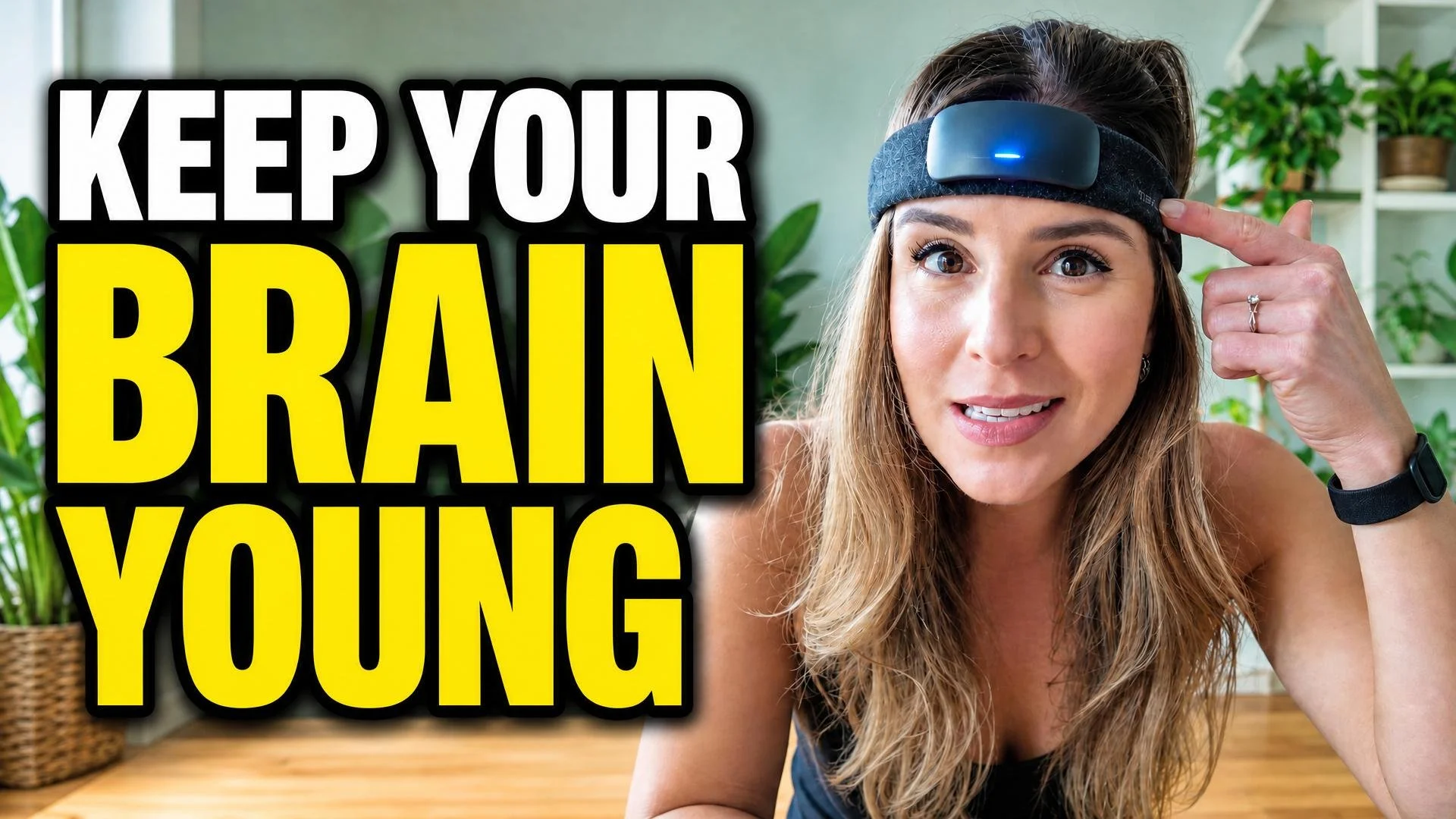
Why Your Wearable Can't See Your Brain
Muse's Chief Marketing Officer, Nadia Kumentas, put it like this: "Brains do not age on a schedule. Two people at fifty can have brains that look years apart, and neither of them would know it."
Neither of them would know. Your knees tell you when they're getting older. So does your recovery after a hard workout. Your brain doesn't send a memo.
I'm seeing people age so differently these days, and it's made me more aware that brain health is worth working on. A healthy body matters. Being able to think well as you get older matters just as much.
I'm not the only one who thinks so. The Alzheimer's Association's 2026 Facts and Figures report found that 99% of US adults over 40 say brain health matters at least as much as physical health. Only 9% say they know a lot about caring for it.
Part of that is a measurement problem. I have my WHOOP for heart rate, HRV and sleep. Reading the brain itself takes EEG, which picks up the brain's electrical activity directly. Measuring my brain the way I already measure my body is why I wanted to try this.
What Is Muse Brain Age?
Brain Age is a feature on the Muse headband that estimates how your brain is aging, based on two inputs.
Your brain activity, recorded during eyes-closed sessions.
Four short cognitive tests: processing speed, spatial memory, impulse control and selective attention.
It's built on a published, peer-reviewed study of more than 5,200 people (Banville et al., 2024, Imaging Neuroscience). A computer model learned what brain activity typically looks like at different ages, then compares yours to that.
One design choice I liked: the brain-activity score and the test score are reported separately. If you get better at the tests just from practice, that never moves your brain-activity reading. As a former data nerd, I appreciated that. Practice effects can't fake it.
How Long Does Muse Brain Age Take? (A Week and a Monday Wait)
You don't get a reading the first time you put the headband on. To get your first one, you need:
At least 10 minutes of eyes-closed sessions on seven different days
All four cognitive tests
The days don't have to be back to back
Then you wait. Readings only come out on Monday mornings. If you finish your seventh day on a Wednesday, you're still waiting until Monday.
I get it. Muse says one rough week shouldn't be able to swing the number, so seven days is the least they'll build a reading on. It's the same reason I tell clients a single blood test is a snapshot in time.
My Guess vs. My Actual Number
Before I opened my first reading, I made a guess. I wanted to know if I can tell how my own brain is doing.
I based my guess on what most of us base it on: thinking speed, memory recall, how easily I find the right word, and how clear my head feels. I also have ADHD, and my attention span isn't great, so I braced for a big number. My guess was that my brain would read about 10 years older than I am.
Then I opened it on camera, no cuts.
My brain came out 1.1 years older than my actual age.
I was pleasantly surprised. I'd expected a lot worse. But a number that's close isn't a number that's done, and there's still some work to do. This is my starting point, and now I get to watch the trend.
One reading is one reading. I'm not going to tell you what's behind it.
What Nobody Can Promise You About Your Number
Once you have a number, the next thing you want is a reason for it. I used to run statistical analysis on research lab data, and that job left me with one rule I can't shake: a single data point can't tell you what caused it.
So I'm not going to tell you that a habit explains my number, good or bad. What I can tell you is which habits have real research behind them for your brain, strongest evidence first. My number is the snapshot. These three are the strategy.
3 Habits With Real Research Behind Them for Brain Health
1. Strength training (the habit with the most proof)
Lifting usually gets filed under body stuff, like muscle and bone. It is that. But of these three habits, it's also the one with the most research behind it for your brain.
Researchers have run trial after trial where one group exercises and the other doesn't, and the exercise groups tend to do better on memory and thinking (Gallardo-Gómez et al., 2022, Ageing Research Reviews). And lifting held up about as well as cardio in that research, so you don't have to be a runner. With my ACL history, that was good news for me.
It isn't magic. The brain benefit is real, but modest, and the reviews don't all agree. I'd still tell you to lift even if your brain weren't part of the picture, because it pays off for the rest of your body.
How to start: Lift twice a week, about 45 minutes. Do one push, one pull and one leg movement (a push-up, a row and a squat), heavy enough that the last couple of reps feel hard. On most other days, get 20 to 45 minutes of cardio at a pace where you can talk but not sing. Then give it a few months. This is a long game.
2. Sleep consistency (you can't feel when you're short)
Sleep is the first thing busy people cut, because it feels like downtime. But your brain is working overnight. Sleep helps lock in what you learned that day, and when you cut it short, your focus and thinking speed take the hit the next day.
The study that gets me: in a sleep lab, people slept six hours a night for two weeks. Their attention kept getting worse, but they didn't feel much sleepier as it went on (Van Dongen et al., 2003, Sleep). They were getting worse and couldn't tell, which is the same problem as judging your brain by feel.
How to start: This week, pick one wake-up time and keep it every day, weekends included. Yes, even Sunday. Your brain likes boring consistency.
Want more on sleep? I've covered it with Muse before, including the 3 things that actually control your sleep.
3. Blood sugar (the brain input most people ignore)
Most people think of blood sugar as a weight thing, or a diabetes thing for later. But your brain runs mostly on glucose, so how well your body handles blood sugar can show up there too.
One large study of adults aged 40 to 70 found that people with diabetes had brains that looked older on scans than people the same age without it (Dove et al., 2024, Diabetes Care, Karolinska Institutet).
It's a link, not proof. But I take it seriously, because blood sugar is one of the most changeable things there is. If you already have diabetes, this is a conversation for your doctor.
The easiest lever is your biggest muscles. When you use them after you eat, they pull sugar out of your blood to use as fuel, so that meal gives you a smaller spike.
How to start: After your biggest meal of the day, go for a 10-minute walk. If a walk isn't doable, do a few minutes of bodyweight squats and calf raises instead. I do mine in my kitchen while my tea steeps. Very glamorous.
Could I Tell? Where Muse Brain Age Falls Short
I guessed about 10 years older and landed 1.1 years older. I'd have bet I could feel how my own brain was doing, and I was way off.
That's why I don't wait to feel something before I work on my lifting, my sleep and my blood sugar.
Where it falls short for me: it shows you whether your brain activity or your tests are pulling your number, but not what in your life is behind it. It's built to be read as a trend, so what I care about is where mine is heading over the next few months, not one number.
It's also a wellness reading, not a medical test. If you're worried about your memory, talk to your doctor.
Who Muse Brain Age Is For (and Who Should Skip It)
Try it if you already track things like HRV, sleep or bloodwork, you change what you do because of them, and you want that same kind of baseline for your brain.
Skip it if:
You want a diagnosis, or a doctor to explain a symptom. This isn't that.
You have more numbers than you act on. This is one more, and data without action is just expensive information.
You aren't going to do anything with a trend.
Your first Brain Age reading is free on a Muse 2, a Muse S or the Muse S Athena. Weekly readings, your full history and the breakdown of what feeds into your number come with Muse Premium. If you want to try it, use my Muse link and code VICTORIADORSANO.
FAQ: Muse Brain Age
What is Muse Brain Age?
Brain Age is a Muse feature that estimates how your brain is aging using your EEG brain activity from eyes-closed sessions plus four short cognitive tests. It's built on a peer-reviewed study of more than 5,200 people. It's a wellness reading, not a medical test.
How do you get your first Muse Brain Age reading?
You need at least 10 minutes of eyes-closed sessions on seven different days, plus all four cognitive tests. The days don't have to be consecutive. Readings are released on Monday mornings.
Which Muse headbands support Brain Age?
Your first Brain Age reading is free on the Muse 2, Muse S and Muse S Athena. Weekly readings, your full history and the breakdown of what's pulling your number up or down come with Muse Premium.
What does Muse Brain Age measure?
Two things, reported separately: brain activity from eyes-closed sessions, and performance on four tests (processing speed, spatial memory, impulse control and selective attention). Keeping them separate means practice on the tests can't change your brain-activity reading.
Is Muse Brain Age a medical test?
No. It's a wellness reading. It can't diagnose anything or explain a symptom. If you're worried about your memory or thinking, talk to your doctor.
Can you lower your brain age with habits?
I can't promise that, and neither can one reading. What I can say is that strength training has the most research behind it for memory and thinking, sleep consistency protects attention, and blood sugar is a changeable factor linked to brain aging. The benefits are real but modest, and a single reading can't tell you what's behind your number.
When the Data Stops Being the Problem
A headband that reads your brainwaves, a WHOOP, a few apps, a folder of biomarker results you haven't acted on. At some point the bottleneck stops being information and starts being what you do with it.
That's exactly the problem my coaching practice exists to solve: turning the pile of data into a small number of habits that actually change how you feel. If that sounds uncomfortably familiar, book a free discovery call here and let's talk.
The Bottom Line
You can't feel your brain aging, which is why I wanted to measure it. Muse Brain Age gives you a baseline from EEG plus four tests, reports the two separately, and makes you wait for a trend instead of a single flashy number. What it can't do is tell you why your number is what it is.
So don't wait for a number to work on the basics. The one action to take this week: lift twice, pick one fixed wake-up time, and walk for 10 minutes after your biggest meal.
Related Articles
Why Can't I Fall Asleep? The 3 Things That Actually Control Your Sleep
Why You Wake Up Groggy After 8 Hours of Sleep (And How to Actually Fix It)
Sponsorship disclosure: This post was sponsored by Muse, who gave me early access to the Brain Age feature. The opinions are my own.
This article contains affiliate links. If you purchase through my links, I may earn a small commission at no extra cost to you. I only recommend products I actually use and that meet my evidence-based quality standards.
This article is for educational purposes and is not a substitute for professional medical advice. Brain Age is a wellness reading, not a medical test. I am a health coach, not a physician. Consult your healthcare provider before making changes to your diet, exercise, sleep, or supplement routine, especially with existing conditions or medications. If you have diabetes, talk to your doctor about blood sugar strategies.