The short answer: to train for the Tour du Mont Blanc, build leg and hip strength first, then train the downhills on purpose, then practice hiking on back-to-back days with your daypack. Most people prepare for the climbs, but the long descents are what leave legs sore and shaky. Twelve weeks of steady, progressive training is enough for most healthy adults who can already walk for a few hours.
I'm Victoria Dorsano, founder of Be Victorious Coaching. Our team of coaches and a registered dietitian works with busy professionals and former athletes, and next June a small group of us is hiking the Tour du Mont Blanc together. So this Travel Tuesday, we're splitting the work: our team covers how to get your body ready, and my friend Alicia Case of Case & Points covers how to book a trip like this with points.
The training lines up with the Longevity Blueprint, our four-pillar framework: strength, metabolic health, recovery, and resilience & mobility. A hiking trip is a great reason to train, and the strength you build for it doesn't expire when you fly home.
How hard is the Tour du Mont Blanc?
The Tour du Mont Blanc is a moderately hard hike that most healthy, prepared adults can enjoy. The challenge isn't any single day. It's doing long days on uneven ground several days in a row, with big climbs and even bigger descents.
Here's what our version of the trip involves (June 21–28, 2027):
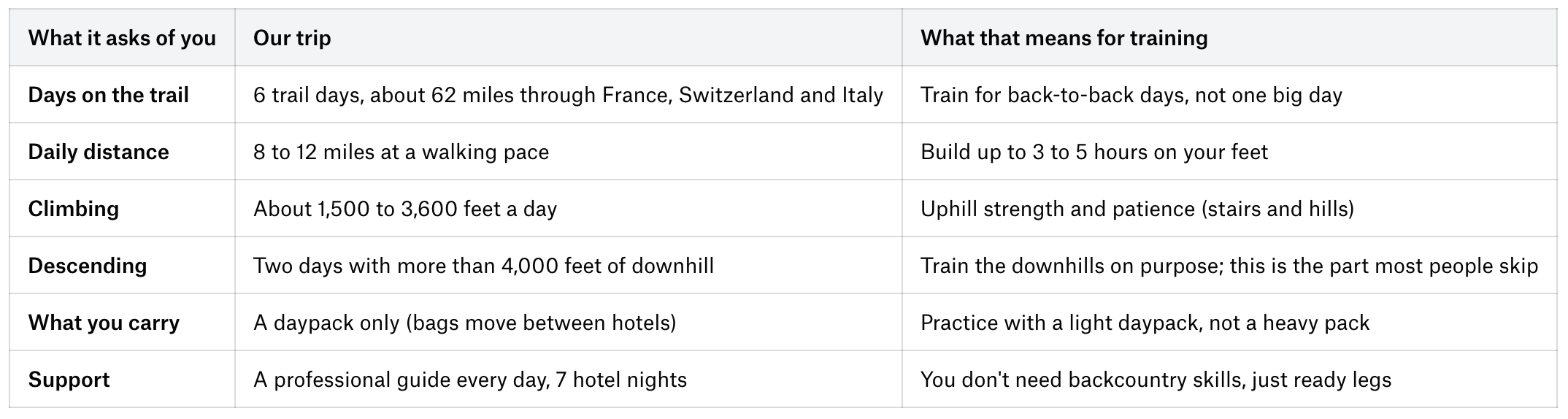
You don't need to be an athlete. You need legs that say yes two days in a row.
Why is downhill hiking harder on your legs than uphill?
Downhill hiking is harder on your legs because your thigh muscles work as brakes while they lengthen, which is called eccentric work. That kind of work causes more muscle damage and soreness than climbing, and it also raises the load on your knees and hips.
Going up is mostly lungs and patience. Going down is where the front of your thighs does the heavy lifting, one controlled step at a time. In a lab study of sloped walking, Alexander and Schwameder (2016) found that walking downhill significantly increased hip, tibiofemoral and patellofemoral (kneecap) joint compression forces compared with level walking.
That's why people come home from a big mountain day saying their knees hurt, even when the climb felt fine. The climbs get the photos, and the descents get the complaints.
What that means for you: downhill training belongs in your plan from the start, not as an afterthought in the last two weeks.
Can you train your legs for long descents?
Yes. Muscles adapt to downhill work quickly, and even a small dose of downhill walking ahead of time can reduce the soreness and strength loss from a long descent later. Researchers call this the repeated bout effect.
The repeated bout effect means a muscle that has done a bout of eccentric work is better protected the next time it does similar work (Hyldahl, Chen and Nosaka, 2017). Three studies make this concrete for hikers:
A little goes a long way. In Maeo and colleagues (2017), people who did just 5 minutes of downhill walking a week before a 40-minute downhill walk had 47% to 64% less strength loss, muscle damage and soreness afterward. Five minutes of level walking didn't help. The authors concluded that a small volume of downhill walking is crucial preparation for trekking.
The protection lasts at least two weeks. In two studies from the same French research group, people did two identical bouts of loaded downhill walking two weeks apart. After the second bout, strength recovered faster and markers of muscle damage rose less (Chalchat and colleagues, 2023), and the second bout also felt easier, with a lower heart rate and lower energy cost (Chalchat and colleagues, 2024).
What that means for you: start with short, easy descents early, and build them gradually. You're not trying to wreck your legs in training. You're teaching them what June will ask for.
The honest limit: these were small lab studies, mostly in young, healthy adults walking on a steep treadmill. The effect is well established, but how much it carries over to a week in the Alps hasn't been measured directly.
Do trekking poles actually help on descents?
Yes. Trekking poles reduce the load on your knees going downhill and reduce muscle damage and soreness after a mountain hike. They're one of the simplest things you can bring.
Schwameder and colleagues (1999) found that using hiking poles on a steep downhill reduced peak and average knee joint forces by about 12% to 25%.
In a real mountain hike up and down Snowdon with a daypack, Howatson and colleagues (2011) found the group using trekking poles kept more of their leg strength in the two days after, with less soreness and lower muscle-damage markers than the group without poles.
What that means for you: get your poles early and train with them, so they feel normal long before the trip. Poles you've never used are just something else to carry.
What strength training is best for hiking?
The best strength training for hiking works the legs and hips through single-leg, step-based movements, plus slow, controlled lowering to prepare for descents. Two or three sessions a week is enough for most people.
The WHO's 2020 physical activity guidelines recommend muscle-strengthening activity on at least two days a week for adults, and the American College of Sports Medicine recommends training each major muscle group two to three days a week. For hiking, we'd point that work at the muscles the trail uses most:
Step-ups onto a box or bench: the uphill movement, one leg at a time.
Slow step-downs: stand on a step and lower the other heel to the floor over three or four seconds. This is downhill training you can do at home.
Split squats or reverse lunges: single-leg strength and balance for uneven ground.
Romanian deadlifts or hip hinges: hamstrings and glutes for climbing and for carrying a daypack all day.
Calf raises: for long climbs and ankle control.
If you want more on why strength matters long after the trip, read how to build a body that lasts.
How do you train for hiking several days in a row?
Train for back-to-back days by stacking two hiking or long-walking days on a weekend, then gradually lengthening them. The goal is for day two to feel familiar, not brand new.
One long hike is a nice Saturday. Six in a row is the trip. Most of the soreness research above looks at a single bout, so this part is coaching judgment more than lab data: we build back-to-back days because that's what the trip asks for, and training is most effective when it looks like the thing you're training for (the principle of specificity in the ACSM's resistance training guidelines).
Recovery is the other half. Sleep, enough food (especially protein), and a few minutes of easy mobility after a hike are what let you show up for the next day.
What that means for you: once a month, do a weekend with two longer walks or hikes in a row, with your daypack and poles. Notice how you feel on the second morning. That's your real fitness test.
What does a 12-week Tour du Mont Blanc training plan look like?
A 12-week plan for the Tour du Mont Blanc usually moves through three phases: build strength, add hills and descents, then practice back-to-back hiking days. Here's a general outline. Every booking on our trip includes Trail-Ready, our 12-week prep plan (a $799 value), which builds this out session by session.

If you're working through a knee, hip or back issue, check with your doctor or physical therapist before you start any new training plan, including this one. If you're joining our trip, let us know when you book so we can plan around it.
How do you book a bucket-list hiking trip with points?
Alicia Case of Case & Points, our friend and travel expert, shares her Travel Tuesday tips.
Here are some of my biggest tips to go on more frequent free trips.
Flexible cards. Get a travel credit card with flexible points/miles redemption options that you can transfer to multiple airline programs for when you find the best deal.
Search non-US airlines. Get out of what you default to with US-based airlines and search for points and miles reward flights with international carriers that can often offer superior redemption options. For example, instead of always defaulting to Delta, try searching Air France, KLM or Virgin for partner rewards that come in tens of thousands fewer points. For our annual friends' ski trip, some of our crew booked their roundtrip flights from NYC to Geneva on Delta for 70,000 miles. Not bad, but I can do you one better. With our European sleuthing, we nabbed the same codeshare flight for 21,000 Air France miles. Yup, we cut that itinerary to a third, AKA I could take three trips on Air France to their one on Delta!
Don't default to your credit card's travel portal. So often this feels like the "easy" thing to do since it's tied to your credit card, but it's often one of the least valuable options. Moving your points into the airline's own rewards program can give you options that cost FAR less than what the credit card's reward currency will offer you.
Transfer points from your credit card. Once you find your desired flight on, say, Air France, go into your credit card's point-transfer area and move points from your credit card balance into the airline's points program. This also gives you more flexibility: if you need to cancel your trip with the airline, you'll often get those points back in the airline's rewards balance to use for a future trip.
Search one-way routes, not just roundtrip. One airline may have a great one-way as you head to your destination, and another airline has the better return home. Yup, it's OK to do two one-ways. Having credit cards with the flexibility from tips 1 and 2 means you don't box yourself into roundtrips, and you can book the best points deal for each leg. It also lets you take advantage of a points deal if you only have enough for one leg, helping you save money on the trip overall.
Don't hoard points. You're just leaving value on the table. I see it all the time: folks get decision paralysis over whether to use points for a flight or buy it outright. Meanwhile, trip after trip, they keep using cash because they aren't confident they're "getting it right." And those points are actually losing value year over year as the credit card companies and airlines keep diminishing their value. That's why actually using those points instead of your cash is so important. Imagine what you could do with the cash you saved. You could invest it back into your trip and have more spending money when you're there, save it in a wealth-building account, or even put it toward a class or a coach to benefit your long-term goals. There's so much more runway for what that cash can do when you finally put points and miles to work for you.
Claw back points when the price drops. One of the top reasons I love booking with miles directly with the airline is that if the cost in points/miles goes down, I can often recoup those points/miles back into my mileage account. Once I've purchased a flight with points, I use Google Flights to set up a "Flight Alert" on the flight I've chosen. This way, I get an email when the price changes on that trip. If I see the cash price go down, it often means the points/miles price has too. Then I search for my same flight again with the airline, and boom, if the points price is less, I contact the airline to rebook me at the lower rate and refund the difference in miles. This has worked for me dozens of times and is a stealth way to keep my mileage balances working in my favor!
Alicia's favorite points hack: the same New York to Geneva flight for 21,000 Air France miles instead of 70,000 Delta miles."
Who is this training guide not for?
This guide isn't the right starting point if you have a current injury, a joint replacement, or a heart or lung condition, or if walking for an hour is hard for you right now. In those cases, start with your doctor or physical therapist.
Current knee, hip or back pain: get it assessed first. Downhill training adds load to exactly those joints.
Joint replacements or recent surgery: your surgeon or PT should set your limits.
Heart or lung conditions: get medical clearance before you add hills and long days.
Experienced mountain hikers: you may already have the base. Focus on the back-to-back days and the descents.
Where should you start this week?
Start with one walk that includes a real hill, down as well as up. Notice which direction your legs have more opinions about.
Take that hill walk this weekend.
Add two short strength sessions next week, with slow step-downs in both.
Then start building your long walk by about 15 to 30 minutes every week or two.
FAQ
How long does it take to train for the Tour du Mont Blanc?
Most healthy adults who can already walk for a few hours need about 12 weeks of consistent training. Start earlier if you're new to exercise or coming back from an injury.
How fit do you need to be to hike the Tour du Mont Blanc?
You don't need to be an athlete, but you do need to be able to hike for several hours and then do it again the next day. Our version has 6 trail days of 8 to 12 miles, with about 1,500 to 3,600 feet of climbing a day.
How do I train for a hiking trip if I don't live near mountains?
Use stairs, steep streets, a treadmill on an incline, and slow step-downs at home. Practice going down as well as up, since the descents are what most people underestimate.
Should I use trekking poles on the Tour du Mont Blanc?
Most people should. Studies show poles reduce knee joint forces on descents and reduce muscle soreness and strength loss in the days after a mountain hike. Practice with them before the trip.
What is the Longevity Blueprint?
The Longevity Blueprint is Be Victorious Coaching's four-pillar framework for building a body that lasts: strength, metabolic health, recovery, and resilience & mobility. Training for a hiking trip touches all four.
Can you use points to fly to Europe for a hiking trip?
Yes. Flights to Europe are one of the best uses of airline and credit card points. Alicia Case of Case & Points recommends a card whose points transfer to several airlines, then comparing partner airlines like Air France or KLM, which often cost far fewer points than US carriers for the same route. Award prices change, so compare before you book.
Ready for the Alps?
Next June, a small group of us is hiking the best of the Tour du Mont Blanc: six trail days, a professional guide every day, a real hotel bed every night, and your bag waiting at the next hotel so you only carry a daypack. Every booking includes Trail-Ready, our 12-week prep plan, so your preparation is included from the day you save your spot.
4 more bookings and the Alps are officially on. 7 spots open, small group, June 21–28, 2027. Explore the trip →
The Bottom Line
To train for the Tour du Mont Blanc, or any multi-day hike, build strength first, train the descents early and gradually, practice back-to-back days with your daypack and poles, and protect your recovery. The research on downhill walking is clear that a little preparation goes a long way. The one action: take one walk this weekend with a real hill in it, down as well as up.
Related Articles
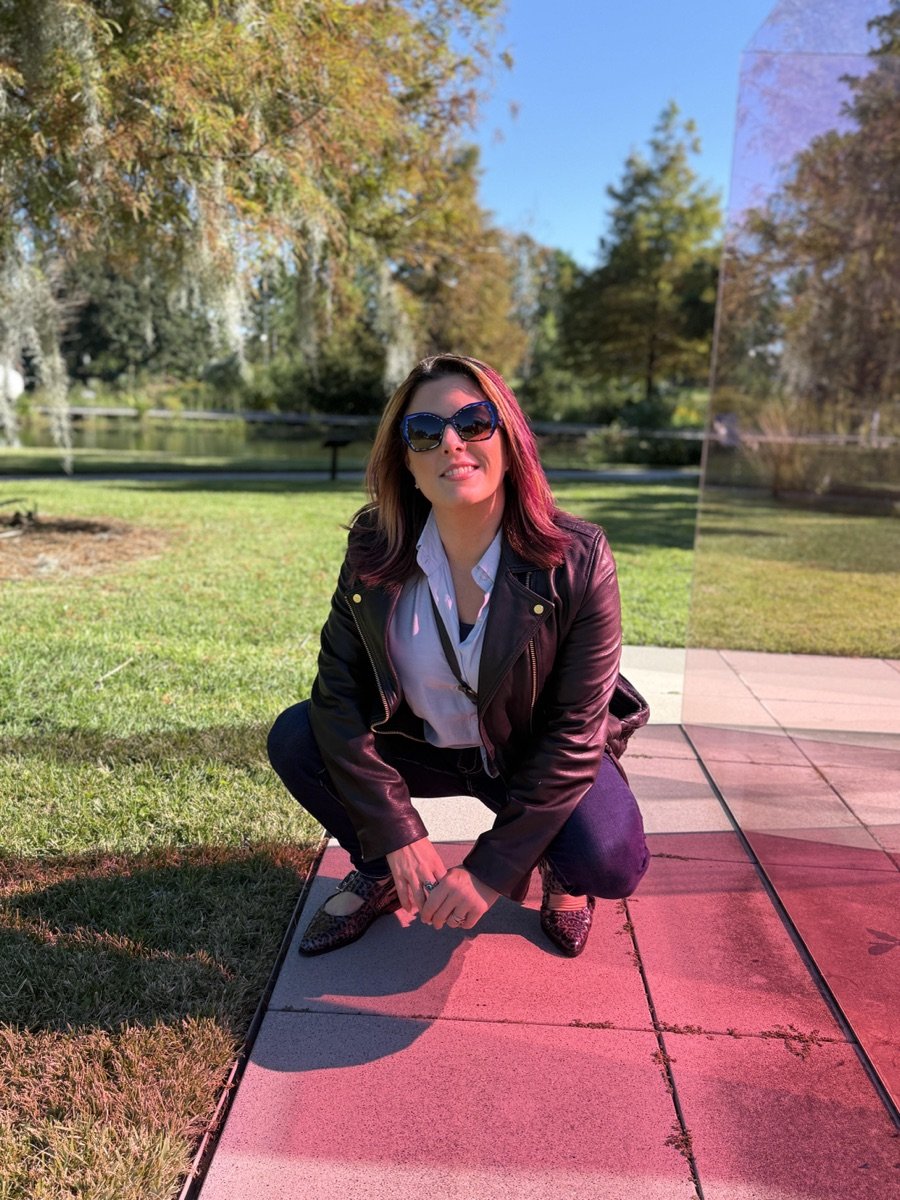
Alicia Case is the founder of Case & Points. After not paying for her last 256 flights and 150 hotel nights, she's saved multiple six figures by hacking travel points and miles programs, and she helps clients make sense of the systems so they can take more trips.
Find her at caseandpoints.com and on Instagram at @caseandpoints.
Sources
Alexander N, Schwameder H. Lower limb joint forces during walking on the level and slopes at different inclinations. Gait & Posture. 2016;45:137-142. PMID 26979896
Hyldahl RD, Chen TC, Nosaka K. Mechanisms and mediators of the skeletal muscle repeated bout effect. Exercise and Sport Sciences Reviews. 2017;45(1):24-33. PMID 27782911
Maeo S, Yamamoto M, Kanehisa H, Nosaka K. Prevention of downhill walking-induced muscle damage by non-damaging downhill walking. PLoS One. 2017;12(3):e0173909. PMID 28288187
Chalchat E, et al. Circulating microRNA levels after exercise-induced muscle damage and the repeated bout effect. American Journal of Physiology: Regulatory, Integrative and Comparative Physiology. 2023;324(1):R58-R69. PMID 36374177
Chalchat E, et al. Neuromuscular and metabolic responses during repeated bouts of loaded downhill walking. Medicine & Science in Sports & Exercise. 2024;56(2):277-286. PMID 37703332
Schwameder H, et al. Knee joint forces during downhill walking with hiking poles. Journal of Sports Sciences. 1999;17(12):969-978. PMID 10622357
Howatson G, et al. Trekking poles reduce exercise-induced muscle injury during mountain walking. Medicine & Science in Sports & Exercise. 2011;43(1):140-145. PMID 20473229
Bull FC, et al. World Health Organization 2020 guidelines on physical activity and sedentary behaviour. British Journal of Sports Medicine. 2020;54(24):1451-1462. PMID 33239350
Garber CE, et al. American College of Sports Medicine position stand: quantity and quality of exercise for developing and maintaining cardiorespiratory, musculoskeletal, and neuromotor fitness in apparently healthy adults. Medicine & Science in Sports & Exercise. 2011;43(7):1334-1359. PMID 21694556
Kraemer WJ, et al. American College of Sports Medicine position stand: progression models in resistance training for healthy adults. Medicine & Science in Sports & Exercise. 2002;34(2):364-380. PMID 11828249