You're Using Red Light Therapy Wrong (Dose, Distance & Timing)
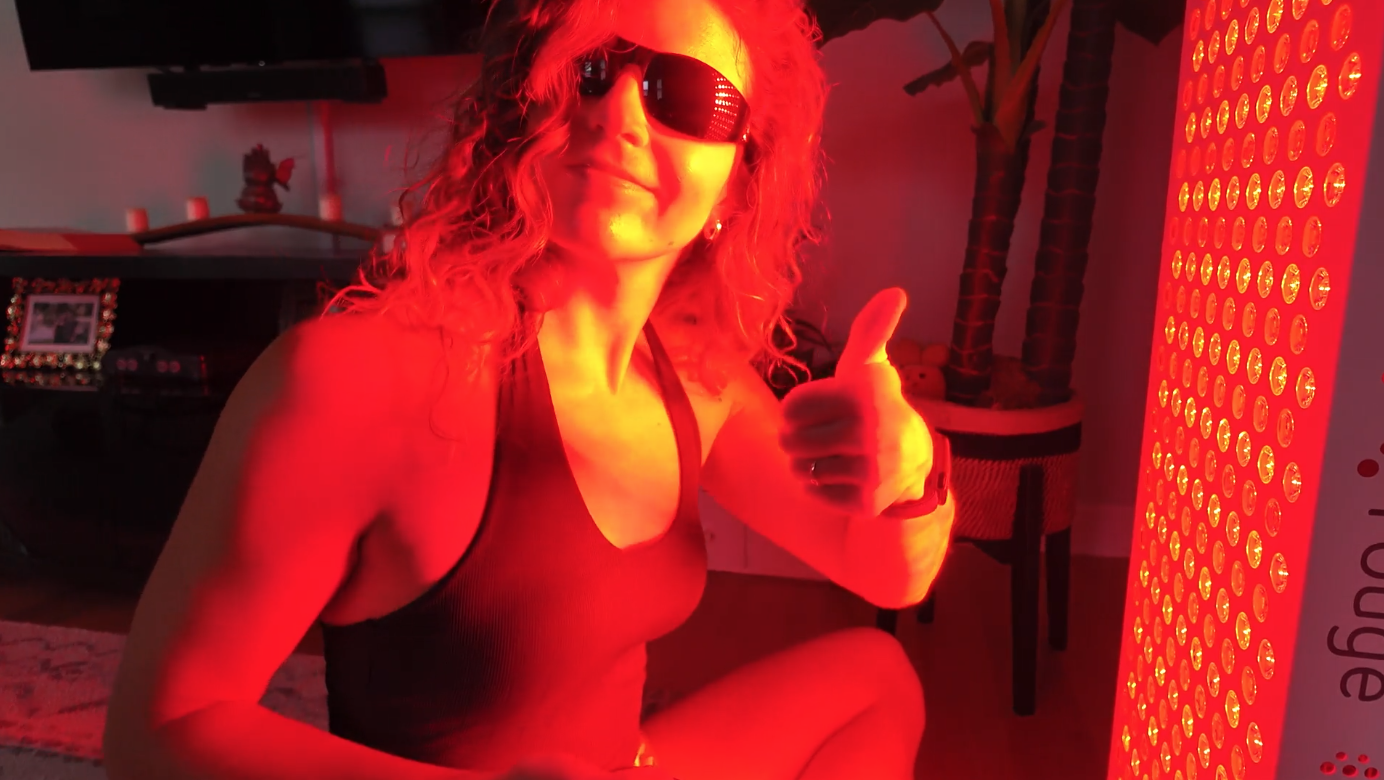
This blog is based on a video from my YouTube channel. Prefer to watch? Click here.
This post is a paid partnership with Rouge Care, who make the panel I used throughout. They also reviewed the script and corrected two of my claims — more on that below. All opinions are my own, and I kept the honest limitations in.
If you're standing a few feet back from your red light panel scrolling your phone, you're probably not getting the benefits you think you are.
And if you've gone the other way — 45-minute sessions, because more has to be better — that's not it either. That one might actually be working against you.
This is how most people use one of these. It's also why most people quietly decide it doesn't work and let the thing collect dust.
Three variables decide whether red light therapy does anything at all: dose, distance, and timing. Get them roughly right and it's a legitimate recovery tool. Get them wrong and you're just standing near an expensive lamp. Here's how to use red light therapy properly at home — including the two things that surprised me most.
Dose: it's a dose, not a lightbulb
Here's what almost nobody applies to red light: it's a dose. And doses don't work in a straight line.
Red light follows what's called a biphasic dose-response curve — a technical way of saying it's shaped like an upside-down U. Too little does nothing. There's a window in the middle where it works. And past that window, more light stops helping and can start to blunt the very healing response you were trying to trigger.
That's not exotic. Training load works that way. Sodium works that way. Most supplements work that way. The difference is nobody thinks about light as something you could overdo — but you can. You won't hurt yourself. You'll just undo your own work.
The unit that matters is joules per square centimetre (J/cm²) — energy delivered per area of tissue. Most research showing benefit for surface-level stuff (skin, superficial tissue) lands around 3–15 J/cm². Go after something deeper — a muscle, a joint, a tendon — and you need considerably more at the skin, because most of the light never makes it down there.
And here's what people mix up constantly:
Panel size changes how much of your body you're treating. Panel intensity changes how long it takes to get there. Two completely different things — and it's intensity you need to look up. A bigger panel doesn't deliver more to any one spot; it delivers the same to more of you at once.
Which means if you picked your session length off a random blog or YouTube video, you picked it for someone else's panel. Your manufacturer's numbers exist for exactly this reason — they've done the translation for their specific hardware.
The Pro G4 I used is a decent example: skin is a 10-minute preset on four wavelengths at 80%; muscle recovery and joint pain are 20 minutes on all eight wavelengths at full output. Bigger dose for the deeper target. Its manual also caps you at 20 minutes in any 6-hour window — and credit where it's due, that's them telling you overusing can wipe out your results just like underusing.
Translation for you: find your device's recommendations, start at the low end, and build up gradually. It varies person to person anyway — skin tone, tissue density, and how inflamed you are all change absorption. There's no universal number, and anyone selling you red light as a precision science is overselling it. Getting it roughly right is enough, same as a workout.
Distance: a targeting dial, not a strength dial
This is the one that surprised me most.
Most people assume standing further back means getting dramatically less light. That's how a lightbulb works — and a panel is not a lightbulb.
The Pro G4 puts out about 81 mW/cm² at 6 inches. Back up to two feet and it only drops to about 65. Four times the distance, and you lose roughly 20%.
Here's why. A bulb throws light from one tiny point, so it collapses fast (the inverse-square law you half-remember from school). A large panel is three feet of light — stand close and you're not near a point source, you're standing in front of a wall. Back up a foot and you're still inside that wall.
So if distance isn't really a strength dial, what is it? It's a targeting dial. What changes as you move isn't so much how much light you get — it's what that light reaches and how much of you it covers:
Distance, What it's for, Why
~6 inches | Deep tissue — muscle, joints, tendons | Concentrates a higher dose on a smaller area so enough reaches deep
10–12 inches | General-purpose session | Biggest net: decent depth and decent coverage
8–20 inches | Skin | Skin only needs a few J/cm², easily cleared while covering your whole body
Past ~20 inches you're drifting out of the useful range. So pick your distance for the result you actually want — not because closer is "stronger" (it isn't, particularly), but because closer is deeper and further is broader.
Then, whatever you pick, be able to repeat it.
I set my stand height once and put tape on the floor. Same spot, every session. Because if you're 8 inches away Monday and three feet away Thursday, you're not running a protocol — you're just standing near a light.
Timing: there is no magic hour
This is where I think most people optimize the wrong thing entirely.
Everyone asks: morning or night? Honest answer — nobody knows, because nobody's tested it head to head. I went looking for a study that directly compares morning, afternoon, and evening red light and couldn't find one. What we have instead is a handful of trials that each picked a window and measured something different:
One controlled trial ran mid-morning sessions for four weeks. People reported better mood and less drowsiness — but only at the highest dose, and only in winter. No effect on sleep or circadian rhythm (Giménez et al., 2022, Biology).
Another ran sessions before bed. People reported falling asleep faster — but when researchers actually measured sleep, there was no difference from the sham group (Kennedy et al., 2023, J Clin Sleep Med).
So morning might help mood in winter. Evening might help how you feel about your sleep. Neither's been tested against the other — which makes the clock a distraction.
The variable that actually has evidence behind it is frequency. A few sessions a week, sustained over weeks, beats a perfectly-timed session you do four times and abandon. So the ideal timing is simply the time you'll actually keep. That's the whole strategy.
The one real exception
These panels are genuinely bright, and bright light is alerting regardless of colour. Red light doesn't suppress melatonin the way a screen does — that part holds up — but if you stare into an intense light source right before bed, the brightness alone can disrupt your sleep. Wear the goggles, don't look directly into it, and if you use it late, actually check whether your sleep improves. Test it on yourself.
And if your real goal is your circadian rhythm
Red light isn't the tool. Your body clock is set by receptors in your eyes that respond to blue wavelengths (~480 nm). Red sits well outside that. Bright daylight in your eyes in the morning — or a daylight lamp if you live somewhere dark — is the intervention with real evidence. That's a daylight problem, not a red light problem.
What red light therapy won't fix
Getting all three right still doesn't make it do things it can't do.
It won't heal a complete tear or replace surgery. It won't reverse structural joint degeneration — it may take the edge off, but it isn't rebuilding cartilage. And the big one I see as a coach: it will not fix a mechanical problem. If a joint hurts because of how you're loading it, light is a band-aid. Use it to feel better so you can do the real work — not to skip the real work.
It's an adjunct. It sits on top of loading, sleep, and stress management, and it replaces none of them. If you're weighing devices in the first place, my honest review of the Kineon MOVE+ for joint pain and recovery walks through panels vs. wraps vs. targeted contact devices.
FAQ
How long should a red light therapy session be?
It depends entirely on your panel's intensity, not on a generic number. Find your manufacturer's recommendation, start at the low end (often 1–2 minutes building up), and don't exceed their stated cap. For many panels, deeper-target sessions run around 10–20 minutes. More is not better.
How far should I stand from a red light panel?
Around 6 inches for deep tissue (muscle, joints, tendons), 10–12 inches for a general session, and 18–20 inches if you're mainly after skin benefits. With a large panel, intensity barely drops across that range — distance mostly changes what you're targeting, not how "strong" it is.
Is more red light therapy better?
No. Red light follows a biphasic dose-response curve: too little does nothing, there's an effective window, and past it more light stops helping and can blunt the response. Start low and build up rather than maxing out session length.
When is the best time of day for red light therapy?
There's no proven best time — no study directly compares morning vs. evening. Frequency and consistency matter more than the clock. The one rule: don't stare into a bright panel right before bed, since the brightness itself can be alerting.
Does red light therapy actually work?
For surface tissue and some tendon and muscle-recovery uses, the evidence is reasonable when dose and distance are right. It is not a cure for structural damage, complete tears, or a mechanical loading problem. Treat it as an adjunct to training, sleep, and stress — not a replacement.
What does J/cm² mean for red light therapy?
Joules per square centimetre is the dose — energy delivered per area of tissue. Surface goals need roughly 3–15 J/cm²; deeper tissue needs more at the skin because most light never reaches depth. It's the number that actually determines results, and it's why session length is panel-specific.
If this sounds uncomfortably familiar…
If you've got a nagging injury, a panel, a couple of recovery gadgets, and no real system tying them together — that scattered, hack-of-the-week approach is exactly what I help clients replace with something that actually works for their body and their schedule. If you want a second set of (evidence-based) eyes on it, [book a free discovery call here](https://geni.us/bvc-book-a-call).
The Bottom Line
Three rules. Dose — it's a dose, not a lightbulb; find your device's number, start low, build up. Distance — a targeting dial, not a strength dial; close for deep tissue, 10–12 inches for general use, further back for skin, and keep it consistent. Timing — there's no magic hour; frequency beats clock time, just don't stare into it before bed.
If you do one thing today: pick your distance, mark the spot on the floor, and commit to a frequency you'll actually keep. The panel I used throughout is the Rouge Pro G4.
Related Articles
This article contains affiliate links and reflects a paid partnership with Rouge Care. If you purchase through my links, I may earn a small commission at no extra cost to you. I only recommend products I actually use and that meet my evidence-based quality standards. All opinions are my own.
This article is for educational purposes and is not a substitute for professional medical advice. I am a health coach, not a physician. Consult your healthcare provider before making changes to your diet, exercise, or supplement routine — especially with existing conditions or medications.