The Mental Side of ACL Recovery: 5 Blocks That Stall Progress (And How to Break Them)
This blog is based on a video from my YouTube channel. Prefer to watch? Click here.
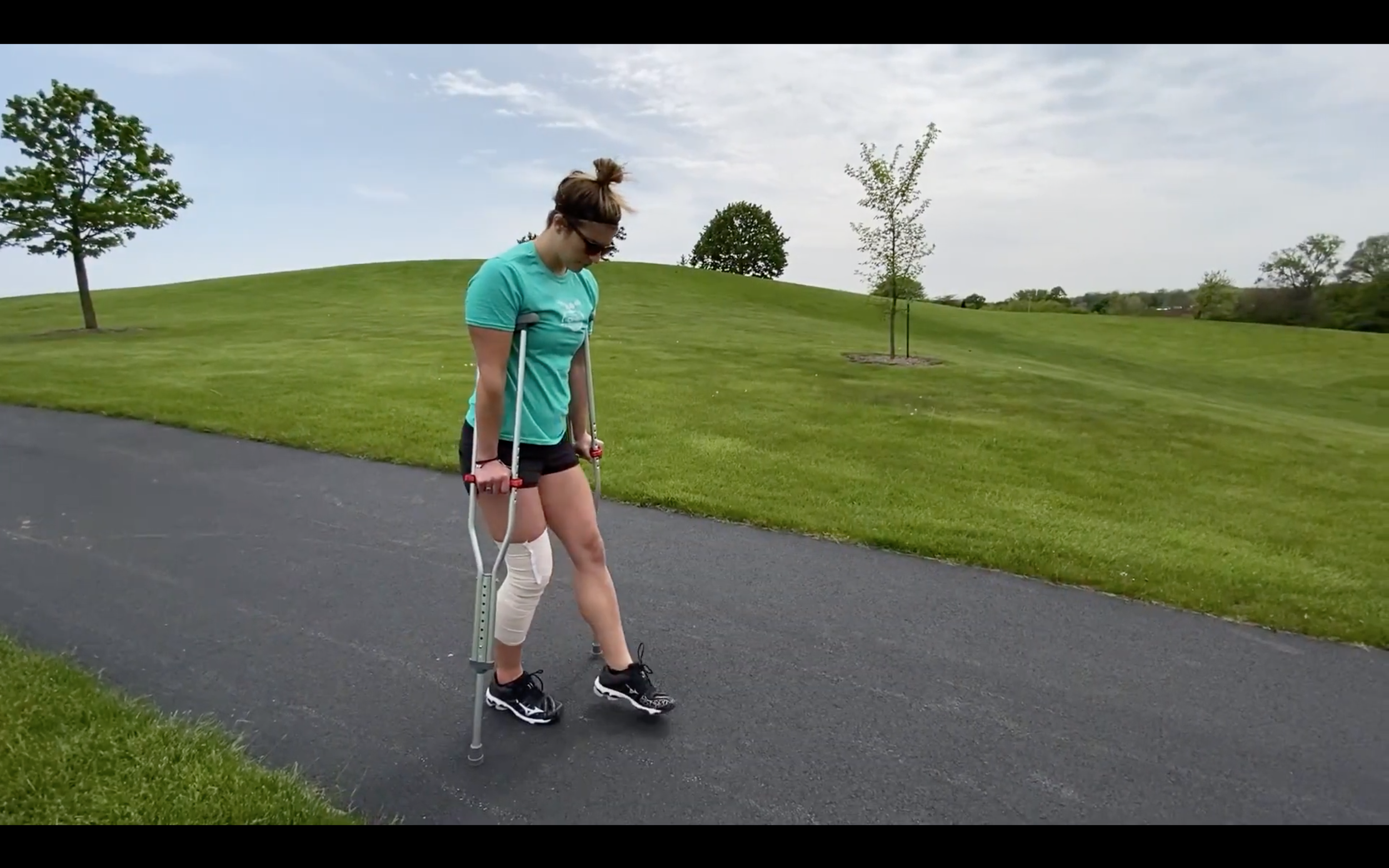
At six months post-op, my surgeon cleared me for most activities again. Strength numbers good. Range of motion good. On paper, I was ahead of schedule.
And that was the hardest month of my entire recovery.
Because nobody prepares you for the part of ACL surgery recovery that isn't your knee. The FOMO watching everyone else play. The fear that shows up the first time you try to cut. The anger. The grief, honestly.
So here are the five mental blocks that stall ACL recoveries, what the research actually says about each one, and the specific counter-move I use with clients. Block five is the one almost nobody sees coming, and it usually hits after you've been cleared.
Quick disclaimer: I'm a certified health coach, not your doctor or your therapist. Talk to your care team about your specific situation.
Why the mental side of ACL recovery actually matters
Isn't ACL recovery just physical? No. And this is what I wish someone had told me at week one.
Start with the return-to-sport numbers. In the largest review of its kind — [Ardern and colleagues, British Journal of Sports Medicine, 2014], pooling 69 studies and 7,556 people — 81% returned to some kind of sport, but only 65% got back to their pre-injury level and 55% returned to competitive sport.
So roughly a third of people who have the surgery never play at the level they used to. And when [the same group looked at why in 2011], across 5,770 participants, they found something uncomfortable: around 90% had normal or near-normal knee function on objective testing. Fear of re-injury was the single most commonly cited reason for cutting back or stopping.
The knee was fine. The person wasn't.
Here's the study that makes this concrete. [Xiao and colleagues, American Journal of Sports Medicine, 2022], pooled 16 studies and 3,744 patients. Athletes who returned to sport scored dramatically higher on psychological readiness (a 20.8-point gap on the ACL-RSI scale) and lower on fear of movement — despite having clinically similar knee function scores to the people who didn't return.
Same knees. Different heads. Different outcomes.
Translation for you: rehab builds the engine. If nobody's touching the brakes, the car doesn't move no matter how good the engine is. Most ACL programs are all engine, no brakes.
Block 1 — The comparison trap
You're eleven weeks out. Someone in an ACL Facebook group is jogging at eleven weeks. You are not. And suddenly you're convinced you're behind.
Here's the truth: graft type, meniscus involvement, quad tendon versus hamstring versus patellar, your pre-surgery strength, your age, your sex, any additional procedures — all of it changes your timeline. Comparing your week eleven to a stranger's week eleven is comparing two different surgeries.
The evidence backs how much spread there is. Return-to-sport rates range from around 69% in female athletes to 83% in elite athletes, and average time to return ranges from roughly 6 to 13 months depending on the population studied. There is no single correct timeline.
The counter-move: pick three markers that are yours and only ever compare to your own numbers from four weeks ago. Write them down.
That's your scoreboard. Nobody else's. Ask your PT which three markers matter most for your specific graft and stage — the three above are a starting point, not a prescription.
Block 2 — Fear that doesn't respond to logic
This one blindsided me. I knew my graft was strong. I had the data. And the first time I tried to plant and cut, my whole body said absolutely not.
That’s not weakness and it's not you being dramatic. There's a name for it — kinesiophobia, fear of movement — and it's one of the most studied psychological factors in ACL rehab. Your nervous system is doing exactly what it's built to do after a traumatic injury. It's protecting you.
It also isn't random. [Meierbachtol and colleagues, 2020], asked 33 post-op athletes to name the specific task that scared them most. Cutting came first, followed by contact and jumping. If cutting is your wall, you are the rule, not the exception.
And this fear is worth taking seriously for physical reasons, not just emotional ones. In a pilot study of 40 athletes, [Paterno and colleagues, Sports Health, 2017] found that people with higher fear scores at return-to-sport were more likely to have asymmetric hop performance and lower quad strength — and those scoring 19 or above on the Tampa Scale were substantially more likely to suffer a second ACL tear within 24 months. That was a small pilot, so hold the exact numbers loosely. But the direction is consistent with the wider literature: fear and physical output are tangled together.
The counter-move: you don't argue with fear, you outrank it with graduated exposure. Not "just try cutting."
You're giving your nervous system evidence, not arguments. Evidence is the only thing it accepts. Run this progression past your PT before you start — they should own the timing.
Block 3 — The adherence cliff
Weeks one through six, you're a model patient. Every rep. Then around week ten, when it stops being novel and starts being boring, you skip one session. Then two.
Here's where I want to correct something I said in the video. I described ACL rehab adherence as "genuinely poor." Having gone back through the research, that's not quite right, and the real finding is more useful anyway.
[Brewer and colleagues, Rehabilitation Psychology, 2013] tracked 91 post-op patients daily for six weeks. Overall adherence was actually high. What predicted a missed day wasn't personality, optimism, or how much of an athlete someone considered themselves — it was daily mood and stress. People skipped on the days they felt worse.
That's a much better piece of information. It means the fix isn't discipline or motivation. It's designing a program that survives your bad days.
And here's the ugly part nobody mentions: skipping makes you feel guilty, guilt makes you avoid thinking about it, avoidance makes you skip again. It's a loop, and it's driven by exactly the stress-and-mood mechanism the research points at.
The counter-move: shrink the ask until it's stupidly small. Build a "bad day version" of your program before you need it — one exercise, two minutes, written down next to the full program. On a bad day the goal isn't progress. It's not breaking the chain.
The 167 hours nobody helps you with
Here's the thread running through all three of those blocks.
None of them show up in your PT appointment, where you could actually talk them through. They show up at 10pm on a Tuesday when you're scrolling and everyone's playing without you. Or Sunday morning, when the band is right there and you cannot make yourself pick it up.
You see your PT maybe an hour a week. The other 167 hours are where recovery actually happens, and you're in them by yourself.
That gap is the real problem, and it's worth being deliberate about how you fill it. Options that people I work with have used: a therapist or sport psychologist (the gold standard if you can access one), a training partner or teammate who checks in, a written log so the bad days are visible instead of vague, an in-person or online ACL recovery community, and mental-health support apps such as Headspace, Calm, or DAWN. None of those replace a clinician. They're scaffolding for the hours between appointments.
If what you're feeling has tipped past frustration into something heavier — persistent low mood, loss of interest, hopelessness — that deserves proper care, not an app. Post-injury depression is real and it's common. Talk to your doctor. If you're in crisis, call or text 988 (US Suicide & Crisis Lifeline).
Block 4 — The identity gap
If a big part of who you are is "athlete," and you can't be that for nine months, there's a hole where that used to be. Most people try to fill it by white-knuckling through and refusing to acknowledge it. That's grief. It's a normal response to a real loss, and pretending otherwise just makes it louder.
The counter-move — and this is the reframe that changed it for me: an athlete adapts. That's the whole job description. You don't stop being an athlete. It just looks different for a while.
Find the thing you can train, and pick one that gives you something back later:
Swimming — aerobic base and mental focus, almost nothing asked of your knee
Ping pong — hand-eye coordination and reaction time, genuinely useful when you're back on the court
Upper-body strength work — you'll return with a stronger platform than you left with
Breath work — carries directly into managing competition nerves
Film study and the tactical side of your sport — you can get smarter while you heal
You're not filling time. You're building a skill you'll carry back into your main sport. And the athletes I've worked with who stayed physically around their sport during recovery had a dramatically easier time going back to it.
Block 5 — The post-clearance crash
You get cleared. You expect euphoria. Instead you feel… flat. Or anxious. Or weirdly sad.
Here's why. For nine months you had structure — appointments, milestones, someone checking on you, a clear next step. Then someone says "you're good," and all of it disappears in a single afternoon. You lose the scaffolding and the fear at the same time, and you're expected to just go be an athlete again.
The counter-move: build your next phase before you get cleared. Work through this in the month leading up to that appointment:
[ ] A written return-to-sport progression — weeks, not vibes
[ ] A strength maintenance program for after PT ends
[ ] Your next three sessions actually on the calendar
[ ] One person who knows to check in on you at weeks 2, 6, and 12 post-clearance
[ ] A re-test date for your three markers (see Block 1)
[ ] An honest answer to: what am I training for now?
Don't let clearance be the end of the plan. Make it the middle of one.
Three things that don't help
"Just stay positive." Forced positivity doesn't process anything, it buries it. Then it resurfaces at month seven.
"Push through it." In ACL recovery specifically, pushing through pain and fear is how people re-injure. Your fear is sometimes bad data and sometimes good data. Learning the difference is the actual skill.
"Don't compare — but here's where I was at your stage." Comparing timelines is the single most common thing I see wreck someone's confidence. Worth saying twice.
Where the evidence is genuinely messy
I'm not going to pretend this is settled. Two honest caveats:
More confidence isn't automatically better. [Zarzycki and colleagues, 2023] followed 39 female athletes and found that the ones who went on to a second ACL injury had higher psychological readiness scores and met return-to-sport criteria sooner. Small study, one population — but it's a real finding and it cuts against the simple story. Confidence that outruns your tissue is its own risk.
The measurement tools are contested. The Tampa Scale of Kinesiophobia is the most-used fear questionnaire in ACL research, but [a 2026 analysis] argues it was built for pain populations and may not measure re-injury worry well in athletes who aren't in pain. So treat any specific TSK cutoff as a rough signal, not a verdict.
What holds up across all of it: the mental side predicts outcomes independently of knee strength, and almost no rehab program addresses it. That's the part worth acting on.
FAQ
Is the mental side of ACL recovery really that important?
Yes. A 2022 meta-analysis of 3,744 patients found athletes who returned to sport had significantly higher psychological readiness and lower fear of movement than those who didn't — despite clinically similar knee function scores. Psychological readiness predicts return independently of strength.
What is kinesiophobia?
Kinesiophobia is fear of movement — specifically, the fear that loading or moving the joint will cause re-injury. It's one of the most studied psychological factors in ACL rehab, and it doesn't respond to reassurance. You address it with graduated exposure, giving your nervous system evidence rather than arguments.
What percentage of people return to sport after ACL surgery?
Pooling 7,556 people across 69 studies, roughly 81% return to some sport, 65% to their pre-injury level, and 55% to competitive sport. Rates vary widely by age, sex, sport, and competitive level, so treat these as context rather than your personal forecast.
Why do I feel worse after being cleared to return to sport?
Because clearance removes your structure and your fear at the same time. For months you had appointments, milestones, and a clear next step, then it all ends in one afternoon. Building your next phase before clearance day is the most reliable way to prevent that crash.
How do I stay motivated to keep doing my rehab exercises?
Research tracking daily adherence found that missed sessions were predicted by mood and stress, not by personality or motivation. So plan for bad days rather than trying to out-discipline them: write a two-minute "bad day version" of your program and use it. Consistency beats intensity over a nine-month rehab.
Should I see a therapist during ACL recovery?
If you have access, it's the strongest option — especially for persistent low mood, anxiety around returning, or grief about your sport. A health coach or support app can help with structure and the day-to-day, but neither replaces a licensed clinician. If you're in crisis, contact the 988 Suicide & Crisis Lifeline.
If you're doing this alone and it's not working
If you've read this far nodding — cleared on paper, stuck in your head, no real plan for the mental side — that gap is exactly the problem my coaching practice exists to solve. I help athletes build the return-to-sport plan and the scaffolding around it that most rehab programs skip, because I needed both and only got one.
If that's where you are, book a free discovery call and let's talk it through.
The Bottom Line
The hardest part of ACL surgery recovery often isn't the knee. It's the comparison trap, the fear that ignores logic, the adherence cliff, the identity gap, and the post-clearance crash. The research is clear that psychological readiness predicts who gets back to their sport — independently of how strong the knee tests. None of these blocks mean something is wrong with you, and each one has a concrete counter-move.
If you do one thing today: pick your three personal markers and write them down. Your scoreboard, nobody else's.
Related Articles
This article is for educational purposes and is not a substitute for professional medical or mental-health advice. I am a health coach, not a physician or therapist. Consult your healthcare provider before making changes to your rehab, exercise, or recovery routine — especially with existing conditions. If you are in crisis, contact the 988 Suicide & Crisis Lifeline.