I wear a WHOOP nearly 24 hours a day, and we use it with coaching clients every week. So when people ask me whether WHOOP is worth it, they usually expect a yes.
My honest answer is that it depends on something that has nothing to do with the strap: whether anybody is going to do anything with the number.
Your WHOOP knows you slept badly. Your WHOOP knows you're stressed. Now what? If you have an answer to that question, it's a genuinely useful tool. If you don't, it's a very well-designed way to feel bad about Tuesday.
Here's what it measures well, what it doesn't, what it costs, and who I'd tell to skip it.
What WHOOP actually does
WHOOP is a screenless band that tracks your heart rate, heart rate variability (HRV), sleep and activity around the clock. It turns all of that into three daily scores: Strain (how much load you took on), Sleep, and Recovery (how ready your body looks for more).
There's no screen and no notifications, which I love. You also don't buy the device. You buy a membership, and the band comes with it. That's the part that makes people hesitate, so let's get to the honest breakdown.
How accurate is WHOOP?
Better than the skeptics say, and worse than the marketing implies. It depends on what you're asking it to measure.
Heart rate: good. In a study comparing WHOOP to an ECG, heart rate agreement was strong. HRV was less tight, close enough to track trends but noisy enough that small daily changes can be measurement error.
HRV: good, but not the best. A 2025 study in Physiological Reports tracked five wearables against an ECG over 536 nights. WHOOP 4.0 showed moderate accuracy for overnight HRV, Oura's rings came out on top, and Garmin and Polar trailed. One small group of 13 adults is not the final word, but it's a fair reality check.
Total sleep: good. In a 2022 validation of six wearables, 53 adults slept in a lab wearing all of them at once. All six, WHOOP included, were valid for telling when you were asleep and for how long.
Sleep stages: treat them as a guess. That same study found WHOOP matched the lab on specific sleep stages about 60% of the time. It was in the upper half of the group, and the authors still said every device needs to improve here. Wrist wearables estimate your stages from movement and heart rate, because they can't read your brain directly. (More on that in my deep sleep breakdown.)
Translation for you: trust the trends, not the decimal points. Your 30-day HRV pattern means something. Whether you got 58 or 71 minutes of deep sleep last night does not.
What we see with real clients
This is the part the review sites can't tell you.
It catches patterns people can't feel. A lot of our coaching conversations start with a trend the client hadn't noticed, which is exactly what you want a tracker to do.
It isn't always right, and it's fixable more often than you'd think. This fall we had a few clients whose walks were showing up as all-out efforts, with a casual 20-minute walk logged like a hard workout. There's no way a walk got them into zone five. Before you write off the data, tighten the band, move it a little higher above your wrist bone, and clean the sensor with soap and water. If it still looks off, contact WHOOP support, which is what we did.
It doesn't know your context. Recovery will often dip for at least the first couple of days at a new altitude, and a rough night in a hotel will show up too. That doesn't mean something is wrong with you. It means you traveled. The score is a data point, and you're the one who knows what kind of week you've had.
It can backfire. Sleep researchers have a word for getting anxious about your sleep data: orthosomnia. It's not a formal diagnosis, but I've seen the pattern, and I've written about the bigger version of it. If you wake up feeling great, see a low score and suddenly feel terrible, the tracker is working against you.

Does wearing a tracker actually change anything?
Here's the encouraging part. A 2022 umbrella review in The Lancet Digital Health, covering 39 reviews and nearly 164,000 people, found activity trackers led to about 1,800 more steps a day and modest gains in fitness. Effects on things like blood pressure and quality of life were usually small.
That review covered activity trackers in general, not WHOOP in particular. The evidence for WHOOP itself is thinner. One small week-long trial found it improved how people rated their sleep, but total sleep didn't change, and the participants were healthy adults in their mid-20s.
So tracking can nudge behavior, and I'd expect a coach to make it nudge harder, but no study I'd stand behind shows that a recovery score alone makes you healthier. The band gives you information, and the change comes from what you do next.
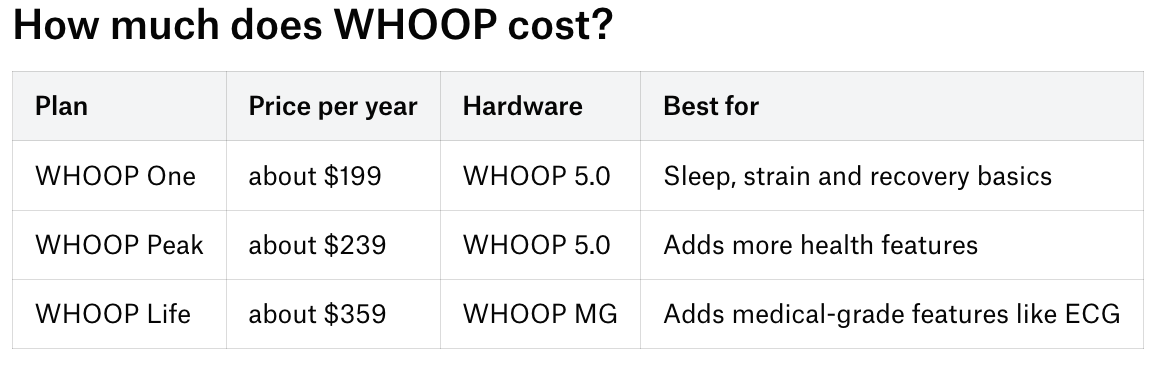
Prices as of November 2026. Check WHOOP's site for current pricing, since it often runs Black Friday deals on multi-year memberships. There's no one-time purchase, so if you cancel, the membership ends.
Worth knowing on the Life tier: WHOOP's ECG feature was cleared by the FDA, but its Blood Pressure Insights feature went through a very public dispute. The FDA sent a warning letter in 2025 and closed it out in June 2026 after WHOOP made changes, which is not the same as FDA clearance. Treat those blood pressure numbers as a wellness trend, and keep using a real cuff if blood pressure matters for you.
WHOOP vs. Oura: which should you get?
The honest answer is that they're close enough that you should pick the one you'll keep wearing.
Pick WHOOP if you train hard, care about strain and recovery, and want daily feedback on how much to push.
Pick an Oura ring if sleep and readiness are your main interest, you don't want a band on your wrist, or you'd rather not pay as much per year after the first purchase.
Who should skip it
You'll only look at it when you already feel bad. Save the money.
You tend to spiral over data. If numbers make you anxious, this will make that worse, and a basic step counter may serve you better.
You've got a medical question. A wearable is not a diagnosis. Snoring, ongoing fatigue, or a heart rhythm concern belong with your doctor.
You aren't sleeping, moving or eating consistently yet. You probably already know what to work on first.
Frequently asked questions
Is WHOOP worth it without a coach?
It can be, if you're willing to look at your trends once a week and change one thing at a time. Most people get the most value when someone helps them interpret the data, because knowing your recovery score and knowing what to do about it are two different skills.
Is WHOOP accurate for sleep?
WHOOP is reliable for how long you slept, and less reliable for sleep stages. In a 2022 lab study, it matched specific stages about 60% of the time. Use total sleep and consistency as your main numbers, and treat deep and REM as rough estimates.
Is WHOOP better than an Apple Watch?
They do different jobs. WHOOP is built around recovery and sleep, with no screen and few distractions. An Apple Watch is a full smartwatch with strong general fitness tracking. If you want recovery coaching data, go with WHOOP. If you want a smartwatch, go with the Apple Watch.
Can you use WHOOP without a subscription?
No. The membership is the product, and the band is included with it. If your membership ends, you lose access to WHOOP's ongoing features, so plan on it as a yearly cost rather than a one-time purchase.
Why is my WHOOP recovery always low?
First check the basics: sleep, alcohol, late meals, stress, illness, travel and altitude. Then check the fit, because a loose band or dirty sensor can throw off readings. If your recovery stays low and you feel unwell, talk to your doctor rather than troubleshooting the app.
If you've got the data but not the follow-through
Maybe you've got a WHOOP on your wrist, a few months of recovery scores, and bloodwork you haven't acted on. You know what the numbers say, and you're still not sure what to change first. That's exactly the problem our coaching practice exists to solve. Our team helps you decide which number matters this month and builds it into your real calendar. Book a call with us here.
The Bottom Line
WHOOP is worth it if you'll use it to make decisions and it won't make you anxious. It's strong on heart rate, sleep duration and long-term trends, and weaker on sleep stages and day-to-day precision. It's not a medical device for most of what it reports, and no score does the work for you.
If you're on the fence, ask yourself one question before you buy: what will I do differently when the number is low? If you've got an answer, start here (the link includes a free month).
Related Articles
This article contains affiliate links. If you purchase through my links, I may earn a small commission at no extra cost to you. I only recommend products I actually use and that meet my evidence-based quality standards.
This article is for educational purposes and is not a substitute for professional medical advice. I am a health coach, not a physician. Consult your healthcare provider before making changes to your diet, exercise, or supplement routine, especially with existing conditions or medications.