Bluevua Ropot Lite Review: I've Used It for Nearly 2 Years. Here's My Honest Take.
This blog is based on a video from my YouTube channel. If you prefer to watch that, click here.
Most product reviews tell you how something works after 30 days. Maybe 60. Then the review cycle moves on and you never find out if anyone actually kept using it.
I bought the Bluevua Ropot Lite countertop reverse osmosis system nearly two years ago — and I'm still using it every single day. So this isn't a first-impression review. This is what actually happens when you use a water filter for the long haul: what holds up, what the real maintenance looks like, and whether the investment is actually worth it.
Short answer: yes, for the right person. But let me show you why.
Why I Went Down the Water Filter Rabbit Hole
This started during COVID. When everything felt out of control, I started focusing hard on the controllables: what I'm breathing, what I'm drinking. I already wrote about my water filter journey — the full arc from pitcher filter to Berkey to eventually landing on reverse osmosis.
But the thing that consistently mattered to me wasn't just better water — it was being able to verify that I actually had better water. I didn't want to rely on hope or marketing. I wanted a measurable outcome.
That's what ultimately pointed me toward reverse osmosis, and specifically toward a unit with a built-in TDS (total dissolved solids) meter so I could see the difference for myself.
What is TDS? Total dissolved solids is a measure of the combined content of all inorganic and organic substances dissolved in water. Tap water in a city like Chicago, for example, can clock in around 170 parts per million (ppm). After running through the Ropot Lite, I consistently see readings of 1-3 ppm. That's the verification I was looking for.
Why Countertop Reverse Osmosis Specifically
Reverse osmosis is the gold standard for water filtration — it filters down to 0.00001 microns and removes things standard pitcher filters simply can't touch: heavy metals, PFAS, microplastics, pharmaceuticals, and other disinfection byproducts from municipal water treatment.
The catch is that most RO systems require under-sink installation or whole-home setups. I rent an apartment. That wasn't happening.
Countertop RO solves that. Plug it in, fill the reservoir, done. No installation, no permanent fixtures, no landlord conversations.
Why Bluevua Specifically
Bluevua isn't trying to be everything. They specialize in countertop reverse osmosis — that's their focus. And the Ropot Lite is NSF/ANSI 58 certified, which is the industry standard for reverse osmosis performance verification.
The features that kept me with this unit:
Built-in TDS meter: see your actual water quality before and after filtration. This was non-negotiable for me. It's one thing to assume the filter is working. It's another to see the number drop from 170 to 1.
Glass carafe: not plastic. After going through all the effort to remove contaminants from your water, pouring it into a plastic container that could leach its own compounds is a fair concern. Glass eliminates that.
Compact design: fits cleanly on a counter without dominating the space. In nearly two years, it's moved around with my kitchen setup and always found a spot.
Portable: it weighs under 10 lbs fully empty. I can pick it up, move it, take it with me. For renters who move periodically, that's not a minor thing.
Remineralization filter: more on this below, but this was important for addressing the "RO strips all minerals" concern.
Nearly 2 Years In: What Still Holds Up
Nothing surprising has gone wrong. The unit still performs exactly as it did on day one — I check the TDS meter regularly and the numbers haven't drifted. The glass carafe has held up with daily use.
Filter changes have been easy. I've gone through one main RO filter replacement (at about the 9-11 month mark, the unit tells you when it's time) and a couple of remineralization filter changes. Both take maybe five minutes and require no priming, no tools, and no confusion.
Real Maintenance Costs After 18-24 Months
Here's what I've actually spent, not what the marketing says you'll spend:
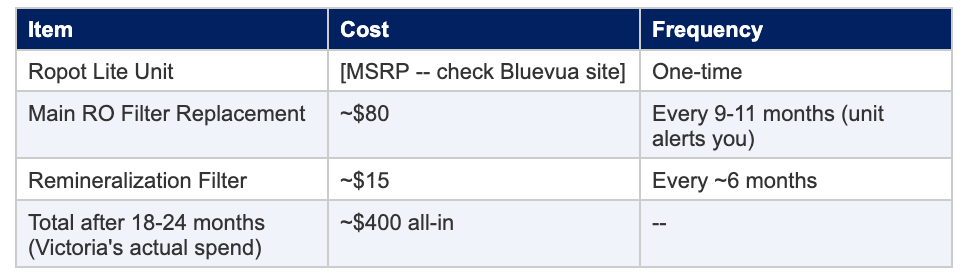
For context: that's not dramatically different from what I was spending on a Berkey, but the water quality is categorically better and the maintenance is far less annoying.
How It Compares: Bluevua Ropot Lite vs. Berkey vs. Pitcher Filter
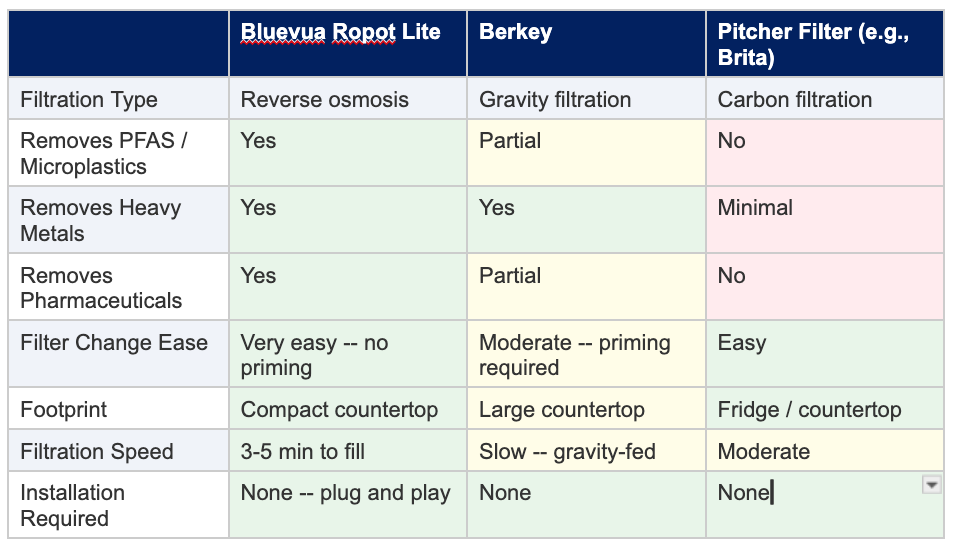
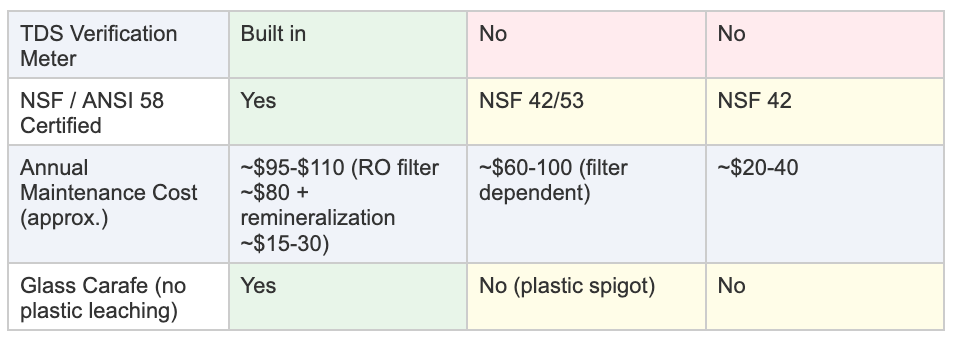
The Berkey served me well for a while. But the gravity filtration is slow, the filter priming process when changing filters was genuinely tedious, and it takes up significantly more counter space. The Ropot Lite is faster (3-5 minutes to fill), smaller, and the filter swap is dramatically simpler.
Pitcher filters like Brita are fine for basic taste improvement. They are not in the same category for comprehensive contaminant removal. If PFAS, microplastics, or pharmaceuticals are concerns, a pitcher isn't solving those.
The Questions I Get Most Often
Does reverse osmosis waste a lot of water?
RO does produce "waste water" — water that doesn't make it through the filtration membrane. But that water isn't unusable. I've mopped floors with it. You can dilute it slightly and water plants with it (if you were already using tap water on your plants, the mineral content in RO waste water is similar). Some people use it to wash their cars. It's not water that has to go straight down the drain.
Is the reservoir heavy to fill?
At about 9 lbs 10 oz when full, it's manageable for most people. If that's a concern — say, you're buying this as a gift for someone elderly, or you have shoulder issues — you can fill it incrementally using a cup or smaller container. Not ideal, but completely workable.
Does reverse osmosis dehydrate you by removing minerals?
This comes up a lot and the short answer is no. The Ropot Lite includes a remineralization filter that adds magnesium, calcium, and zinc back into the water after the RO process strips contaminants. And even without remineralization, the amount of minerals you get from water is minimal compared to what you get from food. Demineralized water doesn't dehydrate you.
Who is this actually for?
Renters and apartment dwellers who want RO-quality water without any installation. People who are serious about comprehensive filtration and want to verify it's working. Anyone who's already tried pitcher filters and knows they're leaving meaningful contaminants behind. Folks who've outgrown the Berkey and want something more compact and less fussy.
Who is it probably not for?
If you're on a tight budget and basic taste improvement is the goal, a pitcher filter will do that more cheaply. If you own your home and want a whole-home solution, an under-sink RO system offers higher flow rates. And if convenience and portability aren't relevant to your situation, there are more powerful stationary options.
On the topic of controlling the controllables...
Water quality is one piece. But figuring out which health investments actually move the needle for your specific situation -- and which are just marketing -- is most of what I do with clients. If you want help cutting through the noise and building a health approach that's sustainable and verifiable, that's exactly the conversation we have on a discovery call.
The Bottom Line
Nearly two years of daily use, two filter cycles, and counting. The Ropot Lite has done exactly what it promised: verifiable, comprehensive water filtration in an apartment-friendly format with minimal maintenance.
If you're ready to actually upgrade your water quality and want something you can verify is working, not just hope is working, this is the unit I've stuck with and would buy again.
You can check it out here: geni.us/bluevua-ropot-lite. Use code VICTORIA15 for 15% off.
This post contains affiliate links. If you purchase through my link, I may earn a small commission at no extra cost to you. All opinions are based on nearly two years of personal use. This content is informational and not a substitute for professional health or medical advice.