5 Science-Backed Exercises to Feel 10 Years Younger (No Stretching Required)
This blog is based on a video on my YouTube channel. If you prefer to watch that, click here.
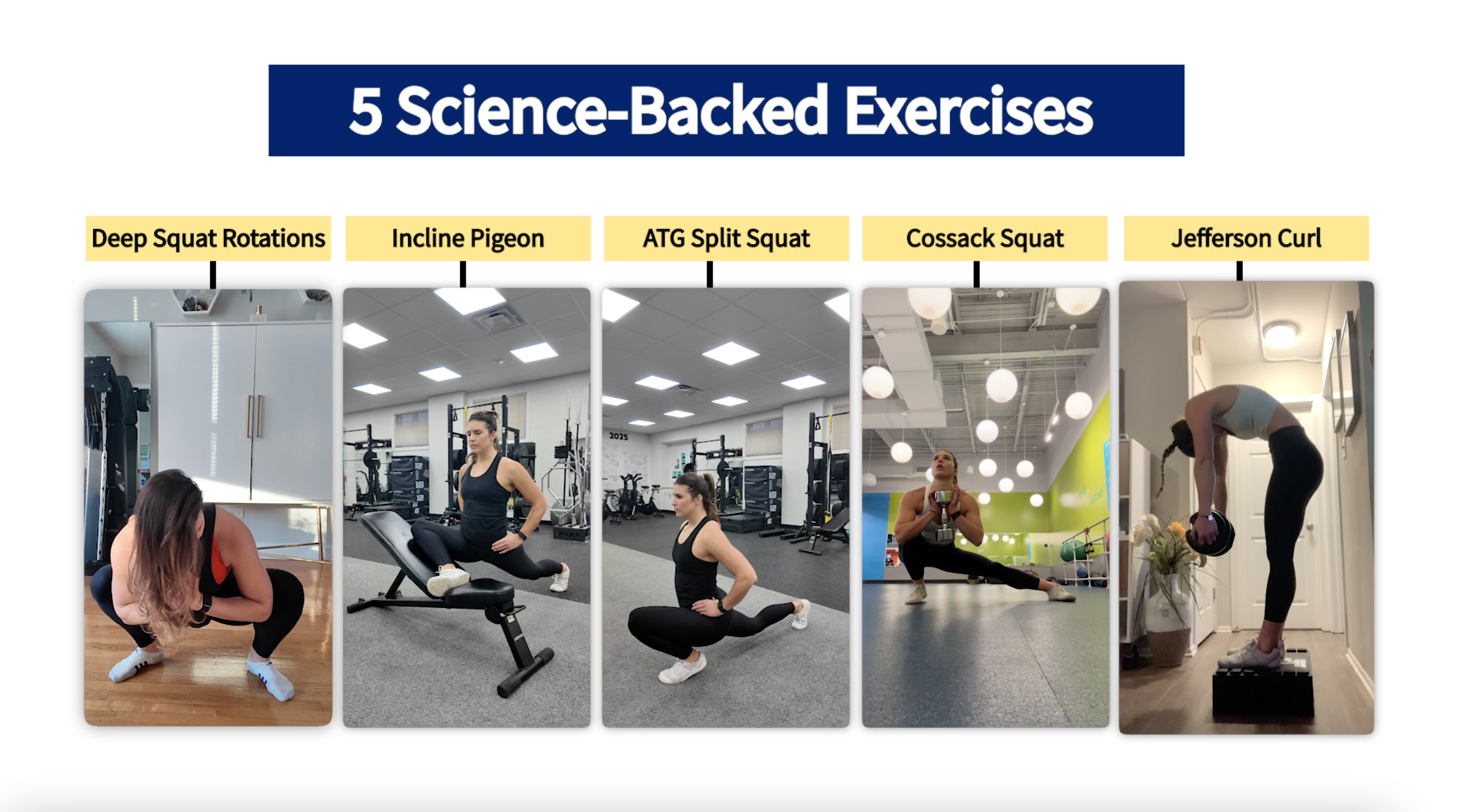
If you feel stiff rolling out of bed in the morning, or your hips lock up after sitting at your desk, or you've lost that springy, athletic feel you used to have...
You probably don't need more stretching.
What you actually need is strength in the ranges you're losing.
That's the difference between passive flexibility (touching your toes for 30 seconds) and functional mobility (controlling your body through full ranges of motion under load).
As a health coach who specializes in athletic performance and ACL recovery, I've seen this pattern repeatedly: People stretch constantly but stay stiff. Meanwhile, athletes who build strength through full ranges stay mobile, explosive, and injury-free for decades.
Today I'm sharing the five science-backed exercises I personally use to stay injury-free and that elite athletes use to maintain mobility and explosiveness as they age.
The secret? Every single one builds strength AND length through ranges of motion your body tends to lose over time.
Why Stretching Alone Isn't Enough
Here's what most people get wrong about mobility:
They think flexibility = mobility.
But flexibility is just passive range of motion—how far someone else can push your leg. Mobility is controlled range of motion—how far you can move yourself with strength and stability.
The research is clear: Building strength through full ranges of motion does more for long-term mobility than passive stretching ever will.
This is why gymnasts and Olympic weightlifters (who move through extreme ranges under heavy load) maintain incredible mobility into their 40s and 50s, while people who just stretch stay tight.
The 5 Exercises That Actually Work
1. Deep Squat Rotations: The Triple-Threat Mobility Move
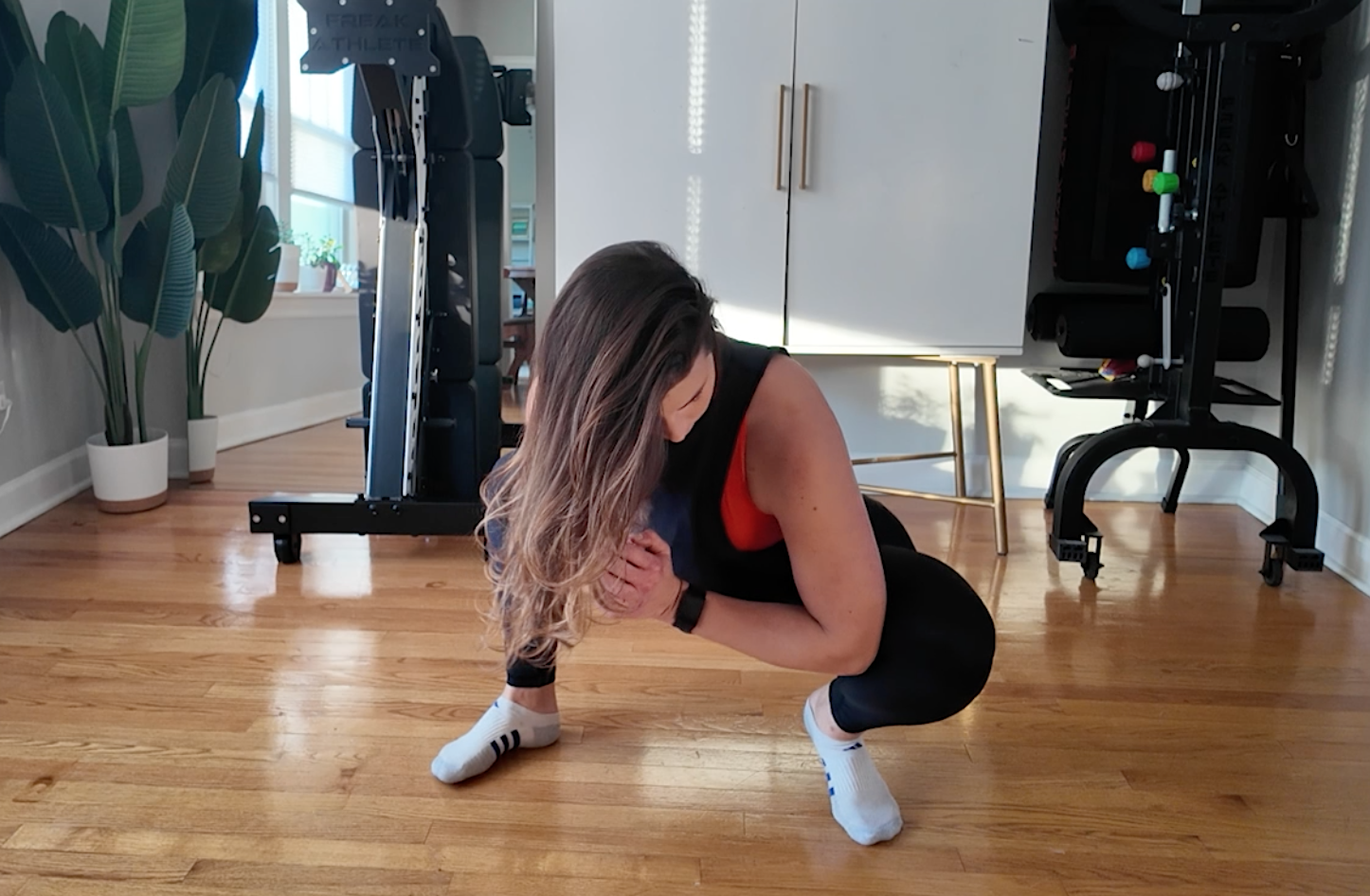
What it hits: Ankles, hips, and thoracic spine (three key areas that lock up from modern life)
Why it matters: Research shows that deep squat ability is one of the greatest predictors of overall mobility and injury risk. If you can't comfortably sit in a deep squat, you're losing fundamental human movement capacity.
How to do it:
Get into a deep squat position (as low as you can go)
Press your hands together at chest height
Dig your elbows into the insides of your knees (this helps widen your stance and open the hips)
Rotate side to side, lifting one heel slightly, then the other
Move slowly and deliberately—this isn't about speed, it's about control
Key points:
Spend 1-2 minutes daily on this
Focus on finding movement that feels good but controlled
Over time, you'll notice greater range of motion in all three areas
Common mistakes:
Rushing through the movement
Forcing range you don't have yet
Holding your breath (breathe naturally throughout)
2. Incline Pigeon: The Sitting Antidote
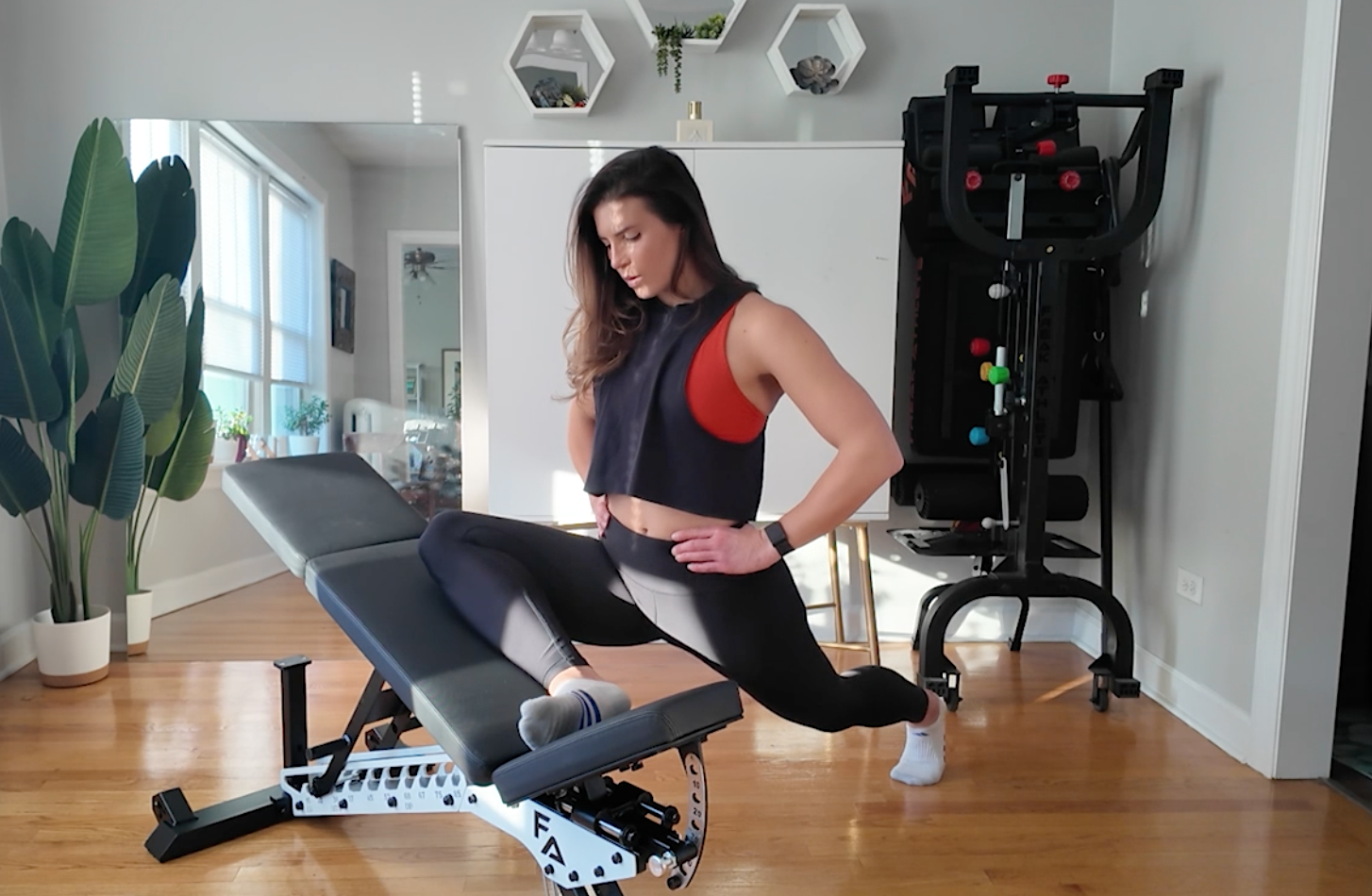
What it hits: Hip external rotation with hip flexion (the exact range that gets destroyed from desk work)
Why it matters: Studies show that improving this specific range reduces knee valgus (that inward knee collapse) during landing—the #1 movement pattern that leads to ACL injuries.
How to do it:
Use a bench or elevated surface
Place your front shin across the bench (parallel to the edge)
Extend your back leg behind you
From this position, you have options:
Gentle slow pulses pushing through the external hip and glute
Leaning forward and coming back up (changing the stretch angle)
Why this version is better than floor pigeon:
The elevation allows you to work through progressive ranges. As you get more mobile, you can lower the surface height. This builds strength through the range, not just passive flexibility.
ATG/Ben Patrick fans: This is a staple in the Knees Over Toes Guy program for good reason. It directly addresses hip dysfunction from sitting.
Programming: 8-10 reps per side, 2-3 sets, 2x/week
3. ATG Split Squat: The Knee-Saving Signature Move
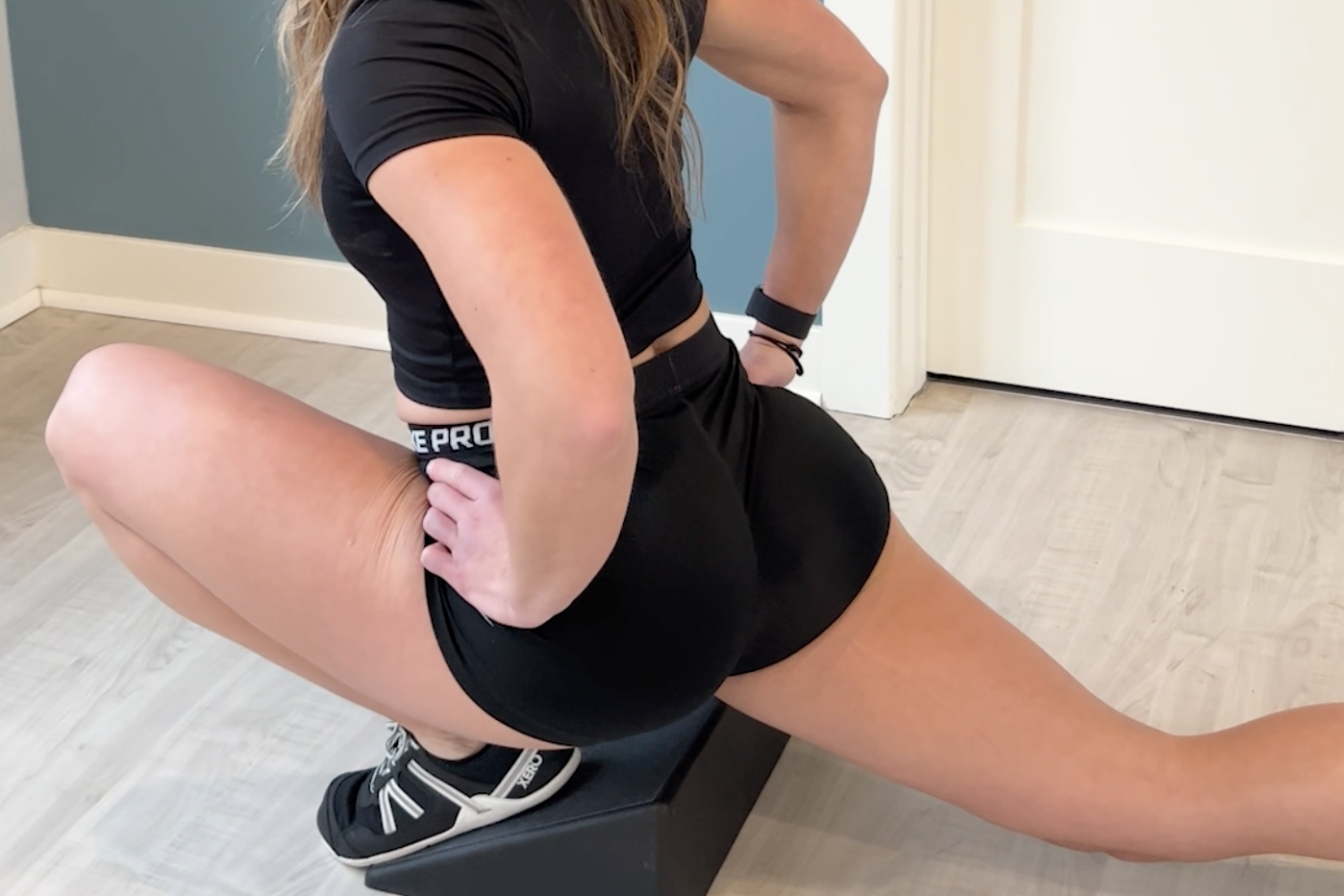
What it hits: Deep knee flexion, ankle mobility, hip flexor lengthening, quad and patellar tendon strength
Why it matters: This is THE exercise I used as a cornerstone during my ACL recovery. It's legendary in the ATG community for knee health, and the research backs it up.
The backstory that matters:
For years, athletes were told "never let your knee go past your toes" during squats or lunges. It was universally accepted as bad—you'd wear down your knees.
Research has completely debunked this.
Modern studies show that training your knee through full flexion (knee WAY over toes) actually strengthens the tissues around the knee, making them more resilient and preventing injury—particularly to the patellar tendon and quad tendon.
How to do it:
Start with your front foot on an elevated surface (box, bench, plates)
Position yourself so when you lower down, your knee goes fully over your toes
The goal: "hamstring-to-calf coverage" (your hamstring and calf fully meet)
Lower yourself slowly and controlled
Come back up and repeat
Progression strategy:
If you're new to this movement, start HIGH. Use a surface that allows you to get the movement pattern without pain or extreme limitation.
Every 2-3 weeks, lower the surface height slightly.
Eventually, you'll work down to the floor—knee fully over toe, hamstring covering calf, full control through the range.
Limiting factors you might encounter:
Hip flexor tightness (back leg)
Ankle mobility (front leg)
Knee tolerance (this is advanced—don't force it)
Programming: 3 sets of 8-12 reps per leg, 2x/week
Real talk: This exercise changed my knee health after ACL surgery. It's not comfortable at first, but the long-term payoff is incredible.
4. Cossack Squat: The Lateral Strength Gap-Filler
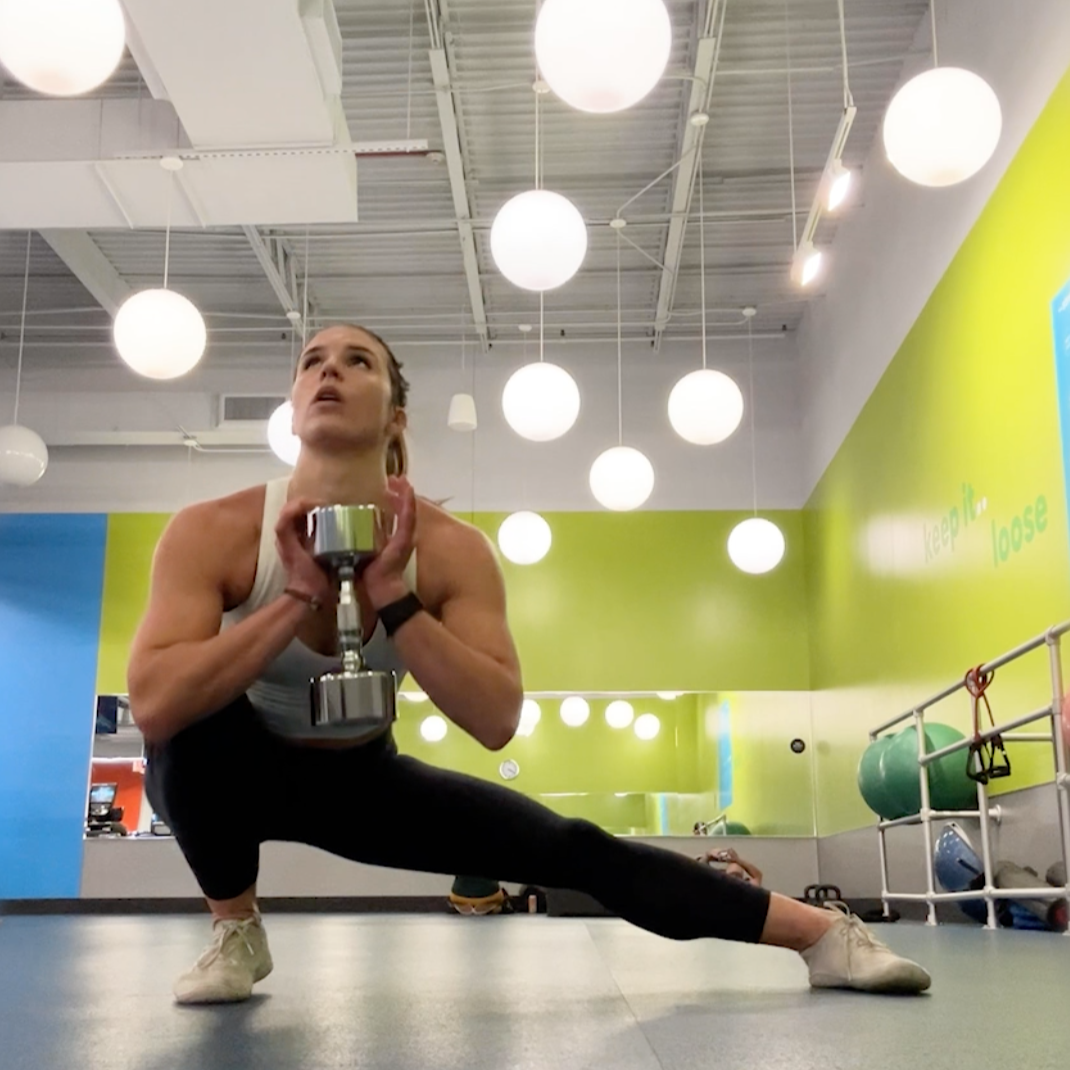
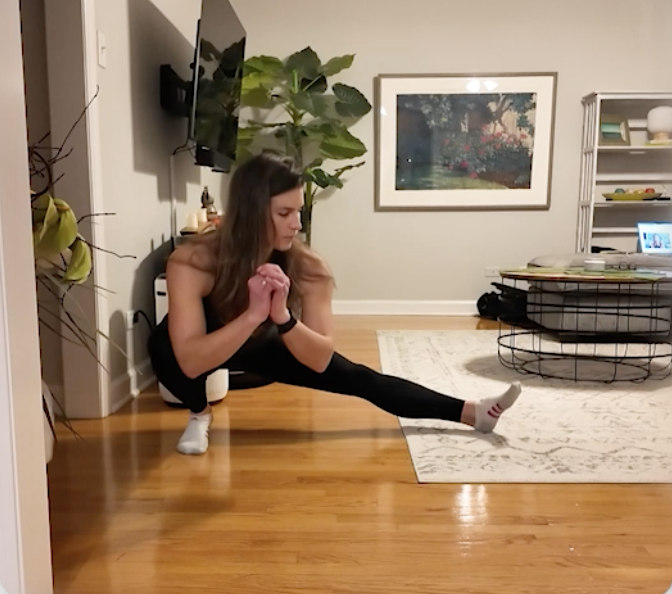
What it hits: Hip adductors (inner thighs), lateral mobility, knee stability in multiple planes
Why it matters: Research shows that athletes with better adductor strength have significantly lower rates of groin and knee injuries. Yet most training programs completely ignore lateral movements.
How to do it:
Take a wide stance (feet much wider than shoulder-width)
Shift your weight to one side, sinking into a deep side lunge
Keep the other leg straight
Alternate sides in a controlled manner
Reality check:
If this is your first time doing Cossack squats, you might realize you have ZERO control in this range of motion.
That's okay. That's exactly why you need to do this now.
Why this matters for real life:
Your adductors are usually weak when loaded at length (stretched position). But this is the EXACT position we put them in when we:
Cut quickly to change direction in sports
Reach down to one side to pick something up
Step laterally quickly to catch your balance
Play with kids on the floor
This isn't just mobility to feel good. It's injury prevention.
Programming: 3 sets of 8-10 per side, 2x/week
5. Jefferson Curl: The Black Sheep of Mobility (And Maybe the Best)
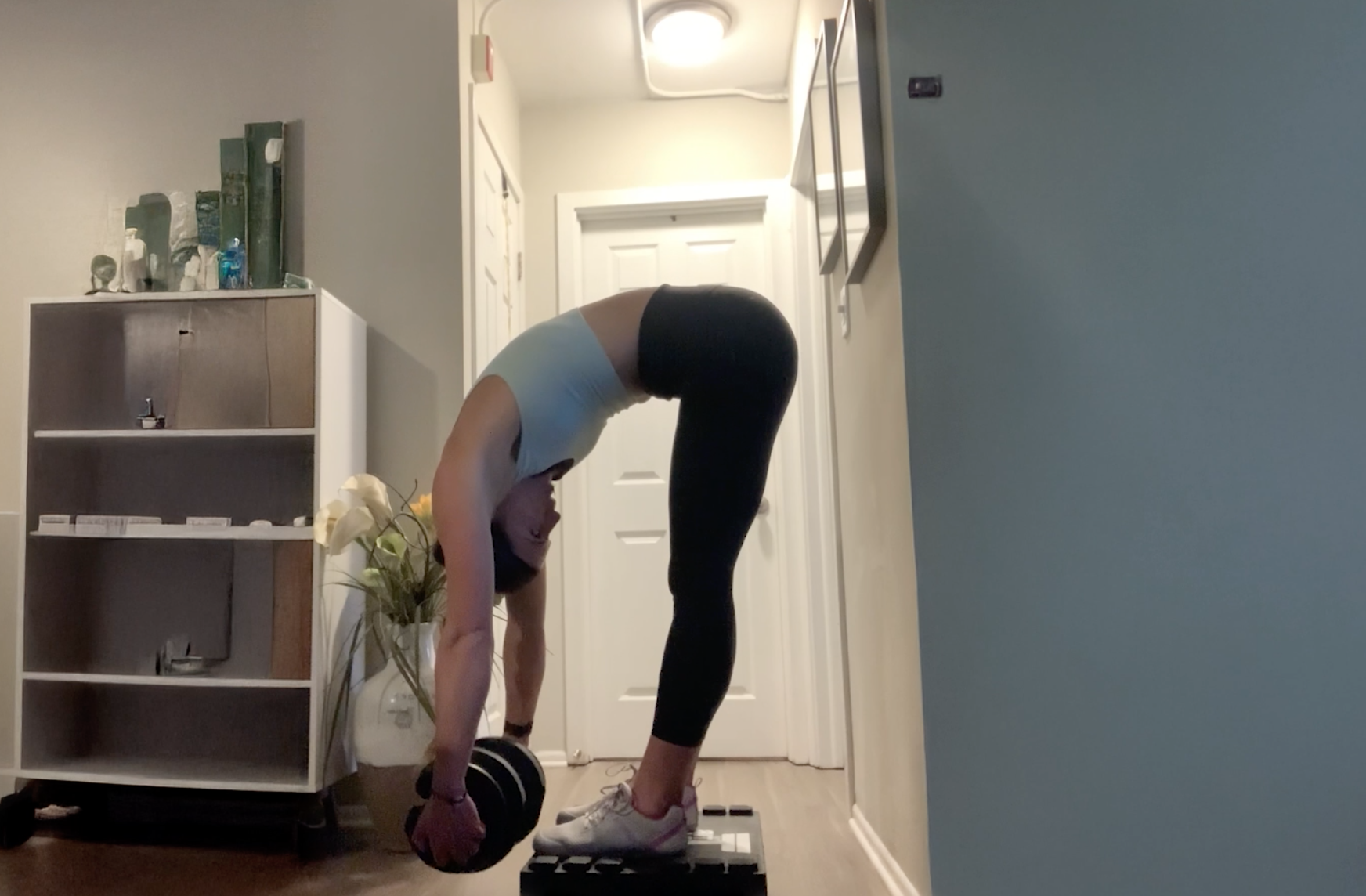
What it hits: Controlled spinal flexion, hamstring lengthening, segmental spinal control
Why it's controversial: For years, we've been told "never round your spine, especially under load."
What modern spine research actually shows:
Spinal flexion itself is not dangerous.
What's dangerous is fast flexion under heavy load, especially when fatigued.
Progressive loading through controlled range builds tissue tolerance and resilience.
How to do it:
Stand on an elevated surface (box or plates)
Hold very light weight (5-25 pounds to start)
Slowly round your spine, one vertebra at a time
Start with cervical spine (neck)
Move to thoracic (mid-back)
Then lumbar (lower back)
This should take 5-10 seconds to reach the bottom
Pause at the bottom
Reverse slowly, vertebra by vertebra, back to standing
Critical points:
LIGHT weight (this is not a strength exercise)
SLOW tempo (5-10 seconds down, 5-10 seconds up)
Very controlled movement
If it hurts, you're doing it wrong
What it does: Restores segmental spinal control—the ability for each vertebra to move independently. This is what you lose from sitting in one position all day.
When NOT to do this:
Acute disc issues
Severe back pain
Without proper form instruction (watch detailed tutorials first)
Variations: Some people perform this with toes elevated on a wedge, which increases hamstring involvement.
Programming: 2-3 sets of 5-8 reps, 1-2x/week
This is the most advanced movement on this list. But for people without disc issues, it's incredibly valuable for spinal health and resilience.
The Pattern You Need to See
Notice what all five exercises have in common?
They're not passive stretches.
Every single one builds strength through a range of motion your body tends to lose over time.
That's the secret to staying mobile and athletic as you age:
It's not about getting more flexible. It's about building strength and control in ranges that matter for how you actually move in real life.
How to Program These for Best Results
Minimum effective dose: Pick 3 of these exercises, perform them 2x/week
Better approach: Rotate through all 5 across the week
Day 1: Deep Squat Rotations + ATG Split Squat + Cossack Squat
Day 2: Incline Pigeon + Jefferson Curl
Best approach: Daily mobility work (5-10 minutes)
1-2 minutes Deep Squat Rotations (every day)
Rotate the other 4 exercises throughout the week
Progression timeline:
Weeks 1-4: Focus on form, find your limiting factors, establish baseline
Weeks 5-8: Start challenging range progressively (lower surfaces, add control)
Weeks 9-12: Begin seeing real improvements in daily movement quality
Month 4+: These become maintenance exercises that keep you feeling young
The Recovery Factor No One Talks About
If you're training hard to build mobility and strength like this, recovery matters.
Your body needs quality protein to rebuild tissues and adapt to training.
Whole food protein sources are ideal, but let's be real—we live in a busy world. When you need convenient, high-quality protein, I recommend Legion Athletics Whey.
Why Legion specifically:
Third-party tested (NSF Certified for Sport)
No proprietary blends (you know exactly what you're getting)
No junk fillers
Clean, well-absorbed protein
My current favorite flavors:
Strawberry Cheesecake
Cookies and Cream
Peanut Butter Fudge (unreal)
Shop here and use code VICTORIA for:
50% off your first order (new customers)
10% rewards back (returning customers)
Full disclosure: This is an affiliate relationship. I only recommend Legion because I actually use their products and they meet my evidence-based quality standards. See my supplement evaluation criteria.
Common Questions About These Exercises
"Won't these exercises hurt my knees/back?"
Not if you do them correctly with appropriate progressions.
The research is clear: Controlled loading through full ranges STRENGTHENS tissues, it doesn't damage them. What damages tissues is:
Uncontrolled movement under heavy load
Impact when fatigued
Sudden movements without preparation
These exercises build the resilience that prevents injury.
"How long before I see results?"
Most people notice improved movement quality within 2-3 weeks of consistent practice (3-4x/week).
Significant range improvements usually show up around weeks 6-8.
But this is about long-term mobility maintenance, not quick fixes.
"I have an old injury—can I still do these?"
Depends on the injury. General guidelines:
These exercises are GREAT for:
Post-ACL recovery (I used them extensively)
General knee pain
Hip tightness
Upper back stiffness
Proceed with caution if you have:
Acute disc issues (skip Jefferson Curl)
Recent surgery (get clearance from your surgeon/PT)
Sharp pain (not just discomfort) with any movement
Work with a professional if:
You're unsure about your specific situation
You have chronic pain that hasn't been evaluated
You want personalized progression strategies
"Can I just do these instead of strength training?"
No.
These are mobility and movement quality exercises. They build strength through specific ranges, but they're not a complete strength program.
You still need:
Traditional strength work (squats, deadlifts, presses)
Cardiovascular conditioning
Sport-specific training (if relevant)
Think of these as the foundation that allows you to train hard without breaking down.
Who Should Do These Exercises?
✅ These Are Perfect For:
Athletes looking to prevent injury:
Build resilience in vulnerable positions
Maintain mobility despite heavy training
Reduce injury risk in high-demand sports
Former athletes who've lost that "springy" feel:
Rebuild ranges you've lost from sitting
Get back movement quality from your athletic days
Feel young again in your movement
Busy professionals dealing with desk-work stiffness:
Counteract sitting dysfunction
Improve posture and movement quality
Prevent long-term degradation from modern lifestyle
Anyone in post-injury recovery:
Rebuild movement capacity safely
Strengthen tissues that were injured
Return to activity with confidence
❌ These Might Not Be Right If:
You have acute injuries requiring medical attention (get cleared first)
You're looking for passive stretching (these require active effort)
You expect overnight results (this is a long-term practice)
You won't commit to consistent practice (2-3x/week minimum)
Your Next Steps
Step 1: Pick 3 exercises from this list that address your biggest limitation
Stiff hips? → Deep Squat Rotations + Incline Pigeon + Cossack Squat
Knee issues? → ATG Split Squat + Incline Pigeon + Deep Squat Rotations
Back stiffness? → Jefferson Curl + Deep Squat Rotations
Step 2: Commit to 2-3 sessions per week for the next 4 weeks
Track your progress (take videos week 1 and week 4)
Note improvements in daily movement quality
Adjust as needed based on results
Step 3: Watch detailed form tutorials before starting
Don't rely on my brief descriptions alone
Find comprehensive breakdowns of each exercise
Start conservative with range and load
Need more guidance? I work with busy professionals and athletes to build personalized mobility and strength programs that fit their lifestyle and goals.
Book a free discovery call if you want help creating a systematic approach to staying mobile, strong, and injury-free.
One Last Thing: What's YOUR Biggest Stiffness Issue?
I tried to create a fairly general list covering the most research-backed movements for the main body parts that tend to give us trouble.
But I want to hear from you:
What body part is most nagging, stiff, or limiting for you?
Hips?
Knees?
Ankles?
Lower back?
Shoulders?
Drop a comment below and let me know. I create content based on what you actually need and find helpful.
If enough people request a specific area, I'll create a deep-dive article on it.
Disclaimer: This article is for educational purposes and not intended as medical advice. I am a health coach, not a physical therapist or physician. If you have injuries, chronic pain, or medical conditions, consult appropriate healthcare professionals before beginning new exercises. Always start with conservative progressions and stop if you experience sharp pain.